Current Travels

Showing posts with label people. Show all posts

Meeting Bhutan


15 to 18 Sep, 2024 - Thimphu - (Bhutan)


Arriving at Bhutan's international airport, you quickly get the sense of how quaint and boutique the experience is going to be. The single runway; the tiny terminal beautifully presented; being the only plane of note in sight; the small arrivals space with respectful images of the royal family; and the two baggage carousels.
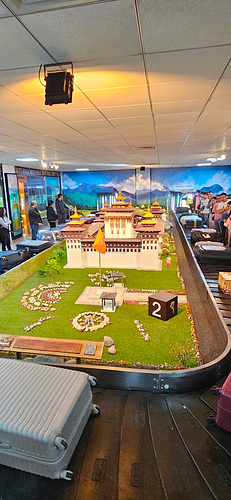
Bhutan Baggage Carousel
On arrival at Paro airport, collecting baggage is a uniquely Bhutanese affair, with the two baggage carousels running around models of the country's two finest Dzongs.


But let's wind back 40 minutes or so. Approaching the land of the thunder dragon, we felt like Khalesi on her dragon. Mountains to the left and right of the plane as the pilot weaved the slowing aircraft along the valley, only straightening for the runway 30 seconds or so before the wheels hit the tarmac. Skillfully done, but even the locals say it takes some getting used to.
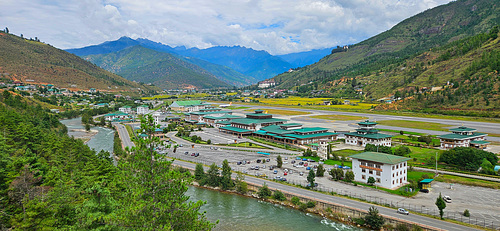

Paro Airport, Surrounded by Mountains
Back in Paro, we got another view of the airport, highlighting how there are no real approaches that don't avoid weaving through the terrain.


Our flight from Bangkok left at 5:00 a.m. We awoke at 2. Our Paro arrival was early, but our hotel was expecting us. Or so we thought. It is festival time in Thimphu, and accommodation is in high demand. For whatever reason, the hotel thought our reservation was suspect and might have been a scam, so they ignored it. The manager was so embarrassed, and arranged a nearby apartment as an alternative, owned by his sister-in-law, or so we gather. This, though, had us staying in an even less touristed area of a quite untouristy city. Which suited us to a tee.

But, what is this festival? Thimphu Tsechu. Although we had little control over our exact arrival day in Bhutan, after booking, we realised it had us arriving on the last day of this beautiful three day festival. So, airport to hotel (which became apartment), and then off the the main Dzong in Thimphu. Although not terribly bleary eyed, it was very helpful to have such an activity to keep us going through what turned out to be such a long day.
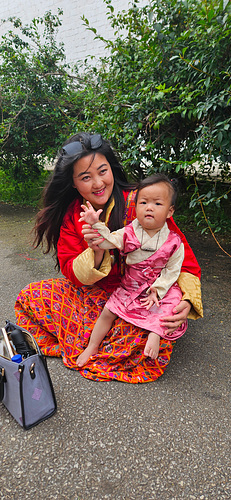

Everyone Wears their Finest
It is Thimphu Tsechu time, and everyone comes dressed in their finest. Some of the younger Bhutanese seemed less satisfied with wearing their finery, but this baby is not yet old enough to mind.


Joining the Crowd
Joining the Crowd
Coming up the stairs at the back of the Dzong, we were not quite ready for the scene. The open space with colourfully clothed dancers, and thousands of spectators filling every available vantage spot.
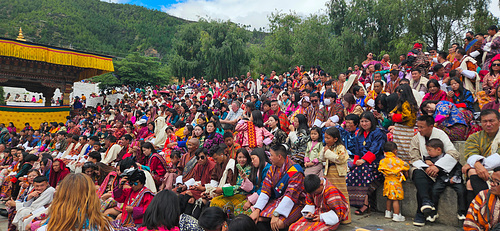

Searching for Space to Sit
We slowly circuited, watching for people stirring in a "we're about to leave" kind of way. The tsechu runs for three full days, with spectators coming and going at any time. So, it was a patience game.
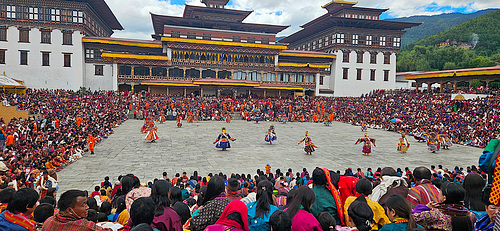

Eventually we were Seated
It did not take too long, and we found a spot big enough for two. We had to climb around a few people, but that was not considered an issue - given the lack of spaces. Everyone remained seated, and men in official capacity walked around, reminding people who were standing or putting up umbrellas, to get down and not block anyone's views. People walking and looking for seats could not stop for longer than 20 or 30 seconds before being moved along.
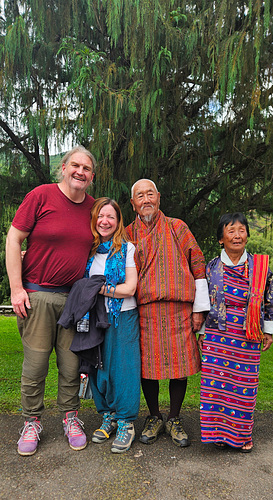

Meeting Locals
Meeting Locals
On our way out of the Dzong, leaving the tsechu, we passed many families stopping to take photos of each other to remember the day. We found it easy to be included, and realised they liked taking us in their photos as much as we enjoyed them being included in ours.
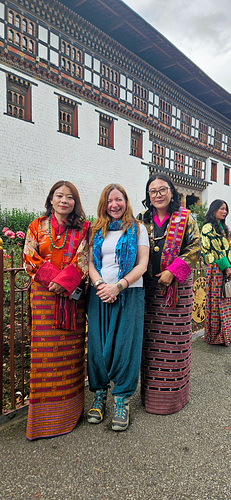

Jo, and Local Ladies
The outfit for women is known as the Kira.
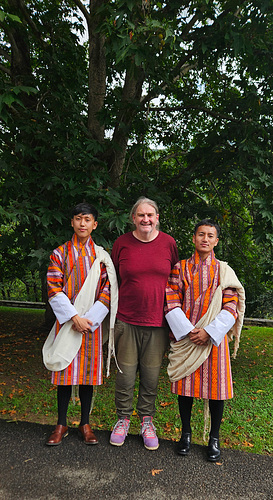

The Young Man on the Left Studies in Perth
Men wearing traditional outfits, known as the Gho.


Even before arriving, on the flight, we had a glimpse in to the Bhutanese reliance on chilli. Chilli was included in the breakfast menu. At lunch, we had our first "ema datse", lots of cut open peppers cooked in a cheesy sauce. Chilli was the star of both our dinner items. In fact, breakfast our second day, when we had eggs and toast, was the first meal where the chilli was just a spicey home made sauce on the side.
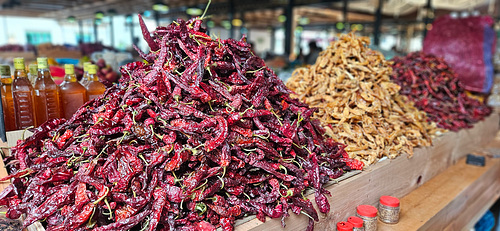

Bhutanese Cuisine Uses Chilli, a Lot
It is probably the first time we have been given dishes where chilli is the vegetable, not just the condiment. And then, they add chilli sauce to their chilli based dishes.

The market had tons, with some piles approaching a metre in height.
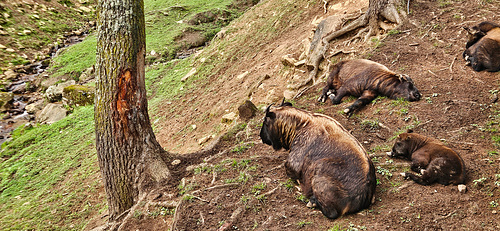

A Family of Takin
A Family of Takin
Motithang Takin Preserve.
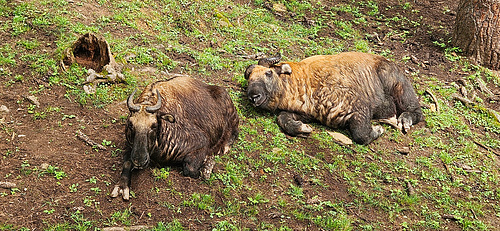

National Animal of Bhutan - Takin
Part goat, part cow, part yak, part moose. They're big, and quite unusual.
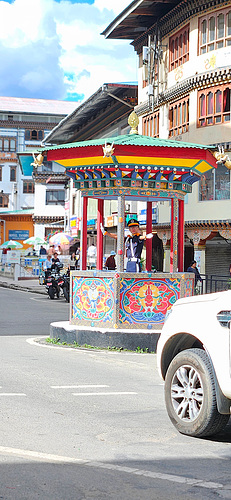

Thimphu's @quot;Dancing Policeman@quot;
Thimphu's "Dancing Policeman"
Traffic control in downtown Thimphu. The reliable story is, the position of directing traffic was replaced with an automatic system, known as traffic lights. However, whether people just didn't like them, or whether they didn't understand, eventually the only traffic lights in the whole country were eventually removed and the flamboyant white gloved "dancers" were returned to the intersection.
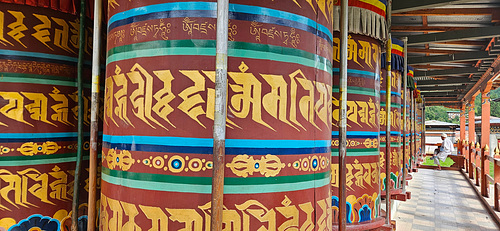

Prayer Wheels - Zangto Pelri Lhakhang
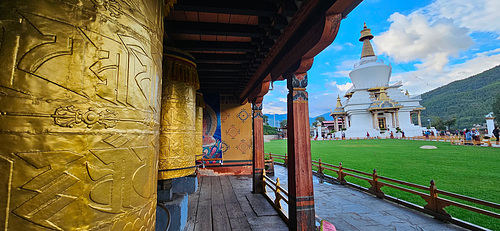


Prayer Wheels - National Memorial Chorten
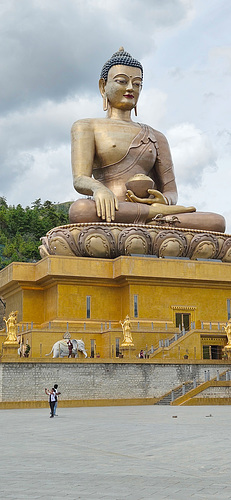


We Climbed to Buddha Dordenma
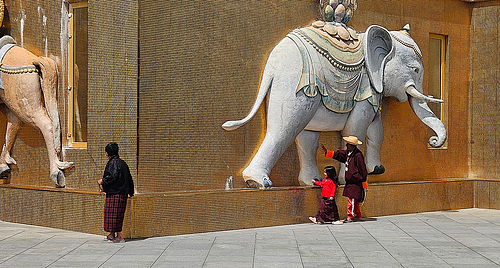


Perhaps her Grandparents
Circling the base of Buddha Dordenma.
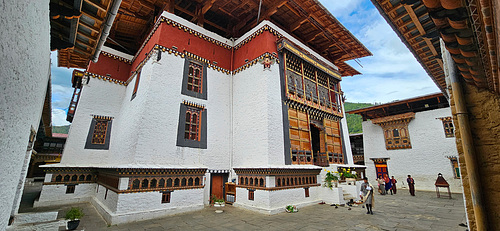

Inside Simtokha Dzong, Thimphu


CLICK FOR VIDEO
Bhuddhist Prayers and Chanting in Simtokha Dzong
CLICK FOR VIDEO


Photos and videos are not allowed inside the halls, but we were allowed to enter.

In fact, we got some smiles from a handful of the rows and rows of monks who were inside, as we made our way as discretely as we could, from the door to some cushions by the wall.

Two blocks of monks sat facing each other. four rows of robed men and boys, on each side of the temple. The front row had drums, and a few wind instruments were played in the back rows.

Up the front, one very auspicious looking gentleman led them all. His throat singing deeper than I thought possible. In front of each monk, pages and pages of loose leaves with what looked like hand written prayers. Without direction, the instruments and drums instinctively played, the rhythm accelerating and the chanting building, and suddenly, they stop. A short lull. Then, again, the scores of monks continue in slow deep tones.

We had been in there fifteen minutes or so, but they had been obviously going for quite some time, when the instruments were laid down. Quietly, a few monks weaved in and out, carrying large flasks of hot tea, and baskets of bread or cake, and served some refreshment to those who had been praying. This pause was not long. Ten minutes or so, and then, they began again.


Help Us Obi-Five Kenobi


2 to 6 Jan, 2024 - Monastir, Sousse, El Djem, Matmata, Chenini, Tatooine, Tozeur - (Tunisia)


Rental car from airport, and out in to the chaos of Tunis. Quickly, it becomes apparent, lane markings on roads, even on express arterials, are not even treated as suggestions or guides. They are blatantly ignored. The number of lanes depends on the width of the vehicles negotiating at that moment. Extra skilled drivers seem to find a way to squeeze one more in, but the fluidity of that number, when trucks, buses, or tractors get involved, means drivers are forever on their toes. Assertiveness is imperative. Without it, you are quickly lost, becoming a lonely obstruction for other drivers to vent at as they nudge around you.

But once out of the capital, on the divided toll roads, some order returns. Free of speed humps, animals, and pedestrians, smooth and well maintained, the accelerator goes down and the kilometres tick over as quickly as anywhere else in the world, if not quicker...

As the sun sets, and we venture back on to secondary roads, especially after dark, all eyes peeled again. The biggest dangers are the incredible speed humps that come in 2s and 3s. Once upon a time, they may have been marked. There is evidence of very faded yellow triangles painted on some. There are some speed hump signs still vertical, but many are bent over, faded, or entirely gone. So, we just have to learn where to expect them, and watch the vehicles in front or oncoming. Some of these humps are so significant, they need naming. Ears popped as we dealt with the differential in altitude going over them. So, to encounter any of these black, unmarked, behemoth humps at a speed greater than 15 km/h leaves one wondering if the car suspension is still intact, or the contents of the boot may have bounced out.

Day 1 - airport to Sousse, going first to Monastir. Having that extra time in the afternoon, we worked out we wanted to see something significant before checking in, and overshooting to Monastir was the right amount before sunset.


Inside Ribat of Harthouma
Landmark tower inside the Monastir's beautiful ribat. A ribat is the name given to the small muslim forts that were built on the frontiers during muslim expansion in to north Africa.


"Life of Brian"	 Backdrop
"Life of Brian" Backdrop
Shooting location used by Monty Python. Inside Ribat Harthouma.


Our First Stop in Tunisia
Late sun sends long shadows of palms against the walls of the ribat in Monastir.


On from Sousse, heading south, stopping at El Djem. Again, using the very cheap but well maintained toll roads, the distances are quickly covered.


One Entrance
One Entrance
Arches upon arches upon arches.


El Djem - Third Largest Roman Amphitheatre


Picturesque and Evocative
Exploring the many layers of what remains of the 3rd century amphitheatre of El Djem.


We had trouble contacting the hotel we thought we might try. The website seemed to have been hacked and hijacked, they did not answer our emails, and were not on any booking sites. Given it would also be a diversion of almost two hours if they were now closed, we almost changed our minds, but on a whim, headed to the town of Matmata. The hotel was there, open, and thus began our little circuit of Star Wars related locations.

We are not fanatical by any definition. Neither Jo nor myself are sure what proportion of any of episodes 1, 2, 3, 7, 8, or 9 we have seen. Bits and pieces here and there. But the original 3 were from our era, and particularly the first one, episode 4, we know well, and that is the one which had a lot filmed here. Less CGI, less studio work, and more on location filming. And George Lucas and the Star Wars franchise left quite the legacy for Tunisia.

Hotel Sidi Idriss was our stop, known as the Star Wars Hotel now. It was a hotel before that time, but now, it leverages that connection to great effect. It is possible and inexpensive to stay there, but many visitors stop in for a drink or meal while passing through. We did like being overnight guests, despite the simplicity of the accommodation.

The following day we went from location to location, many would have been interesting without any film connection, but the connection means greater effort on restoration and preservation of these sights.


Princess Leia Room
Princess Leia Room
We stayed at Hotel Sidi Idriss, Matmata. Each room in the hotel was named after a character from Star Wars, or a significant name associated with the franchise.

In actual fact, the hotel was already a hotel when chosen to be used in filming. A Berber village, and troglodyte cave structure, it would have been a fascinating stay, even without any movie association.


The Lars Dining Room of Star Wars
This hotel in Matmata, Tunisisa, was the filming location for Star Wars, episode 4. It was used for inside shots of the Lars Homestead, Luke's uncle and aunt.


Young Luke Skywalker Peered Over...
We watched the scene from Star Wars, Episode 4, A New Hope. Just to familiarise ourselves with the scene, again. And then in the morning, worked out this is where Luke peers down to his aunt.


Ksar Hallouf
Ksar Hallouf
Restored 13th century granaries, used to film slave quarters scenes for Star Wars Episode 1: The Phantom Menace.


Ksar Hadada, Now a Hotel
While many of the old structures are bare and open, many are converted to rooms of varying levels of comfort.


Mos Espa Slave Quarters: Episode 1
Another Star Wars film location.


Ksar Ouled Soltane
Ksar Ouled Soltane
Berber granaries.


More Star Wars
More Star Wars
The third Ksar in Tunisia used in filming slave quarter scenes for Star Wars Episode 1, The Phantom Menace.


Stops were made at locations unassociated with movies, too.


Ksar Beni Bakra
Ksar Beni Bakra
Not Star Wars connected. The desolate and largely unrestored hilltop ksar was ours alone for the full time we clambered through it.


Setting Sun on Chenini
We got to Chenini in the late afternoon, and wandered quite aimlessly till a bit past sunset. More than anything, the rapidly dropping temperature encouraged us to finish up.


Tawfik, Newly Friended
After driving hours across the desolate nothingness, we reached the town of Douze. Perfect timing for a break.

Tawfik's little shop was chosen for a bite. A dancer and former Michael Jackson impersonator, he spoke good English and looked after our food needs with a couple of giant wraps.

We left him with a clip on koala to remember us by.


Crossing Chott el Djerid
The road crosses the narrowest point of the salt flat, Chott el Djerid. Barren and featureless, almost horizon to horizon.


By now, day five of our circuit, we were working our way back north in the western part of Tunisia. Not far from the Algerian border, but more significantly, skirting around the fringes of the Sahara. Long straight strips of tarmac connecting oasis towns full of date plantations. When the wind whipped up, the swirls of sand became long fingers over the road, sometimes obscuring it completely. Getting in or out filled the inside of the car with a gritty cloud, and by the evening, we felt quite clogged up with nostrils and the corners of our eyes quite grainy. Even our mouths, with occasional crunching sensations between our teeth.

The men walking in these conditions had their peaked hoods pulled over, their robes wrapped tight to give as much protection as possible. The costume designers must have seen these, and known these practices, and extended it in to the Star Wars movies. "Look there, Obi-wan Kenobi" one of us would indicate. "Oh another over there," the other would reply. Soon we started numbering them. "That must be Obi-two Kenobi". "Obi-three Kenobi, now". We sort of gave up after Obi-twelve Kenobi...


Lars Homestead
Lars Homestead
The exterior of the Star Wars Lars Homestead. Just out there, on the salt flat. Follow the tracks left by other vehicles trekking out here. There was one unattended souvenir stall, with a plate of money, working on an honesty system.


The Star Wars Town of Mos Espa
The buildings are all fake, but holding up surprisingly well in the desert winds, considering they were built for Star Wars Episode 4.


Mos Espa
Mos Espa
This building did not even have an inside. The whole "town" was just three small streets, two intersections, and about 20 or so empty shell buildings.

And a lot of sand.

And a lot of souvenir stalls.


Heading back close to Tunis, day of our 34th anniversary, seems like a good time to break the Tunisia blog.


Our Coffee Stop
Our Coffee Stop
It was a very big day of driving, after making our two morning stops. We allowed ourselves a break for coffee, and probably more importantly, a toilet.

We found this large, quite open, building with a sign for coffee. We worked out they had two things available. Coffee, from a state of the cafe style espresso machine, and water pipes.

We had to take our own chairs from the stack, find and move a plastic table to sit at, and there we drank our 50 cent coffees.

Meanwhile, those seated around the other two tables barely looked up, as the men seemed quite engrossed in their card games. Good news when smoking a water pipe, you don't even need to use your hands. You can tuck the pip under your arm and bubble away, leaving your hands free to deal with the cards.


A Surprise Windmill
A Surprise Windmill
Winding our way across the back roads of Tunisia, we came across the unexpected sight of a very European looking windmill.

I just loved how this came out in the light, looking almost like a painting.


Plov Sofi and Homemade Osh


2 to 6 Oct, 2022 - Bukhara - (Uzbekistan)


Bukhara, another beautiful historic city in Uzbekistan. While the trip from Termez was a relatively long 6 or so hours, having a few nights gave us opportunity to recover and chill. We stayed in a guesthouse which was formerly a guesthouse - actually a 19th century caravansaray, with an atmospheric octagonal inner courtyard.


Walls of the "Ark", Bukhara’s Fortress
Walls of the “Ark”, Bukhara’s Fortress
Greatly damaged when the Soviets took Bukhara, the Ark is still undergoing renovations. Built and expanded over many centuries, it became the compound for the palace, until the decision was made to absorb Bukhara in to the USSR.


Entrance to the Ark
Entrance to the Ark
The western entrance is the only entrance left to this fortress.


Ismail Samoni Mausoleum
Beautiful terracotta brickwork, where even the shadows come to life, bringing depth and interest to the exterior.


Looking out from Kalon Mosque
Taken from in the grounds of the Kalon Mosque, Bukhara. The Kalon Minaret, a beautiful 12th century tower, is clearly visible, and to the left is one dome from Mir-i-Arab Madrasa.


Breakfast at our Caravansary Hotel
Our hotel is a 19th century caravansary, with a cute octagonal inner courtyard.


Indian Inspired Chor Minor Madrassah
Historical landmark building in Bukhara.


A Random House Museum we Passed
Walking the streets of Bukhara, an elderly man gestured us in to his ramshackle home filled with curios and odd items from many different eras. Nothing formal - it was just his house, He showed us up ladders to his roof for some views over the town.


Terrace View while Sipping Tea
Looking out at the domed roofs of the bazaar, the Kalon Minaret, the Mir-I-Arab Madrasa turquoise dome. In the foreground, the Ulugbeg Madrasa on the right and the Abdulaziz Khan Madrasa on the left create bookends for our vista.


At lunch, we found ourselves at a restaurant known for its plov - a Central Asian variant of a biryani, usually with lamb. We were not quite getting our timing right, generally, for plov, as it is made in batches. Good plov restaurants seem to only serve it at lunch time, and since we are beginning most days with a pretty hearty breakfast, lunch is often being skipped or replaced with a light snack. The queue was long, but the turnover high, indications of a highly rated plov. Two Uzbek ladies gestured for us to share the table with them, and after some introductions, they recommended the plov sofi and a jug of cherry compote.

Asal was the name of the daughter, and her excellent English meant we could talk about lots of things. So, we found out that plov and osh are two names for the same dish. But osh sofi and osh are different. Would we like to come to their house tomorrow, where they could treat us to a proper, homemade osh? Did we have to think before answering?

The following day, a pin was sent to us. They lived about 20 minutes drive from Bukhara centre, but conveniently for us, they were 2 minutes from the train station, and us with an overnight train to catch, it could not have been more convenient. We ate osh, drank tea, enjoyed chocolate cake in celebration of her aunt's birthday. We went out and about with Asal, and relaxed in their home until it was time to go to the station.


Osh with Asal and her Family
We met Asal (third along) in a restaurant in Bukhara, with her mother. The place was crowded, and they offered to share their table with us. We got talking, and by the time we finished, they had invited us to their home. So the next day, we came, and they made this feast, with an amazing version of the ubiquitous local dish, osh, also called plov.


Tomb of Shaykh Baha-ud-Din

On the Roof, Dvorets Emira Bukharskogo
Close to the home of Asal, actually in Kogon. We visited this old palace, with an interesting mix of eastern and western architecture.


Learning to Play Chess
In a corner room of the Dvorets Emira Bukharskogo. Close to the front, chess was being taught and played, further back was a bit more anarchic.