Current Travels

Showing posts with label religion. Show all posts

A Bhutanese Phallus-cy


19 to 20 Sep, 2024 - Cheri Goempa, Pangri Zampa, Dochu La, Punakha, Sopsokha - (Bhutan)


The rules for visiting Bhutan are changing. Slowly. It's a two-edged sword thing. The SDF (Special Development Fee), although temporarily reduced in price, is still expesive. This helps encourage high value, low volume tourism, meaning they make more money from less visitors, and this in turn stops sights from being overcrowded and touristy. The additional requirements that you need a guide outside of Thimphu and Paro means that every traveller is actively engaging and employing locals who have chosen a career in tourism. So, while we obviously dislike handing over more money, we do like the low impact and sustainable result of these regulations.

Even the actual travelling would be near impossible without a driver and car. Accessible public transport, especially to places we'd like to visit, is pretty much non-existant. Some sites of particular note apparently refuse to let a foreigner in if their guide is not with them. Even in Thimphu, where guides are no longer needed, most visitors are already on their tour. Visiting top attractions there, we often encountered puzzled faces as officials pondered whether they were supposed to let us in or not, finally deciding that there did not really appear to be a reason to stop us.

So, even if we had our own way of getting about, we did not feel we could take a risk of travelling to a significant sight, only to be turned away.
As we neared the pass that separates Western Bhutan from Central Bhutan, we stopped at a roadside stall to try a local delicacy, chhurpi. This is a dried yak cheese, and it hangs outside the little booths on string, little white cubes actually looking palatable, almost tasty. As it turns out, we never realy got to taste them. They are hard. Very hard. Insanely hard. We may as well have put a stones in our mouths. After 40 minutes, we gave up. It was not going well, and then we were told 40 minutes was not enough time - this cheese can take hours to soften. Later, we met a lady who told us what she did as a little girl. She would put the cube in her mouth when she went to sleep, and by morning, it was soft enough to chew. Neither Jo, nor I, are that committed to the yak cheese.


Cheri Goemba
Cheri Goemba
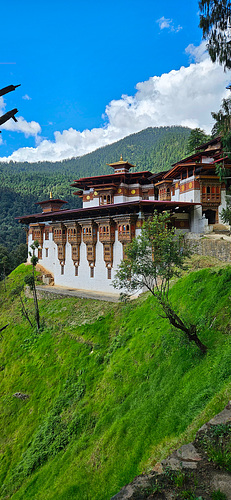
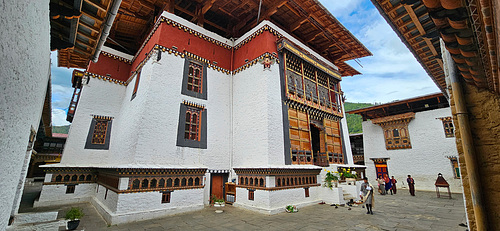
First established in 1620, this monastery north of Thimphu is reached by a 45 minute climb on a very pleasant forest track.


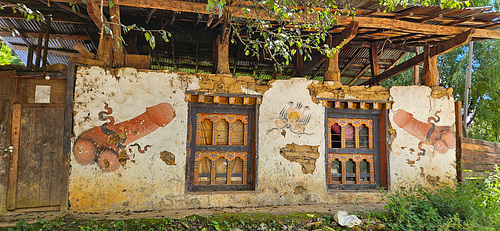
Penis Paintings, on a Seemingly Abandoned Home
Roadside, north of Thimphu, between places, really. The multiple phallus inclusion seemed excessive to our way of thinking.


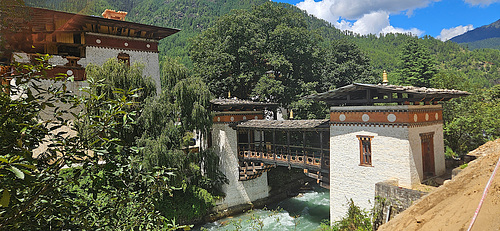
View to Pangri Zampa
A pleasant bridge (currently closed, unfortunately) leads over the river to Pangri Zampa.


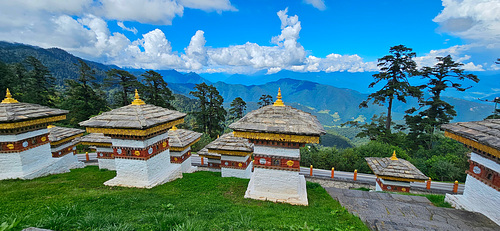
View from Dochu La
View from Dochu La
Dochu La is the high point of the pass between Thimphu and Punakha. Bhutan's highest peak is visible in the Himalayan vista.


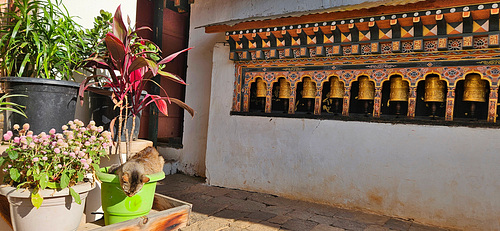
A Kitten Draped in a Pot Plant
Inside Chimi Lhakhang, the temple of the Divine Madman.


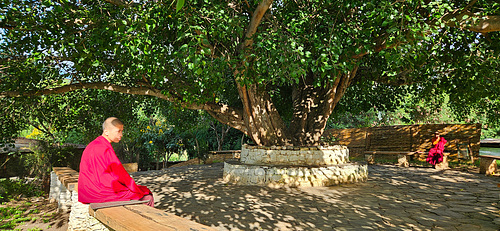
Morning Meditation
Morning Meditation
Beneath the bodhi tree. We came up to the temple early, to catch the atmosphere of individual meditation and group prayer.


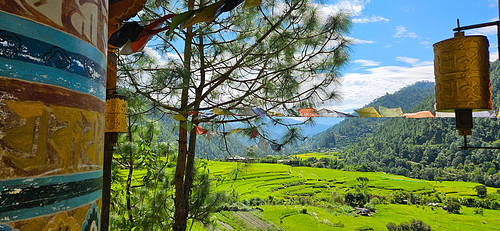
Over the Rice Fields
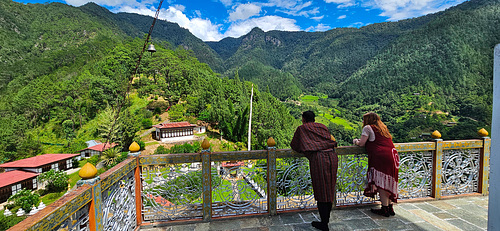
Ascending to Khamsum Yulley Namgyal Chorten.


Jo and Sonam
Jo and Sonam


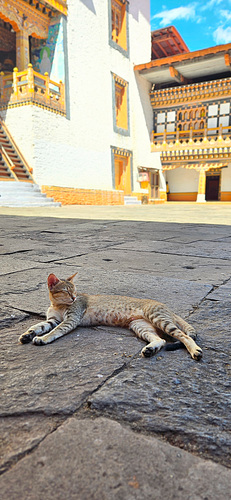
Cat Relaxation and Meditation
Inside Punakha Dzong.


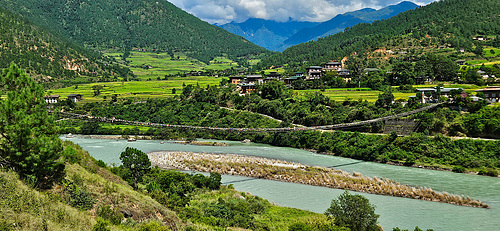
One of Bhutan's Longest Suspension Bridges
It felt stable, and due to not being high, did not require a lot of nerves to make it across.


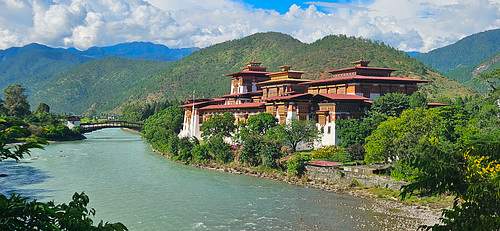
The Obligatory Picture of Punakha Dzong


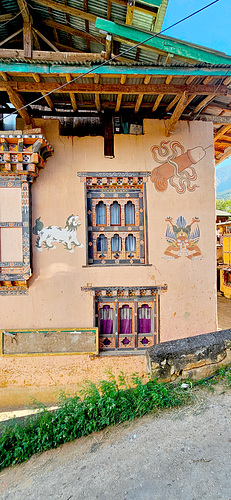
Protective Images, Sopsokha
Of course, again, it is the phallic image that makes this an unusual way to decorate one's house.


Meeting Bhutan


15 to 18 Sep, 2024 - Thimphu - (Bhutan)


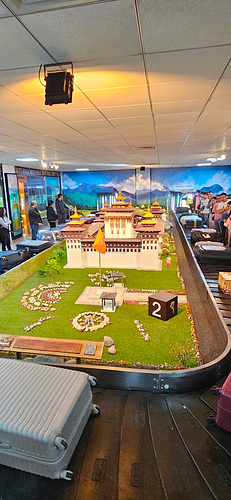
Arriving at Bhutan's international airport, you quickly get the sense of how quaint and boutique the experience is going to be. The single runway; the tiny terminal beautifully presented; being the only plane of note in sight; the small arrivals space with respectful images of the royal family; and the two baggage carousels.

Bhutan Baggage Carousel
On arrival at Paro airport, collecting baggage is a uniquely Bhutanese affair, with the two baggage carousels running around models of the country's two finest Dzongs.


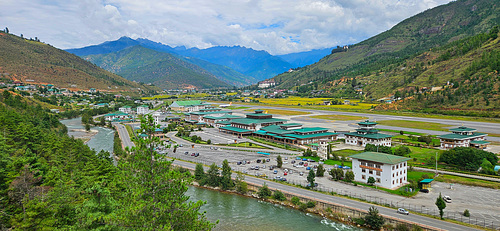
But let's wind back 40 minutes or so. Approaching the land of the thunder dragon, we felt like Khalesi on her dragon. Mountains to the left and right of the plane as the pilot weaved the slowing aircraft along the valley, only straightening for the runway 30 seconds or so before the wheels hit the tarmac. Skillfully done, but even the locals say it takes some getting used to.


Paro Airport, Surrounded by Mountains
Back in Paro, we got another view of the airport, highlighting how there are no real approaches that don't avoid weaving through the terrain.


Our flight from Bangkok left at 5:00 a.m. We awoke at 2. Our Paro arrival was early, but our hotel was expecting us. Or so we thought. It is festival time in Thimphu, and accommodation is in high demand. For whatever reason, the hotel thought our reservation was suspect and might have been a scam, so they ignored it. The manager was so embarrassed, and arranged a nearby apartment as an alternative, owned by his sister-in-law, or so we gather. This, though, had us staying in an even less touristed area of a quite untouristy city. Which suited us to a tee.

But, what is this festival? Thimphu Tsechu. Although we had little control over our exact arrival day in Bhutan, after booking, we realised it had us arriving on the last day of this beautiful three day festival. So, airport to hotel (which became apartment), and then off the the main Dzong in Thimphu. Although not terribly bleary eyed, it was very helpful to have such an activity to keep us going through what turned out to be such a long day.


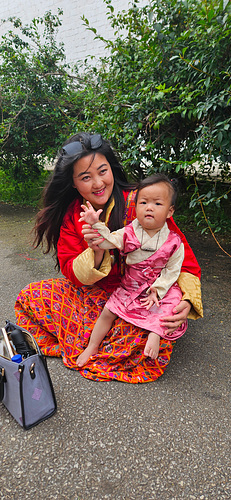
Everyone Wears their Finest
It is Thimphu Tsechu time, and everyone comes dressed in their finest. Some of the younger Bhutanese seemed less satisfied with wearing their finery, but this baby is not yet old enough to mind.


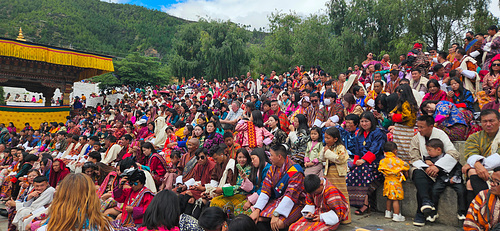
Joining the Crowd
Joining the Crowd
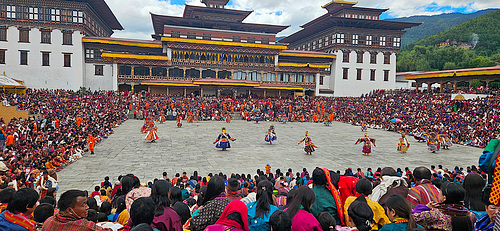
Coming up the stairs at the back of the Dzong, we were not quite ready for the scene. The open space with colourfully clothed dancers, and thousands of spectators filling every available vantage spot.


Searching for Space to Sit
We slowly circuited, watching for people stirring in a "we're about to leave" kind of way. The tsechu runs for three full days, with spectators coming and going at any time. So, it was a patience game.


Eventually we were Seated
It did not take too long, and we found a spot big enough for two. We had to climb around a few people, but that was not considered an issue - given the lack of spaces. Everyone remained seated, and men in official capacity walked around, reminding people who were standing or putting up umbrellas, to get down and not block anyone's views. People walking and looking for seats could not stop for longer than 20 or 30 seconds before being moved along.


Meeting Locals
Meeting Locals
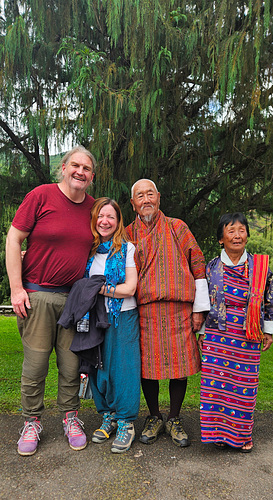
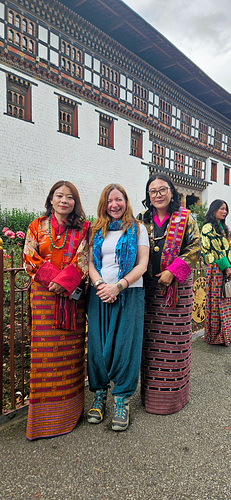
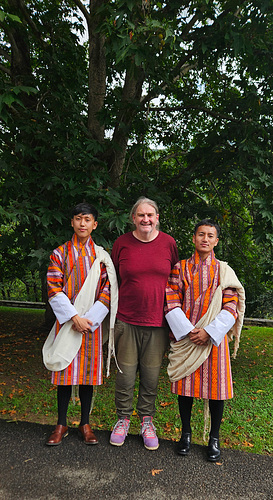
On our way out of the Dzong, leaving the tsechu, we passed many families stopping to take photos of each other to remember the day. We found it easy to be included, and realised they liked taking us in their photos as much as we enjoyed them being included in ours.


Jo, and Local Ladies
The outfit for women is known as the Kira.


The Young Man on the Left Studies in Perth
Men wearing traditional outfits, known as the Gho.


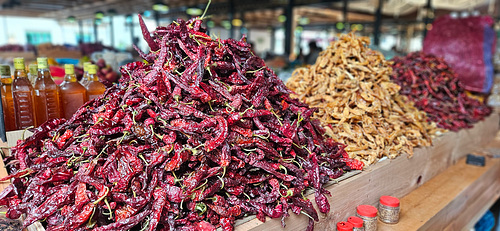
Even before arriving, on the flight, we had a glimpse in to the Bhutanese reliance on chilli. Chilli was included in the breakfast menu. At lunch, we had our first "ema datse", lots of cut open peppers cooked in a cheesy sauce. Chilli was the star of both our dinner items. In fact, breakfast our second day, when we had eggs and toast, was the first meal where the chilli was just a spicey home made sauce on the side.


Bhutanese Cuisine Uses Chilli, a Lot
It is probably the first time we have been given dishes where chilli is the vegetable, not just the condiment. And then, they add chilli sauce to their chilli based dishes.

The market had tons, with some piles approaching a metre in height.


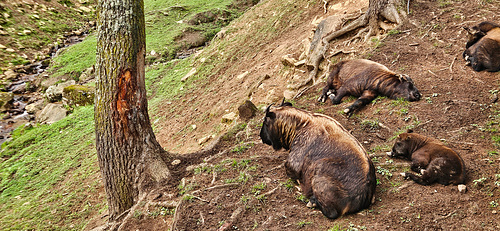
A Family of Takin
A Family of Takin
Motithang Takin Preserve.


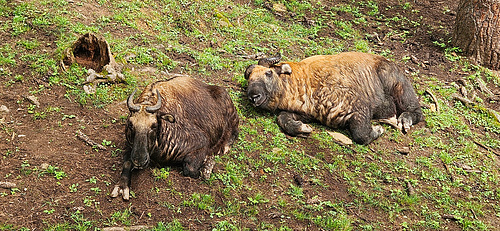
National Animal of Bhutan - Takin
Part goat, part cow, part yak, part moose. They're big, and quite unusual.


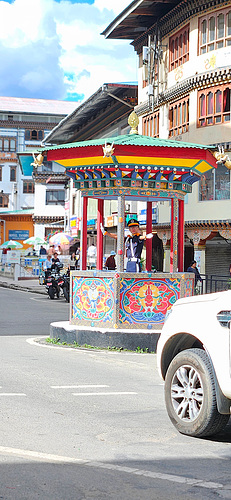
Thimphu's @quot;Dancing Policeman@quot;
Thimphu's "Dancing Policeman"
Traffic control in downtown Thimphu. The reliable story is, the position of directing traffic was replaced with an automatic system, known as traffic lights. However, whether people just didn't like them, or whether they didn't understand, eventually the only traffic lights in the whole country were eventually removed and the flamboyant white gloved "dancers" were returned to the intersection.


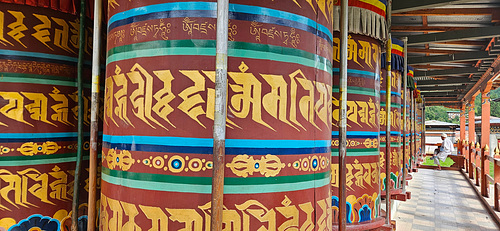
Prayer Wheels - Zangto Pelri Lhakhang


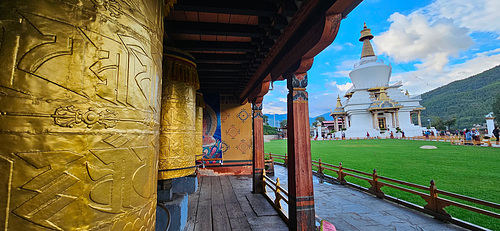
Prayer Wheels - National Memorial Chorten


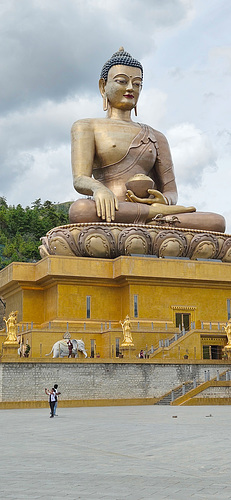
We Climbed to Buddha Dordenma


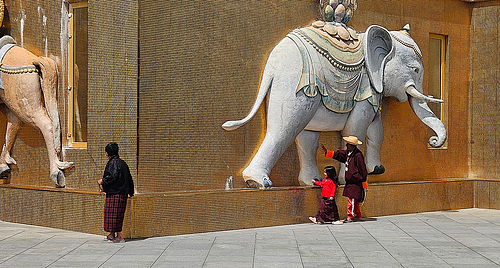
Perhaps her Grandparents
Circling the base of Buddha Dordenma.


Inside Simtokha Dzong, Thimphu


CLICK FOR VIDEO
Bhuddhist Prayers and Chanting in Simtokha Dzong
CLICK FOR VIDEO


Photos and videos are not allowed inside the halls, but we were allowed to enter.

In fact, we got some smiles from a handful of the rows and rows of monks who were inside, as we made our way as discretely as we could, from the door to some cushions by the wall.

Two blocks of monks sat facing each other. four rows of robed men and boys, on each side of the temple. The front row had drums, and a few wind instruments were played in the back rows.

Up the front, one very auspicious looking gentleman led them all. His throat singing deeper than I thought possible. In front of each monk, pages and pages of loose leaves with what looked like hand written prayers. Without direction, the instruments and drums instinctively played, the rhythm accelerating and the chanting building, and suddenly, they stop. A short lull. Then, again, the scores of monks continue in slow deep tones.

We had been in there fifteen minutes or so, but they had been obviously going for quite some time, when the instruments were laid down. Quietly, a few monks weaved in and out, carrying large flasks of hot tea, and baskets of bread or cake, and served some refreshment to those who had been praying. This pause was not long. Ten minutes or so, and then, they began again.


Southern Kazakhstan, and Out


18 to 22 Sep, 2022 - Shymkent, Turkestan, Aysha-Bibi - (Kazakhstan)


Near Shymkent, there are two sights we wanted to get to. And as it is a stone's throw from the Uzbekistan border, and Tashkent, it made sense to finish our Kazakh visit here.


War Memorial
War Memorial
Most war memorials are very moving. Few things have comparable impact to listing names of lives lost. 140000 from south Kazakhstan.


Taking In the Beautiful Tiles
We hopped in a minibus to Turkestan, a couple of hours and some away from Shymkent. Here, the main sight for us was the Yasaui Mausoleum. Built in the 14th century on the site of an existing tomb. It was already a significant pilgrimage site back then, and these days it still seems the pilgrims make up the bulk of the visitors. Coloured bricks and tiles bring delightful colour and patterns to most exterior facades of the imposing structure.


A Pair of Woolly Camels
I can't ever recall seeing camels with, what at least looks like, a soft woolly coat. These too looked fluffy and, almost, cuddly. From this angle, you can see that the Mausoleum was never completed. The main facades remain bare, and structural beams are still exposed. Work ceased when the sponsor passed away. Later, they cleaned it up, but retained the unfinished appearance.


Mausoleum of Aysha-Bibi
It may have been easy enough to get to Aysha-Bibi by minibus, as they will happily drop you off as they go by. We were not quite in the mood to wait by the roadside for a return trip to Shymkent, possibly watching multiple full vehicles whizzing by. So, we decided to take the easy option of getting there by taxi. While not a large building, the beautiful terracotta bricks with various patterns made the time and effort worthwhile. Although extensive restoration was performed in the last 20 years or so, it is reportedly true and accurate to the original 11th or 12th century structure.


At Aysha-Bibi
At Aysha-Bibi
One side had a door, three sides had windows with little spots to sit. Inside, at the tomb, pilgrims received a blessing. Some of the visitors circled the building, touching and praying at various points. We just circled and admired the patterned bricks, and rather than a blessing, went inside for a happy little chat about being from Australia.


Details
Details
Using light and shade to bring the details of the patterned bricks to 2 dimensions.


To finish our time in Kazakhstan, we had some, still to be explained, odd information. The big, comfy bus we were to take to Tashkent was cancelled, and the reason, they said, was fuel. That was it, a one word Google translation, "fuel". We assume not too much, or bad, so perhaps difficulty acquiring? In a fuel producing and exporting nation? Would minibuses run? Maybe not, they said. The taxi driver we had, the day before, went to four petrol stations to get fuel, but assured us there were no fuel problems. We asked in Shymkent, and got told there were no fuel problems. Yet today, on our Tashkent bound minibus, we stopped at eight or ten stations before the driver got some fuel, but only a ration or so, because we subsequently stopped at another three or four to get some more.

So yesterday, after our visit to Aysha-Bibi, we returned to Shymkent via a bazaar with a good reputation for fabrics and textiles. The whole market place was in darkness, as power was off. So we went around a few areas, and stall holders showed us their wares using the torches on their phones. We eventually found something we liked and bargained a suitable price. I left Jo chatting with them while I went to the nearest ATM to get cash, but upon seeing the blank screen, I knew power was an important ingredient in any ATM interaction. I went further and wider, leaving the market district. In the end, I realised this might be a futile endeavour, and decided to rely on some of our emergency US dollars. I knew I was gone a good while, because by the time I got back, Jo was practically one of the family. They had been teaching her Kazakh (counting to five) and more little phrases, and stumbling through descriptions of Australia and family. As we left, I joked to her about being the girl abandoned in a market and raised by a kind local family who took her in. Years later, reaching deep in to her memory, she had some vague recollections about a distant country called Australia, but didn't know where they might have come from.

The City Which Ended with a Different Name


16 Sep to 18 Sep, 2022 - Nur-Sultan (Astana) - (Kazakhstan)


A quick photo based entry about our brief stop in Nur-Sultan. Initially, we were going to bypass this city, capital of Kazakhstan. However, we had such a great couple of days. The layout of the city, and the architecture, something that we really appreciate having experienced. We ate really well, in fact, so well, that we ate at the same place again, the next night.

First, the names of the city. Initially, in the 19th century, a fortress called Akmola was here. In 1961, it became Tselinograd. Post Soviet Union, back to being called Akmola. In 1997, it became Astana, which means capital. Finally, 2019 saw it renamed Nur-Sultan, in honour of the ex-president.

And now the breaking news. Really breaking news. That finally is not as finally as thought. In the last few days, the current president has announced that the name is to revert back to Astana! There you have it, not quite, but by the time you read this, Nur-Sultan may likely be another past name of the city.


Looking Out, Nur-Sultan
Nur-Sultan, capital of Kazkhstan. Looking out from the top of the Baiterek Tower, towards the east. The golden tapered towers provide bookends of the view of Kazakhstan’s presidential palace. Beyond that, the river separates the (obscured in this photo) Palace of Peace and Reconciliation, Independence Square, and more important buildings, as well as an important mosque.


Baiterek Tower and its Egg
This city has had a number of names. In 1998, it became “Astana”, when the capital was moved here. Only in 2019 was it renamed to Nur-Sultan. With that renaming, and the following growth, planners took the opportunity to lay out the wide boulevards, creating a very open feel, and opportunities for key buildings and landmark structures to become features. The focus of the layout is Nurzhol Boulevard, and the iconic Baiterek Tower. It is inspired by legends of Samruk, who lays her egg at the top of the tree of life.


KazMunayGaz, Creating a Frame for Khan Shatyr
Khan Shatyr means “Royal Marquee”. It is a shopping centre full of brands and entertainment, including rides and a dinosaur theme park. These two buildings mark the western end of Nurzhol Boulevard.


Using the Props Provided

Prayer Hall, Hazrat Sultan Mosque
The Hazrat Sultan Mosque was the main mosque for Astana until this year, when a new mosque was inaugurated. We visited at a quiet time, when only a handful of others were inside.


Hazrat Sultan Mosque
A couple of men have chosen sunny spots to study.


World’s Largest Fully Spherical Building
The glass of the building is not pieced together to approximate a ball, but each piece was engineered with the precise curve in it, to make a true sphere. Inside is an eight storey museum about energy, space, and the future for Kazakhstan. This follows on from its original use as the centrepiece of Expo 2017 International Exhibition. It is known as the Nur Alem Pavillion.


Eight Storeys up on a Glass Floor
Inside Nur Alem Pavilion, Jo shows us how fearless she is on the glass floor.


Grand Mosque, Nur-Sultan
Replacing Hazrat Sultan Mosque as the principal place of worship, the Grand Mosque was opened this year. It is the largest mosque in Central Asia, and ranks amongst the largest in the world.


Prayer Hall, Grand Mosque
In contrast to our mosque visit, earlier in the day, the Grand Mosque was bustling and lively. Children cried out and ran across the lush thick carpet, rolling and playing in delight. People sat around and chatted in circles. It felt very uptempo and relaxed.


A Remote Trip Across Mangistau


11 Sep to 16 Sep, 2022 - Aktau, Kampasay, Shopak Ata, Torish, Kokala, Sherkala, Airakty, Shetpe, Tuzbair, Beket Ata, Bozzhira, Mount Bokty, Kyzylkup, Shopan Ata - (Kazakhstan)


Our well selected flight from Almaty to Aktau, in the west, was delayed. We did not receive notification of this, but I discovered it when I went to check in. So, instead of a lovely evening flight, we had another shocking middle of the night trip. Checking in, my hand luggage caused a bit of consternation. Three or four times they passed the bag through the scanner. Each time, they asked if there was a pocket knife or similar. No, I replied, knowing that I had put my pocket knife in the main luggage. Eventually, triumphantly, they pulled out a corkscrew from my bag, which I had totally forgotten about. They let me keep it, and reminded me to put it in the checked bags next time, but I am curious how it got through (twice) when we checked in and began this trip in Rome.

We had read a number of times that travelling to the west Kazakh natural sights can be difficult, and almost dangerous, if you don't know where you are going. Unsigned tracks across the steppes, around the farms, and through the camels mean that having a competent and experienced driver is a must. After twenty minutes of our three day trip, we were comfortable we had done the right thing by booking a car and guide.

Day one was the most crowded with stops. The sights were relatively close together, but the total time bouncing around was still significant. We were keen to see both the natural wonders, and the important pilgrimage cave mosques.
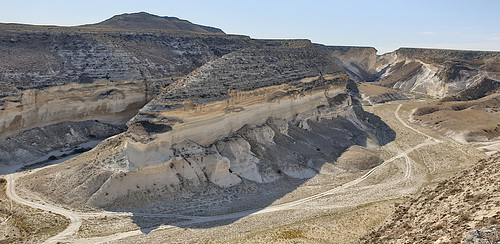

Kampasay, Mangistau region of Kazakhstan
A dusty pot-holed track across the steppe appeared to be taking us nowhere. After a while, a rift in the landscape appeared, and afforded us a view of Kampasay. Only just visible in the picture, behind the layered rock formation, there is an oasis.
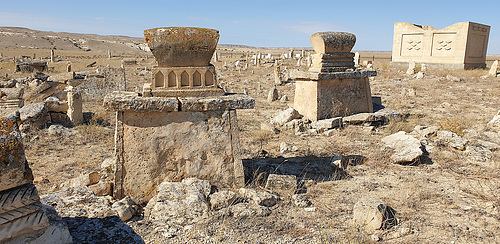

Graves Near Shokpak Ata
Shokpak Ata is a holy site in western Kazakhstan. For about a millennium, faithful have buried loved ones nearby. Some graves date from the 10th and 11th centuries, and newer ones are from the latter 1900s. Since the site is now a protected zone, new burials are no longer allowed. Only in (comparatively) recent years have dates or names been included on graves. So it is clues like style which help age the grave sites. These, we were told, are likely to be 16th or 17th century.


Approach to Shokpak Ata
Shokpak Ata is a cave mosque, where a Sufi monk lived and taught over 1000 years ago. Shokpak was the name given to him because of his legendary ability to create fire by snapping his fingers. Shokpak is the local word for the sound of two rocks striking a spark.
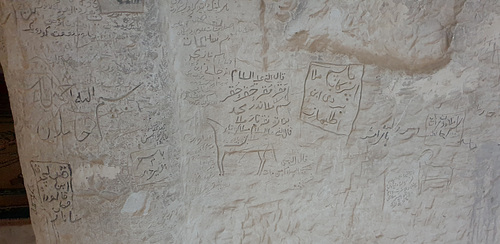

Etched Wishes and Prayers
The age of these requests are unknown, scratched in to the walls of Shokpak Ata cave mosque.
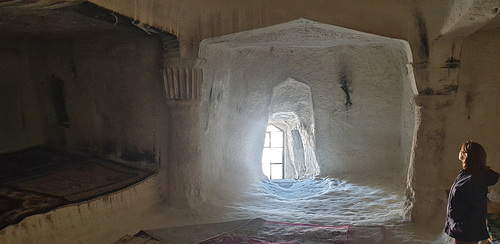

Inside Shokpak Ata in west Kazakhstan
The glass at the entrance is a twentieth century addition to protect the cave, but other than that it is just a natural cave which has been enlarged and shaped. Inside, no man made items exist other than a few beautiful hand made carpets.
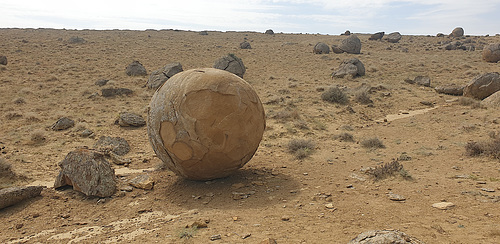

Rock Ball, Torish
Rock Ball, Torish
We were, of course, curious about the science of these balls, which litter the landscape for a strip of a few hundred metres. The shell fossils everywhere attest that almost the entire region was once the floor of the ocean. At that time, molten lava from an underwater volcanic eruption was broken in to blobs which were rolled around on the seabed as they cooled and hardened. Apparently, here at Torish, west Kazakhstan, is one of only two places where this is known to have happened. Eggs, toirtoises, muffins - these were the descriptors we used when pointing the different rocks out to each other. Only a small number were this spherical, but these "giant's marbles" were the most engaging. Most were cracked, and many were split into parts. Millennia of freezing and heating taking its toll. Some showed layers, like rings on a tree. Others peeled a "shell" off, like a boiled egg.
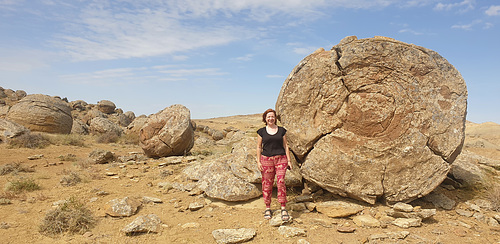

Jo, for Scale
Jo, for Scale
Here, she is a prop, so you can gauge the size of the Torish rock balls. This one is split quite cleanly, and shows off some of the layering.


Losing Myself in the Madness
Balls, part balls, peeled off layers, and distorted shapes. It all seems to be happening.
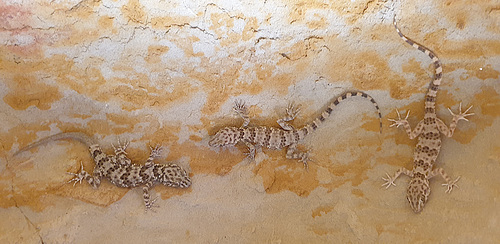

Cave Lizards
Cave Lizards
We were shown a cave, with a simple wooden door and a rug. A shelter if conditions should make it necessary to stay put. A score or more of these fat lizards were enjoying the cool conditions inside.


Kokala
Kokala
According to Nur, the rate of erosion here is so high, this entire site may disappear in the next seventy years. No real rock, just layers of coloured soil. Iron rich red layers, and a brown coal seam near the top, and sulphurous gravels in between. This colourful layered mound seems so fragile.
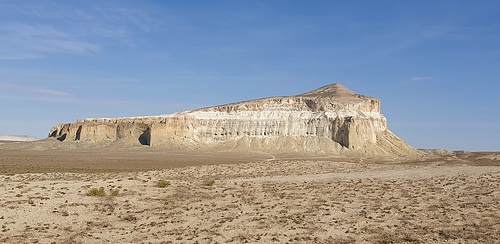

Sherkala, the Lion's Fortress
In western Kazakhstan, Mangistau, Sherkala rises out of apparent nothingness.
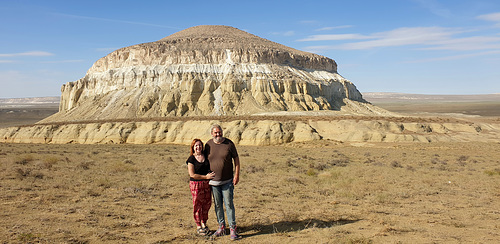

Sherkala, from Another Angle
From here it resembles a giant yurt. A popular photo spot.
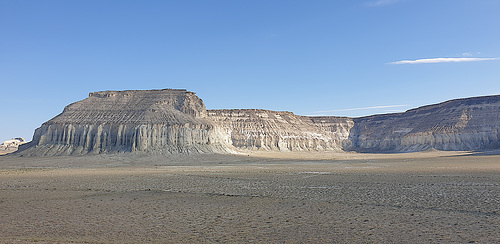

Dramatic Airakty
Dramatic Airakty
With erosion resembling columns, this area was made famous by an exiled Ukrainian artist and poet, Taras Shevchenko. He was sent here in the 1850s after writing some prose that was unflattering to the Russian government of the day.
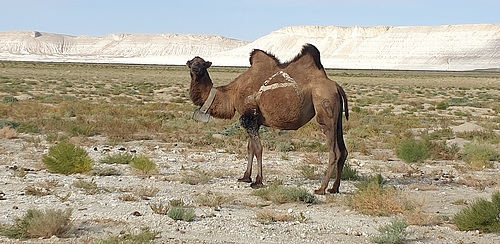

Camel
Camel
All the camels around here are marked. A letter, a number, or a symbol. By this, all know who owns which camel. We did try some proper shubat, I.e not from a plastic bottle in a supermarket. Shubat is the fermented camel's milk. It was surprisingly good, and quite refreshing.


The next two days became one little subadventure. With a magnificent night camping, one of the best camping experiences we have ever had, as the link of the two days. Fewer sights, and longer times in the car, were rewarded with wonderful vistas and stunning scenery.

Beket Ata cave mosque is a reasonable 20-30 minute walk from the car park at the top of the cliff. Winding our way down the path, we encountered hot and tired families and groups coming back up. Many smiled as we greeted them with one of our three Kazakh words. Invariably, they knew we were not local. Maybe it was our pronunciation, maybe our clothes, maybe our hair and features... Anyway, they just knew, and would frequently try and ask for information about us. Well, all we could really communicate is that we were from Australia. Oh, the smiles we would get, and even got a welcoming embrace from an older gentleman who beamed at us. Then, they would chatter amongst themselves, us not understanding a thing, except the word "Australia", and yes, almost every time, "kangaroo". At this, we would laugh, and they would laugh with us. Our confused looks ensured they knew we had only caught that small gist of the conversation.
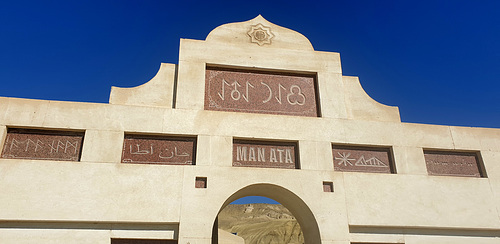

Shrine
Shrine
Man Ata. Little seems to be known about the inhabitant of this grave, now a shrine, attributed with being a protector of travellers. He was a Zoroastrian teacher or priest, from before the 10th century, when Islam came to Mangistau. We have no idea what all the scripts are. But the last one had me most intrigued. The majority of vehicles seemed to stop on the way past, with the occupants spending a few minutes in prayer and meditation at Man Ata's grave.


Tuzbair, a West Kazakhstan Salt Flat
The land is dotted with depressions, many are quite a bit lower than sea level. Tuzbair is the biggest salt lake here.
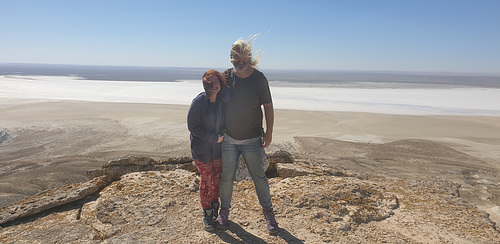

It Was Windy
It Was Windy

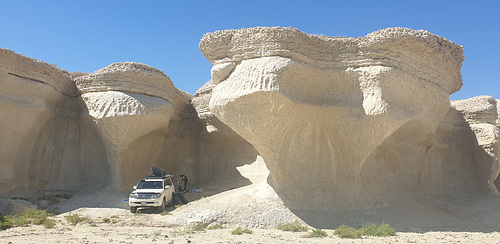
A Sheltered Picnic Spot
A place out of the wind was the number one criterion when choosing where to stop for lunch.
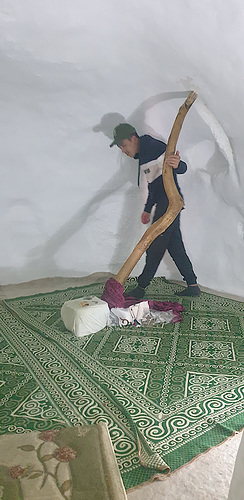

Holy Stick, Beket Ata
In the cave mosque of Beket Ata. Three small "rooms" where the Sufi, Beket Ata lived and taught. Pilgrims visit the cave where he is buried, and then come to this area to walk around the holy stick.
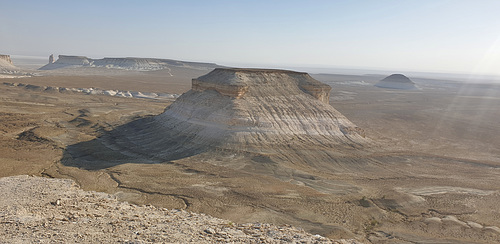

Looking Down, Bozzhira
Bozzhira in Mangistau, Kazakhstan. A multitude of gorgeous view points.
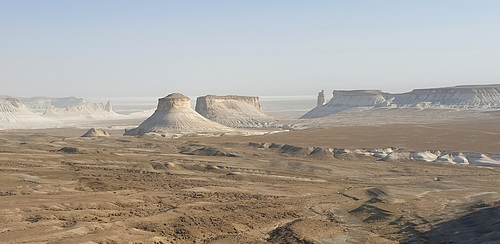

Breathtaking Views Abound
Bozzhira, Kazakhstan
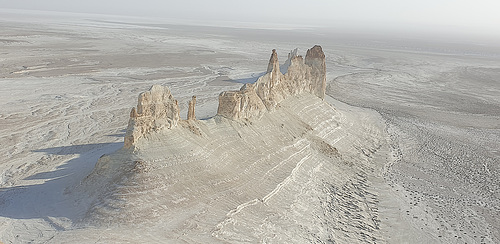

I'm Running Out of Superlatives
A few kilometres from our first stop at Bozzhira. We crossed a narrow join from the surrounding plateau to an outcrop where we could absorb the splendour of this formation.


Looking Out from our Campsite
We spent the night on the floor of Bozzhira. A recess in the rockface was deemed an ideal spot for our tents, protected from the blustery gusts that seemed to build the whole afternoon.
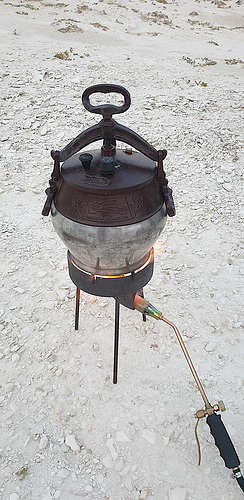

Dinner is On
Dinner is On
Chop vegetables; add some chicken; season and spice; screw the lid on tight; heat with the nearest flame throwing device. The driver, Ruston, got this fantastic pressure cooker from Afghanistan.
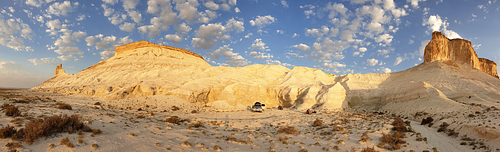

Sunrise Reaches our Camp
Morning in Bozzhira, and while Ruston cooked breakfast we just spent some time appreciating the soft light striking the formations that surrounded us.
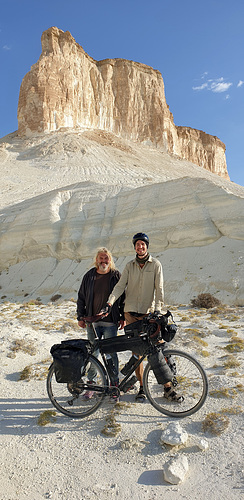

Dima, a "Keen" Cyclist
When we first saw a figure weaving through the rocks and sand and vegetation, I thought it was an animal. Despite a strong confidence in the knowledge that none would be here, I even thought it might be an ostrich. Nur said with confidence that anyone cycling here must be a foreigner, or crazy, likely both. It turned out to be a Kazakh guy, who had been riding four days, with four or five more ahead. He didn't really have a plan, or much of a map for that matter. Just wending and winding through the landscape in search of views. He appreciated greatly our gifts of water and food, and he joined us for dinner and breakfast. He cycled Jordan end to end, and once bought a bike in Amsterdam and rode to Barcelona, frequently being the first Kazakh that many Europeans had met. A toast to our crazy Kazakh Russian friend, Dima.
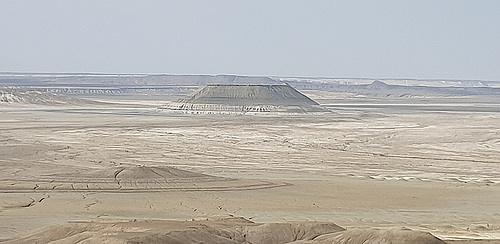

Mt Bokty
Mt Bokty
As depicted on Kazakhstan's 1000 tenge note.


Tiramisù
Tiramisù
Jo taking in Kyzylkup, in the Kazakh region of Mangistau. For fairly obvious reasons, it is also called Tiramisù.
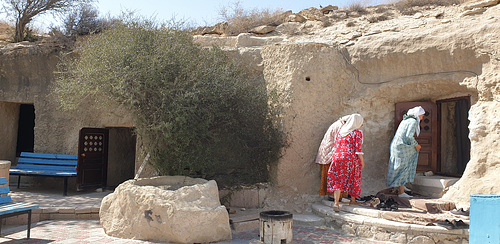

Pilgrims at Shopan Ata
Shopan Ata is the Sufi attributed with bringing Islam to the Mangistau region of Kazakhstan. Probably around the 10th century, he was teaching from this series of caves. The land near the cave mosque has centuries of burials. The closest spots are the oldest graves, with some of his students being amongst those burials. Further away, more recent cemeteries have sprung up, and burials still do occur out here, miles from everything.