6 to 13 Apr, 2026 - Bulboaca, Bender, Tiraspol, Chitscani, Old Orhei, Curchi, Soroca, Tipova, Chisinau, Millesti Mici, Comrat - (Moldova, Transnistria, Gagauziya)
Spontaneously, only two or three weeks before flying out, I decided I wanted to be somewhere different for my birthday. A cheap flight from Naples to Chisinau appeared in my searches, and that settled it.
Coincidentally, between booking and flying, the final line-up of entries for 2026 Eurovision was announced. Instantly, we were hooked on the Moldova entry, by Santoshi. So apt for us, and such a great song for Moldova. 12 points from us.
While I took care of flights and car hire, Jo organised the accommodation, and ensured we were going to be somewhere amazing for my actual birhday. It was perfect, especially when coupled with a drive to Transnistria during the day, and a wine tour meal for dinner.

Birthday View
So, here we are, arriving just before my birthday, in Moldova, in a fancy room in a magnificently beautiful winery, Castel Mimi.
Before coming, we had no idea what an amazingly good wine heritage this country has.
This was the view from our room.
Notably, Castel Mimi frequently is ranked in the top 15 most beautiful wineries in the world.
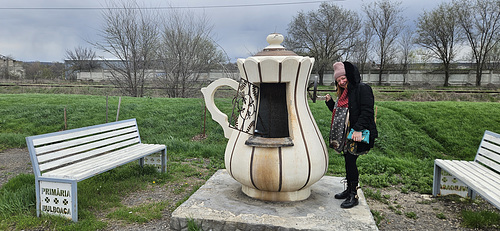
A Well
Another thing we did not know about Moldovax. The wells. The sheer number of them.
Day 1, walking around, we encountered wells, and wondered if that was just this town, or this area. Wrong. They are prolific through the country. Thousands upon thousands, in towns and villages, along the highways.
The proportion of the population still relying on them, without running water to their homes, is scary. They generally are rated quite low on hygiene scales, being polluted by pesticides and harbouring a host of nasties.
Many are purely functional, but the great majority are decorated, or have themes, showing that at some point, they were respected and prized and valued.

Proof They Are Used
I did not want to intrude, or make this lady uncomfortable. Taking a photo may draw attention to something that, most likely, is a highly undesirable chore, repeated countless times per day.

Castel Mimi Barrels
On the day of my birthday.
A wine tour, followed by a multi course dinner with paired wines.

Birthday Dinner
So, the lump on the noggin. A fall in the street when I stumbled over the uneven footpath. Yes, ouch, and it was a massive golf-ball sized mound.
For our menu, we chose to go with the local specialities. Yes, they were fancied up to suit the splendour of the winery restaurant, but I want to, as much as possible, savour the flavours of the region.

Bender Castle
16th century Bender Castle occupying the sight of an earlier fortress.
This was our first stop inside Transnistria, an unrecognised breakaway region of Moldova.

Inside Bender Castle

Tiraspol, Capital of Transnistria
A striking juxtaposition. The tank speaks of the cost of war. The church evokes faith, remembrance, and hope.
The state narrative of strength, duty, and military victory. The personal response of loss and mourning.
It felt like a quiet summary of Transnistria itself - where military pride and spiritual devotion stand side by side.

USSR Cantine
Styled as a Soviet-era canteen, it's designed to recreate the everyday experience of eating in the Soviet Union. Cafeteria trays, simple dishes, Soviet crockery, propaganda posters, portraits of Soviet leaders, old radios and televisions, and shelves of memorabilia. Inexpensive and traditional.
I expected kitsch for tourists. However, it was largely locals eating in. It felt more like stepping into a preserved slice of everyday Soviet life than into a themed restaurant.

Google Maps did not Tell Us
If we'd known, we might have gone a different way.
But I'm glad we didn't.
"Jo, are you sure this is right?" I asked as we wound our way down from the road towards the river. I had been expecting, quite naturally, a bridge to take us across.
Instead, a handful of roubles later, the boatman waved us aboard and got us moving. How many roubles, I couldn't say - it was just the change left over from lunch at the USSR Cantine, so I figured it couldn't have been more than a euro or so.
A dog hopped onto the little ferry with us. Before we'd even reached the opposite bank, he leapt ashore, clearing the narrowing gap as the ferry eased alongside, and disappeared into the bushes. As we drove off, there he was again, trotting back just in time to board with the truck waiting to make the return crossing.
We didn't stop smiling for hours.

Noul Neamt Monastery
The monastery had a blip from the 1960's until the collapse of the Soviet Union. While the churches inside were preserved, the function of the majority of buildings was altered to serve as a hospital. Only in 1990 did the monks return.
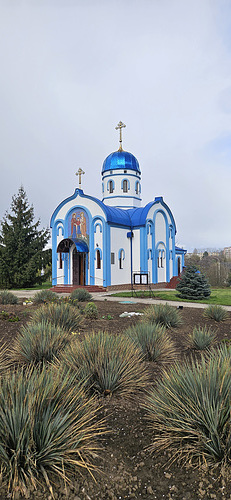
Brilliant Blue Domes
A wonderful splash of colour in Bender, as we headed out of Transnistria and back to regions less controversial.
Our second base in Moldova was at the top, in Soroca. We had a short-stay apartment right on the river. The beauty of the view to the other side was accented by the knowledge tha this waterway marks the border. The quiet and peaceful fields we looked over to are in the next country, namely Ukraine. With everything going on there, at the moment, it was almost difficult to comprehend that it was so peaceful. Yes, the fighting is hundreds of kilometres away, but it still is a country at war.
Both the north-bound and south-bound journeys were punctuated with side trips. There are a lot of places to visit scattered about the country, but the compact nature of things made them easily accessible from our basic travel route.

15th Century Cave Monastery
The main chapel inside a cave monastery. Hewn into the cliff face high above the river, the original entrance involved trekking along the river, then navigating ancient stairs up to a fairly narrow ledge. An addition from the last century is a corridor cut through the rock, allowing much easier access from the walking trail above.
Walls blackened by centuries of burning candles. Narrow passages lit by only those candles and some natural light from the single window. Ancient monastic cells with not a hint of creature-comfort, and not a smidge of decoration.
There are resident monks. This is a living place of faith meets geology.

On a Ridge in Old Orhei
Perched on a ridge, this ancient cross is just above the old cave monastery. A fantastic spot for the breathtaking view.
In the background stands the 20th century St Mary's Church, a true cultural icon for Moldova.

A Monk Heads in to St Marys

Curchi, Moldova
This 19th century cathedral is one of five churches in the monastery of Curchi. The whole complex deteriorated during the soviet era, with frescoes being damaged beyond repair and important pieces of art going missing. The complex was utilised as a hospital focusing on psychiatry and the treatment of drug addiction. The restoration is impeccable, in my opinion, with a genuine feeling of authentic age.

Soroca Fortress
This wonderful perfectly proportioned castle stands as a symbol of Modovan pride. Perfectly circular, on the river facing Ukraine, it was constructed in the 15th century.
Stephen the Great, revered and loved both in his day and now, ordered the defence of this spot. Although his original fort was replaced in the century that followed, he still takes much of the glory for the old defensive structures of Moldova.
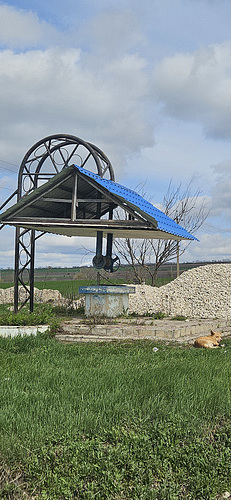
Wells Unique by Engineering
So, there is possibly scope for a coffee table book about wells in Moldova. Certainly, there are already on-line albums and blogs.
This one stood out for it's "hanging" design, with the winch suspended above the well, but not connected directly to it.

Wells Unique by Decoration
Continuing on, we came across this beautiful celebration of the stork, a relatively ubiquitous bird across the country.

Wells Unique by Theme
This well celebrates the Biblical story when the woman at the well encounters Jesus, and he offers living water that never runs dry.

Wells Unique by Tradition
A well at a picnic spot.

Great Lunch
This fantastic lunch at a roadside eatery was a highlight meal of our time in Moldova.
So many dumplings and a genuine pair of traditional Moldovan main courses. Washed down with a glass of local brandy.
But the heart of the people running this eatery really shone through. I went on-line to leave a review, which I rarely do, and read some beautiful stories accompanying the 5 star ratings.

Coins and Prayers
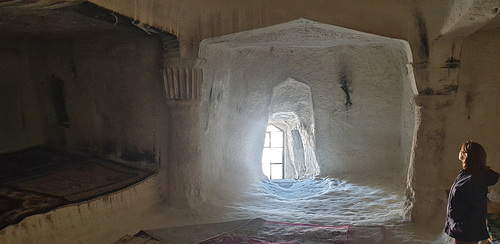
Every crack in the soft walls of this cave was occupied, by either a coin, or a slip of paper with a prayer. However, that would not prevent more being added. Being so soft and crumbly, little effort would be needed to create a tiny new spot. The challenge would be to not upset the balance of earlier offerings.

Tipova
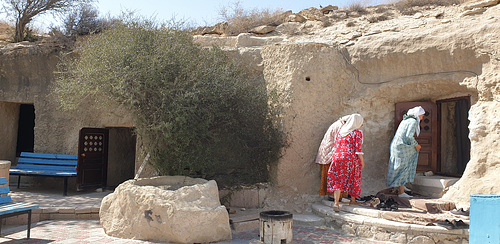
Looking down from one of the cliff-side monk cells. Not more than 100 metres from the cave monastery of Tipova, along the riverside trail, quite a number of caves have been adapted for habitation. Although no longer used in this way, they were utilised for sleeping and living over many centuries.
Three bases for this trip, with the final stop being in Chisinau, capital. A little bit of randomness thrown our way by the altered schedules enforced by Orthodox Easter, but we took it all in our stride.

MIG 17
In Chisinau, there is a military museum, with some of its most interesting hardware sitting outside. With almost everything in town closed for the Orthodox Easter long weekend, we were pleased that we could at least take in part of this site, despite the museum's closed door.

Easter Sunday - Chisinau Cathedral
For many hours, the crowds came and went. On the steps, the choir sang. Of course, in this day, it was a multi-media event, with large screens erected for the proceedings. It was a beautiful event to be a part of.
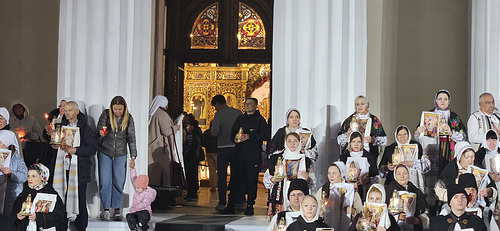
Easter Sunday - Chisinau Cathedral
Getting in and out of the cathedral did involve negotiating a path between the singers. Maybe this was reason enough for many to just enjoy from outside, as despite the large crowd gathered around the building, the inside felt no more or less busy than it did during the day.

Easter Sunday - Chisinau Cathedral
Most people were heading to the main door of the church. Here, many priests bustled busily, lighting the candles that were proferred to them by the faithful. I went forward, mainly because I wanted a photo, and a priest noticed me, and my lack of candle. He took one of the "spares" on the table behind him, lit it, and gave it to me, accompanied by a beautiful smile and some words that I did not understand. I thanked him, and we carried it back to our room, where it continued to burn for most of the night. When I woke, during the early hours, and noticed the flickering flame, it was a wonderful prompt to remind me to be thankful for the true meaning of Easter.

Milestii Mici
The photo is mainly a reminder of the key figures. It also acts as proof when I tell people 1.5 million bottles, that it is not a mis-remembered figure.

Yes, it Was Cold
However, that is only a tiny part of the story. We are in our boots and our heaviest clothes because this was our last day and we were heading to the airport that evening. Since we had bought a fare that only included hand-luggage, the bulkiest clothes were picked aside to be worn at the airport during check-in and boarding. In the end, it was a moot point. We ended up acquiring 4 bottles of wine. We had to fork out for a checked bag to bring our liquid purchases back.

Heading Deep into the Tunnels
Being the only English speakers booked for the tour, we had a personalised guiding service. Getting to the interesting parts of the old mine required a ride in a little electric train. The tunnels were made when building stone was cut out in blocks, making the tunnels quite regular, like a town street plan. Accordingly, they were now named, with inspiration from grape varietals. Chardonnay Street, Cabernet Avenue, you get the idea.
We whizzed past scores of huge barrels, most so large you could not imagine another place they could be used. Eventually, we stopped where some gates were opened for us, presenting smaller tunnels. We continued on foot.

Part of the Golden Collection
Ideal conditions. Wines lying at 80 metres depth, in bottles covered in dust and mould, in small elegant houses. Constant year round temperatures between 12-14 degrees, 85-95% humidity. Genuine long-lived wine varieties, from 1987. This vintage was produced during Gorbachev's anti alcohol era, although it was bottled in 2000.

19 Bottles from 1973
Some of the oldest unsold bottles remaining in the collection. An aromatic dessert wine.

Wandering in the Once-Was-Quarry
Note the scoring in the ceiling from the saws that carved the solid rock in to building material.
I feel like the description should talk about an unfathomable number of shelves with countless bottles of wine. However, to receive the Guinness award that was eventually earned, they were once counted. A proper and complete audit by hand, catalouging location, variety and vintage, and exact number of bottles. Let's just settle on a huge number of shelves with lots of bottles on each.

Crossing to Gagauziya
Another political and geographical oddity of Moldova, albeit much more formal and far less contentious than Transnistria.
We filled in the afternoon on our last day in Moldova with a drive to Comrat, the capital. It is a recognised autonomous region, with its own government, with a stronger dependence on Moldova than they would like. The status of the region, and what they are permitted to do, is not set in stone. Constant legal battles ensure the definition is constantly waxing and waning.

Gold Domed Cathedral of Comrat
Another building that was abused and misused during the Soviet era, with the books and icons purportedly burnt inside. The cathedral spent a good number of years operating as a museum.

Nesting Stork