Current Travels

Showing posts with label Ethiopia. Show all posts

Leaving Ethiopia - A Last Harar

31 December, 2014 to 4 January, 2015 - Addis Ababa, Harar - (Ethiopia)


We celebrated New Year's Eve in Addis. Largely a non-event, due to Ethiopia using it's own calendar. Ethiopia's New Year is in September on the Gregorian Calendar.

While in Addis, it was great to catch up with Kristal, a friend from Melbourne. She is in Ethiopia with a couple of her friends doing volunteer work in the south. Nice to have enjira with friends.

Our main reason for stopping in Addis was to sort out an onward visa for Somaliland. It actually came together a lot easier than expected, giving us a chance to do a couple of things we missed first time through. It was not all cheery, though.

Red Terror Martyrs Memorial Museum, Addis Ababa
Some of the identified remains of victims killed by the Derg during the Red Terror of the 1970's and 1980's. Also on display were piles of bones from unidentified victims. Somewhere between 100,000 and 500,000 people were killed or went missing during Mengistu's time as ruler. Yet another place where you can stand and ponder how incomprehensible it is what some people are capable of doing. And again, as we have seen at similar memorials in a number of places around the world remembering victims of various horrible regimes, people write in hope "Never Again!"


The ten hour bus ride to Harar was not the worst we've had. Relatively comfortable, and one of the first to not exceed the forecast travel time.

While we enjoyed many aspects of Harar, I don't mind confessing it did not live up to my high expectations. The old town, markets, and laneways lacked the anticipated romance. Overall, the vibe was not as pleasant as elsewhere in Ethiopia. The scenes were not as picturesque as described. So we stayed a day shorter than originally planned.

Don't get me wrong. It was worth coming to see, particularly for the hyenas. I was just over-enthused on what it would offer.

A Swooping Kite in Gidir Magala, Harar
Gidir Magala is a market in the old town of Harar. There are a number of butchers in the market, mainly selling goat and camel meat. Kites sit around the market and swoop down whenever there are scraps and offcuts thrown in to the street. Sometimes they swoop at people who are carrying meat!


At a Well, Gidir Magala, Harar
Kites look down from the walls, waiting for scraps of meat from the butchers. In the foreground, some women take their donkeys for water.


Donkey Parking
Donkey Parking
Outside Erer Gate, Harar. About 5 or 6 donkeys were tied to the pole, and the others were then tied to one of those. I'm not sure how anybody identifies their own donkey when they come back out!
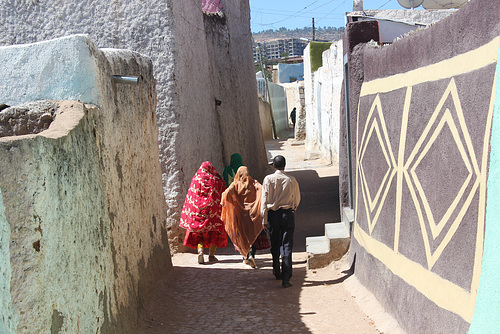

In the Lanes of Old Harar (Jegol)
A typical scene in one of the warren-like laneways within the walls of Harar's Old Town.


And those hyenas. What an amazing sight. Apparently, after "feeding", they wander the streets and lanes of the old town. I do believe, though, you have to be out very late to risk encountering one. Locals assured us that they pose no danger.

Hyena Feeding, Harar
A hyena takes a strip of meat off a stick that I hold in my mouth. As night comes, the Hyena Men of Harar call the hyenas in from outside the city. At first, they skulk and dart in the shadows, snatching a few scraps of meat. But eventually, they come up to the man and begin to eat from his hand. I was asked if I wanted to give it a go, and seeing how healthy they looked, and how gentle they were with the man feeding them, I did not hesitate. First a scrap of meat on a stick hand held, and then he gestured for me to hold the stick in my mouth. It was a truly beautiful moment and I never thought I would see such a gentle and careful nature in an animal with such a horrible reputation. She gently grabbed the meat and lifted it off the stick.


A Hyena Climbs on my Back
There were no claws. I felt the big padded paws as the young hyena climbed on my back to take a piece of meat offered by the Hyena Man. Harar.


Completing the Historic North

24 to 30 December, 2014 - Tigray, Aksum, Gonder - (Ethiopia)


We've come to love the Ethiopian handshake. A firm grasp with the right hands, pull each other close, and bump shoulders. Usually it is a single bump. There appear to be ocassions, though, where one does not appear to suffice. Sometimes, two or three bumps occur, accompanied by a smile, a laugh, or even an embrace. I have discovered it the perfect way to conclude a transaction, particularly where there has been some arguments. It instantly diffuses the situation and acknowledges that everything is fine. The Ethiopians who I have thusly shoulder bumped have always indicated that it was the perfect way to conclude our dealings.

So this blog entry is to describe the rest of our journey through the historic north of Ethiopia.

From Mekele we headed in to the region of Tigray. Well over 100 cave churches are found in this region, varying in style, age, and quality. While they were beautiful, and worth the effort to get to, there is a major problem. We were well and truly ready to move on after visiting three. Each charges a separate and hefty admission. Then the priests want tips. Then the kids who ran up the hill with you want tips, and where tips are deserved and given, they are never enough. And every person anywhere near the church wants to get in on the action and asks for money, it is all draining. It was certainly a major detraction from the experience, and something I would tell prospective visitors to take in to account.

A Church in Tigray
A Church in Tigray
Around Tigray, there are hundreds of churches cut in to rock. We only visited 3, and each felt very different. This is Medhane Alem Kesho in the cluster of churches called Takatisfi.


Medhane Alem Kesho
Medhane Alem Kesho
A priest unlocks the door to the main church chamer at Medhane Alem Kesho, Tigray.


Aksum, the holy city of Ethiopia. We celebrated our Christmas there. Our Christmas? Well, it's not Ethiopia's Christmas. "Do they know it's Christmas time at all?", Band Aid asked. No! Because they celebrate Christmas in January. They have a different calendar, and different New Year, and so on. It's only 2007 here. "Come to Ethiopia and travel seven years younger" one slogan suggested. Anyway, there was some tinsel and a few trees around, but no Turkey. Lamb "tibs" and enjira for our Christmas meal.

Turned out to be a good time to stop for a few days. Christmas. A nice town with a number of walkable sights. Liked our stay in Aksum.

Great Stele at Aksum
Believed to be the largest single piece of stone that humans ever attempted to erect, the Great Stele apparently never quite made it. Somewhere in the 4th century, while being put in to place, it seems it came crashing down and caused the collapse of other nearby monuments and tombs. Quite spectacular, I'm sure.


One of the Oldest Books in Ethiopia
Reputedly over 1,000 years old, this bible was on display in St Mary of Zion Old Church in Aksum.


Is the Ark Really Here?
Most of us have seen Raiders of the Lost Ark with Indiana Jones and the Nazis digging lots of holes in the sands of Egypt. Well, most Ethiopians believe that the Ark of the Covenant has resided in Ethiopia since about one or two generations after the time of Solomon. Whatever they have, it is here, in Aksum. Most people will never get to lay eyes directly on the alleged Ark, although a replica is paraded through the streets at important religious times. The front building is where it is, but the room there is leaking, and the new building at the back will be ready soon. Whether it is the genuine article or not, the mystery and controversy is all part of the charm that is Aksum.


Arbatu Ensessa Church
Some of the lovely decorations in one of the churches of Aksum.


No, it's NOT a Butcher Shop
This is a restaurant that specialises in tere sega, raw meat. Quite the delicacy, here in Ethiopia, and very tasty with various spices and presentations. We enjoyed kitfo again (raw mince, like steak tartar), and gored gored which was delightfully tender raw cubes lathered in spices.


And, then a couple of nights in Gonder before returning to Addis.

Moon Over Debre Berhan Selassie Church
Gonder


Beautiful Fasiladas Palace
Fasiladas Palace inside the Royal Enclosure of Gonder. It dates from the mid 17th century.


Depression in the North, but no Need for Valium

18 to 23 December, 2014 - Mekele, Danakil Depression (Harmadela, Erta Ale, Lake Asale, Dallol) - (Ethiopia)


Our next stop north was Mekele. We managed to score a ride meaning we covered the distance in a single day instead of the anticipated two. The extra day was spent enjoying town and shopping.

In the Market at Mekele
A beautiful smile, spinning by hand, selling her spices and coffee pots.


Berhale Market
Berhale Market

Our reason for coming to Mekele was to arrange our time in the Danakil Depression. The Danakil Depression is a vast low area in northern Ethiopia, largely below sea level. It is hot. In summer it regularly goes over 50 celcius (although it only makes high 30's at this time of year). It is desolate. And it has some beautiful sights to see. Not least of all is the opportunity to see the way people live in such a place. Being close to the Eritrean border, soldiers and guards are never far. There are some who make a bit of money from tourism, either directly or otherwise. However, it seems the vast majority live here because of the salt extraction. They cut salt, or they transport salt, or they trade with the camel caravans. Such a brutal environment to live and work in. Sometimes, we drove kilometres without seeing a single thing growing, yet people live there, with a handful of goats. Oasis dot the land, and we were told there was no shortage of water just below the surface, suitable for animals at least. Or human consumption if desperate enough, but the people know how to make it OK for drinking.

Afar Man with Camel
Afar Man with Camel

Jo Gets her Hair Done
While sitting in a small village, waiting, the children gathered, and soon Jo was getting plaits done from all angles.


Camel Train Near Harmadela
Camels laden with salt. Destination, Mekele. Seven days travel from the salt flats.


Mum and Bub
Mum and Bub
Mother and baby camel in the Danakil depression.


Living where Almost Nothing Grows
Not many people live around here. The environment is incredilbly harsh and unforgiving. How anyone manages at all is beyond me.


Egyptian Vulture
Egyptian Vulture
Despite the feeling that nothing could survive here, it obviously does. Occasional birds this size must feed on small prey, which in turn feed on bugs and insects, which all have something to survive on. The complete cycle is here, difficult as it is to find.


While that was all interesting and worthwhile, nothing was even a close second to the main reason for our trip here. To climb Erta Ale and spend a night on the rim, next to the world's only permanent lava lake.

View in to Erta Ale
View in to Erta Ale
The thin fresh crust of rock tries to form over the massive lake of lava, but it is quickly liquified and absorbed once more in a cycle of heating and cooling.


Late at Night, Erta Ale Volcano
We ascended after dark to avoid the desert heat, and spent most of the evening and morning admiring one of the most amazing sights. I even singed the hair on my arms standing there. We camped on the rim of the crater (not precariously near the edge, though!) and admired the lava lake for sunrise, heading down before it got too hot.


Rolling and Rippling Molten Lava
Mesmerising changing formations in the Erta Ale lava lake, as rock changes state between molten and solid and back again.


Surreal Vistas Created by the Shifting Crust
Erta Ale lava lake. The cracks caused by the molten lava expand into immense bubbling pools before cooling just enough to crust over.


Bubbling Lava Shooting Dozens of Metres
Beautiful shapes and patterns appeared when large pools of lava became so intense that they bubbled and frothed erratically and spurted skywards.


Like Lightning
Like Lightning
Lava in the Erta Ale Volcano crater.


Lava Bursting Through
Pressure beneath the crust causes a dramatic break out of lava. Erta Ale Volcano.


More Lava Leaping
More Lava Leaping
Erta Ale Volcano.


A Gigantic Spurt of Lava
Besides the need to avoid desert heat, the lava activity is so much easier to take in when it is dark. Erta Ale creates an incredible, though momentary, lava "tree" for us.


Wide Angle - Erta Ale Crater
Thankyou, Carl, for lending me your lens. Last photo before going to bed.


Sunrise by a Lava Lake
No reflections in this lake, though. Dawn comes, and there was a new appreciation of Erta Ale. The lava activity and the sun rising were a perfect pair.


Daylight Begins to Enter the Crater
As the sun rose, we could finally see the warped countours of the lava lake crust. But day or night, Erta Ale never sleeps.


With so much land below sea level, so much water coming in, and so much sun, salt is the natural by-product. We stoon on Lake Asale's shore at sunset, seeing white in 3 directions almost to the horizon, and blue in the 4th.

Lake Asale, Ethiopia
Standing on the shore of the salt laden Lake Asale, in the Danakil Depression.


Another amazing area is the volcanic active area around Dallol. After climbing over centuries old lava flows, we came to the sulphur springs. Smelly? Actually, not as bad as you might imagine!

Sulphur Formations
Sulphur Formations
Sulpur laden water bubbles to the surface and evaporates. Dallol in the Danakil Depression.


Striking Yellow - Sulphur - Dallol
Another cluster of sulphur formations in the Danakil Depression.


Ethiopian Soldier
Ethiopian Soldier

And before leaving the depression, we stopped in a much drier area to see the salt extraction in progress.

Salt Extraction Site
A camel waits while in the background, salt blocks are cut and cleaned, ready for loading. Ragad, in the Danakil Depression.


Cutting Salt Blocks
Cutting Salt Blocks
A worker cuts blocks of salt into manageable sizes, ready for transport by camel to Mekele. Ragad, Danakil Depression.


Where the Streets Have No Name


12 to 17 December, 2014 - Addis Ababa, Woldia, Lalibela - (Ethiopia)

Our plans for a morning snooze before lunch never quite fell in to place. We arrived early, but the debacle which is Ethiopian immigration meant we did not emmerge with our bags for at least an hour and a half. Then, our attempts to find a working ATM left us feeling flat and worn out. Eventually, we ended up in a hotel, only to be told we could not get in to our room till after midday.

But, let's go back one step and highlight some of the fun on Ethiopian Air. 1) The number of seats on the plane is known, so why not carry enough blankets so that there is enough for everyone? 2) Ditto for refresher towels. 3) Ditto for headphones. 4) Nice to have in-seat entertainment systems, but as it turns out, we were missing nothing by not having headphones - somebody decided not to run any movies. 5) Do Ethiopian men not lock toilet doors? Jo stumbled in on a man who had decided the lock was unneceassary. 6) Ditto for Ehiopian women, as I stumbled in on a lady sitting on the toilet. 7) I was both amused, and not at all amused, when a man four rows away and on the other side of the plane decided to watch music videos on his phone - without headphones. Even at that distance, it woke me up and kept me awake. I assumed somebody closer would complain, but I soon worked out the task would fall on me.

We decided to push through the incredible tiredness, and see a bit of Addis. Nothing too strenuous, a wander through Africa's largest market, followed by a beer on a cafe's balcony. Trying to orient myself, I asked "What is the name of this street?" "No, no" the waiter replied, almost agitated. "I don't think you understand. This street here, what is it called?" He shook his head. He appeared to be angry, and left us. Had we touched a raw nerve? We had read about the lack of knowledge of street names, but this was like we had asked about one of Addis Ababa's deep dark secrets.

Our First Enjira on Ethiopian Soil
Yum. We were looking forward to our enjira meals, and they have not disappointed. One dish is with lamb, and the other is kitfo, warm raw mince with spices.


Coffee - It's Always a Serious Affair in Ethiopia
In Ethiopia, coffee is NEVER instant. Most establishments, even if they serve burgers, has a person sitting in the corner with a fire and cups. Sometimes you get a full service, with scattered grass and incense, and sometimes you just get the coffee in a ceramic pot. It is always made with beans they have just roasted then and there. It is strong, very strong. It is good, very good!


The road north from Addis Ababa was lined with dozens of tiny stories. Countless sheep and goats being herded along. Children shoving the rear ends of cows to keep them off the bitumen. Men wrapped in white leading camels. Women berating disobedient donkeys. Groups of wandering people huddled under parisoles. Families laden with supplies from market. Even a number of long distance runners training on the highways. The backdrops for these activities varied. Mountain ranges at times, stone fences surrounding mud houses and barns at others, but more frequently, expanses of scrubland with flat topped trees dotted around. Each sight a story in itself, and some of it so stereotypical Ethiopia that we wondered if it was a show for the tourists.

Along the Road, North of Addis Ababa
A typical sight along the road as we headed to Dessie.


Our destination, Lalibela, would not be reached in one day, like we hoped. As expected, we had to overnight in Woldia before catching the bus in the morning. It's nice to have a freshly painted room, but the rooms had just been painted that day! I'm not sure if we slept, or if we just passed out on the paint fumes.

5:15 the following morning, we had one of the more bizarre hotel exits. First, I must highlight what this room was. There was a shared squat toilet down the hall, a shared cold shower next to it, so our room was just the one room. There was a bed, and it was pulled away from the freshly painted wall, and that was the entire furniture. No chair, no table, no wardrobe. And because of the fresh paint, no curtains. And yet, when we left at 5:15, the guard who was supposed to let us out came up and checked the room. Maybe the minibar? What did he think might be a problem? As it turned out, there was a problem. Jo's pillow! She always uses the provided pillow slip on a folded towel for sleeping as the pillows are too fat for her liking. So, this perplexed guard first couldn't find the pillow (next to the bed - in a room with no furniture in it - how could he miss it), and he looked accusingly at me like we had purloined it. Then there was the missing pillow slip to be found, which was caught up in the sheets. He seemed even more convinced we had taken that!

And the reason for all of this? To visit the ancient rock-hewn churches of Lalibelela. These incredible buildings started as pure rock, have been hollowed out, and then cut free from the surrounding rock. Effectively, they are entire buildings, each carved from a single piece of rock. There are 11 visited churches, most still functioning, and some are connected by trenches and tunnels. And all of these were created about 700-900 years ago.

Bet Maryam, Lalibela
The church of Bet Maryam, carved out of the rock. Essentially, it is all one piece!


Interior of Bet Mikael
Some of the interior details of the rock hewn church Bet Mikael, Lalibela.


An Apostle - Lalibela
Inside Bet Golgotha, a "men only" church in Lalibela. This is one of the four apostle carvings that is publicly viewable.


The Top of Bet Giyorgis, Lalibela
This is Bet Giyorgis. It truly is a marvel. The church is actually quite large, hollowed out inside the "cross". Inside, it has no supporting pillars.


Looking Down Bet Giyorgis
Peering over the edge at Bet Giyorgis.


Bet Gyorgis, Lalibela
This angle of Bet Giyorgis allows some true appreciation of what a magnificent feat this rock hewn church really is.


And a funny translation to finish this entry off.

Racial Salad?
Racial Salad?
No idea what it was supposed to be, but really, a very unfortunate name for a dish.