Current Travels

Showing posts with label signs menus. Show all posts

The Emirates - All of Them


30 Dec, 2025 to 9 Jan, 2026 - Dubai, Al Ain, Maleha, Al Nahwa, Madha, Fujarah, Ras Al Khaimah, Al Jazeera Al Hamra, Umm Al Quwain, Ajman, Sharjah - (UAE)


Sure, Dubai looks like an amazing place to visit. Everything to the max and on steroids. Amazingly, we have only flown via Dubai once, and did not leave the airport, so the city has lurked on our travel radar. However, our travel tastes have matured to look for the depths beyond the obvious, the oddities and unusual. OK, so our 10 days is still a short time to scratch much beneath the surface for seven Emirates, but we did our best.

Knowing that we were going to be in Dubai, we jigged the flights and plans a bit to ensure that we could be there for the New Years Eve celebrations. We rightly summised that there might be some celebrations put on.


Waiting for Fireworks
Jo looks up at the worlds tallest building.

We camped out for a good portion of the day, staking out a little patch for watching the NYE show. Being a public thoroughfare, the police came along and asked everyone to stand, and we dutifully obeyed. Equally, as people sat on the ground again, we joined them. We were endeavouring to add weight to the protest against the meaningless requests. Eventually, authorities gave up, when the crowd was large, the majority with their behinds on the ground.

We had certainly secured an excellent free vantage point, but perhaps we did not need to be quite so early. It was a long wait.


CLICK FOR VIDEO
Worth the Wait
CLICK FOR VIDEO


Assumption: nobody was disappointed. We were blown away, having never experienced fireworks like this. Somewhere between 10 and 15 minutes, augmented with lasers and drones.
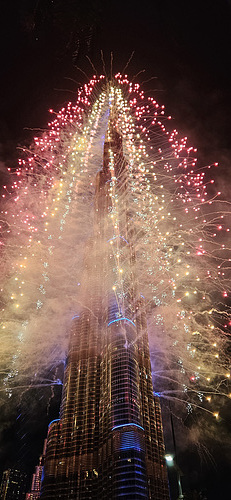
One Moment of "Burj Khalifa" fireworks.
Paid vantage points were pricey, We may have had a long wait, but it was free.


Old Dubai
Old Dubai
There appears to be a bit of a revival in interest in "Old Dubai", and now there are some areas that feel a bit manufactured and lack authenticity. However, some pockets feel nicely restored and genuine, paying legitimate homage to what Dubai may once have been.

We spent a few nights in a gorgeous little boutique accommodation in Al Fahidi, allowing us to wend and wind through the old streets and markets after the majority of tourists had made their way back to their new town hotels.


Dubai Frame
Dubai Frame
Ascending to the top of the frame was not in the agenda. Although at 150 metres it did promise grand views, we found the concept and construction more interesting in its own right.


Museum of the Future
A striking asymmetrical elliptical torus building, decorated with Arabic calligraphy with quotes about innovation and progress. The calligraphy also serves as windows. Inside, one does not really get a sense of how the building is shaped around you. The museum is certainly ranked amongst Dubai's iconic structures.


Camels Form a Caravan up the Burj
One of our favourite moments during the light show spectacular.


CLICK FOR VIDEO
Enjoy a Small Excerpt from Burj Khalifa Fountain and Light Show
CLICK FOR VIDEO


The story of how we ended up at a prime viewing spot for an unexpected Burj fountain and light spectacular is for another time. Perhaps in person.

The long and the short is that we had no idea at all there were special performances were scheduled. A fountain show, even a highly rated one, would be some water squirting in time to music, accompanied by some lasers on the actual Burj Khalifa.

Suddenly, in spite of, or almost because of, our lack of knowledge of the evening's program, we were in a prime spot. From here we witnessed a 25 minute plus performance. Live dancers and musicians, fire, drones, lights and projections, lasers, and of course, fountains. Perfectly choreographed to a score we got a Dubai story.

Light Projections on the Fountains


Al Ain won when we chose somewhere in Abu Dhabi. The actual city of Abu Dhabi will just have to wait until we return another time. Al Ain was a perfect size for our timing, the beautiful oasis and smattering of interesting sights were the ideal counter-balance to everything we had done and seen in Dubail. A place that was important when water was more valuable than oil.


Beehive Tombs near Al Ain
Bronze Age structures nestled in the foothills just out of Al Ain in Abu Dhabi.


Oasis
Oasis
Tens of thousands of date palms form the basis of the Al Ain oasis. Underground irrigation feeds the palms, and hundreds of other plant varieties, in what is considered the oldest oasis in the Emirates. Parts of the irrigation system are 3,000 years old.

Shaded paths meander through and it was a pleasant place to pass a few hours of the day.


Al Jahili Fort
Al Jahili Fort
A nineteenth century mud brick fort in Al Ain, originally both residential and strategic in nature. The palm oasis was a valuable asset, and there are a number of defensive structures dotted in its vicinity.


Our next night was to be in Fujairah city, capital of the Fujairah Emirate. However, another geographic and political anomaly was to divert us from driving directly there.
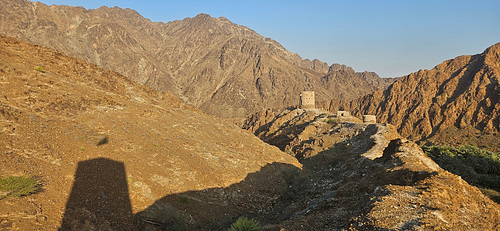

Ridge Towers, Al Nahwa
The day I learnt about the Al Nahwa counter enclave, it was added to my list of unique and weird places in the world to visit.

Madha is an Omani enclave, entirely in the UAE. Al Nahwa is a UAE, more specifically Sharjah, counter enclave, entirely in Madha.

Really, it needs to be seen on a map to start the process of comprehension. Al Nahwa is the hole in the Madha donut on the UAE plate... or something like that.

While in Al Nahwa, we ascended to this ridge with restored old watch towers.


High Above the City, 20 Metres above Sea Level


Back to the west of the Emirates, we spent a few days working our way down through Ras al-Khaimah, Umm al-Qaiwain, Ajman, and Sharjah. As always, we felt we could have spent longer, in almost each stop. Another week or two might have been ideal, but we do what we can with the times and schedules that we get.
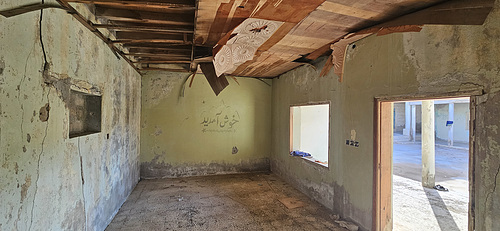

Exploring Al Jazeera Al Hamra
Red Island in English, Al Jazeera Al Hamra was once a thriving centre, one of the regions important pearling centres. With the introduction of cultured pearls, the town was unable to survive the down turned economy. Eventually, everyone left, and by the 1970s it was completely abandoned.

What remains has been largely pillaged. Anything of value or interest carted off long ago.

We spent a few hours clambering through the haunting shells of a once-was-life, creating stories in our head for the rooms with traces of decoration.


Exploring Al Jazeera Al Hamra
Of course, most of the abandoned buildings are houses and some shops. Wandering up and down the streets, we chose one every now and then with an architectural difference to enter and explore in more detail

The tree here is a Eucalyptus, widely planted in the area for its fast-growing shade.


Nothing says Posh Quite as Well as Towel Art

Dinner by the Lagoon
Umm Al Qwain is way less developed than its nearby relatives. The city has few towers, no hustle or bustle, and a vibe of taking it easy.

Celebrating our anniversary in a resort by the lagoon seemed perfect and appropriate.


Contemplating Art in Sharjah
Sharjah is home to a number of interesting and varied museums.

The art museum was a highlight. Having only a handful of pieces for each era kept the experience from feeling crowded or overwhelming. The mix of modern and contemporary pieces was an excellent taster.

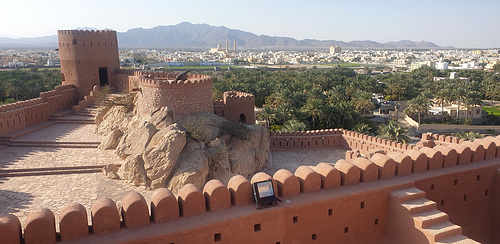
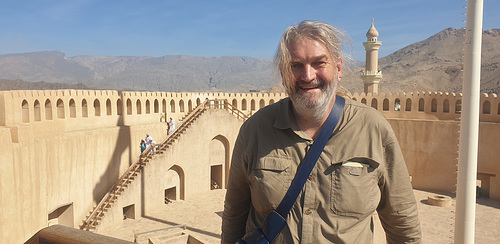
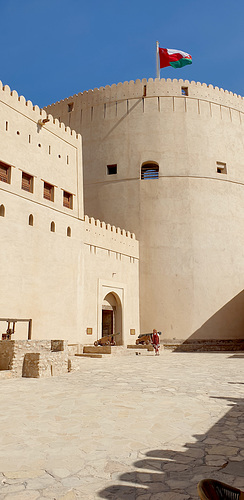
A Land of Castles and Forts, Mountains and Wadis, Deserts and Beaches


16 to 23 Jan, 2024 - Nakhal, Nizwa, Bahla, Jebel Shams, Al Ayn, Jabrin, Wadi Bani Khalid, Al Ayjah, Sur, Wadi Shab, Muscat - (Oman)


All too quickly, another trip is coming to a close, and another "final" blog entry is written. This one covers the time in the main part of Oman.

We opted to spend a bit more for the hire car for this part of the trip, getting a vehicle with 4WD capability. Not 100% sure of needing it, I was hesitant to spend the extra. We had no intention of visiting the deep desert sands, so we knew a true 4x4 would not be necessary, but since we were doing some areas with notorious unmade roads, including steep climbs, we felt obliged to dig deeper and cover ourselves. Now, after returning the car and assessing, the short number of kilometres we drove where it was useful would have been successfully driven in a regular car. Not easily nor comfortably, but possible. You know what they say about hindsight.

We have been observing a local custom. I would be surprised if it was just Omani, but we really don't know if this happens in neighbouring countries. When dining out, we watched the "take away ritual". This involved a customer driving up outside the restaurant and tooting their horn. Someone from the restaurant would then attend to that car. If not quickly, then the little friendly toot is repeated, perhaps as a more pertinent honk. So, the waiter, owner, or maybe one of their children, goes to the most recently arrived vehicle. Sometimes they would be required to run back in to the establishment and return with a menu. Order is taken from the vehicle occupants, which may be just the driver, or may be the whole family. Eventually, a bag or more of food is taken out, and the car leaves. Occasionally it seems the order has been pre-placed, or the driver has left and come back, but this does not appear to be the normal way. While waiting, bored children climb out of car windows or through open sunroofs to entertain themselves. There is often a need for the waiting cars to shuffle around, as they may be double or triple parked.

Jo and I had the idea of suggesting roller skates to these waitstaff, but the stairs and dirt and rocks would probably make implementation of that idea quite treacherous.

South-west we left from Muscat airport. Across the plains for the first half day, before abruptly encountering the mountains, climbing and winding over the next days, eventually nearing Oman's highest point of around 3,000 metres. It was cool at night, there, dropping to around 7 degress.

Nakhal Fort
Nakhal Fort
19th century fort, overlooking the local date plantations.


Inside Nizwa Fort
Inside Nizwa Fort
Inside the inner fortifications of Nizwa Fort. This is a 17th century fort, the inner stronghold of a much larger castle. Entrance to the fort was protected with multiple secret trap doors and pitfalls, reinforced doors where boiling date oil could be poured on enemy attackers, and many other impressive defensive components.


Nizwa Fort's Destinctive Tower
At 40m high, it would make quite the formidable task for any army of that day to consider.


Bahla Fort
Bahla Fort
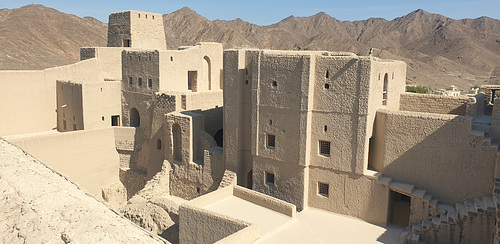
One of the largest forts in Oman. Rooms here were generally left empty and unlabelled, allowing the visitor to be creative and hypothesise as one scrambled in and out and around the multitude rooms and the Escher like stairways.


Bahla Fort Interior
Bahla Fort Interior
Built and modified over the 12th to 15th centuries. The mud-brick walls, as well as the architecture and layout, looked and felt quite different to the other forts we have visited so far in Oman. Not less refined, but they certainly did not feel as evolved.


Wadi Ghul Viewpoint
Wadi Ghul Viewpoint
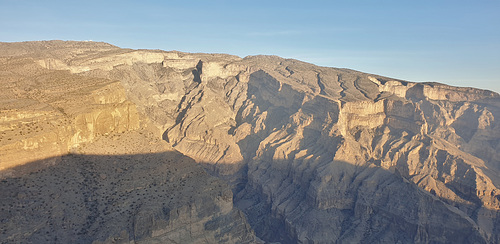
Looking down in to Wadi Ghul from the top of Jebel Shams. This canyon is often called the "Grand Canyon of Oman", and a deserved title it is indeed.


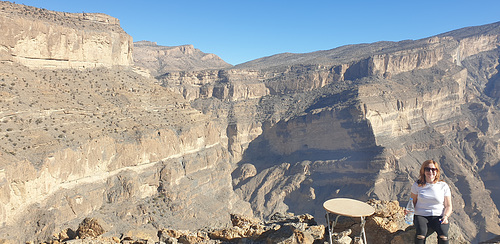
A Stop on the Balcony Walk
The balcony walk is a 5-6 km trail that runs in to Wadi Ghul. It is reasonably level, and although narrow in parts, never precipitous. Doing it in the morning meant we basically were in the sun for the majority. This lookout point seems to occasionally operate as a cafe, with two tables, although there was nobody when we came through. It is reasonably near the end (or start, depending whether you need a break early).


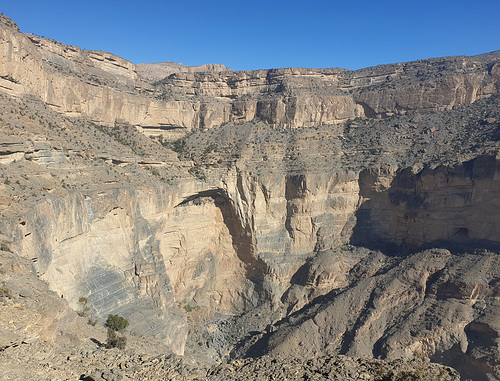
Another View From the Balcony Walk
Deep in Wadi Ghul, Oman's Grand Canyon.


Then east, rapidly loosing altitude, till it was a pleasant 27 degrees by the coast. Circling back to the north, we finished with a coupld of days in Muscat.

Beehive Tombs, Al Ayn
Some of the beehive tombs of Al Ayn, lined along a ridge. Dotted at various sites in the area, they are believed to be between 4000 and 5000 years old.


Inside Jabrin Castle
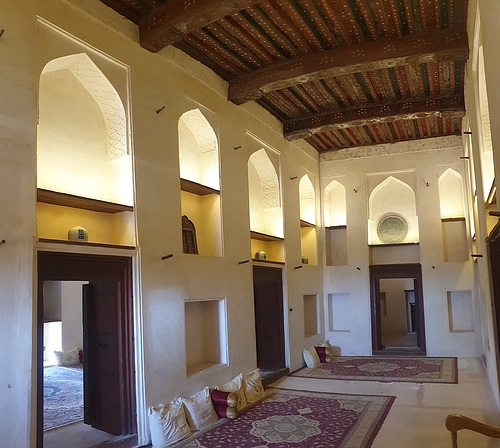
We both felt that Jabrin Castle was our favourite in Oman. The size and layout made for an excellent visit, and a good quantity of information. The furnished rooms, just lovely, and the painted ceilings are especially noteworthy.


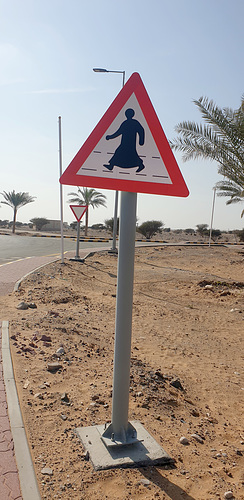
Culturally Appropriate Signage

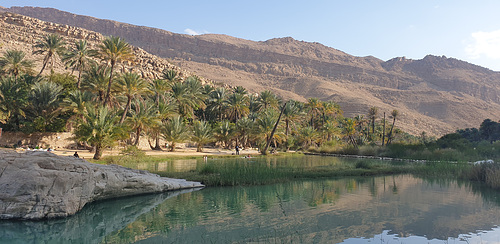
By the Lake, Wadi Bani Khalid
I had read about this location, but when it featured on the plane in Oman Air's in-flight safety video, I was inspired to upgrade it from "maybe" to "must do".


Chai by the Water
Chai by the Water
Although not visible in the shot, in this lake, and further upstream, families swam and played. It was joyful, listening to the chatter and laughter, children squealing with delight, adults calling and joking.

We didn't swim. Just drank chai and absorbed the atmosphere.


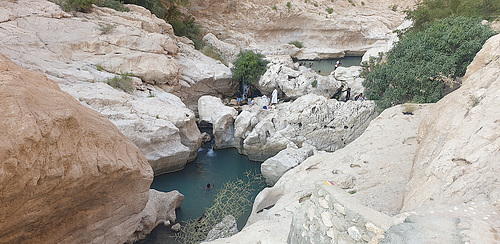
Deeper in Wadi Bani Khalid
Further up the wadi, the rock pools of various sizes were also inhabited by paddlers and swimmers.


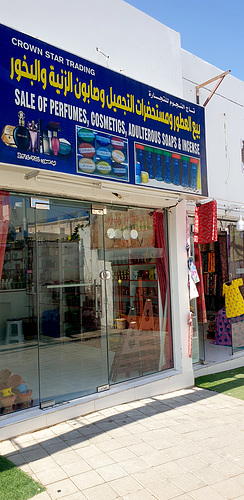
Hmm, Adulterous Soap
A shop sign in the ladies souk in Sur.


Wadi Shab
Wadi Shab
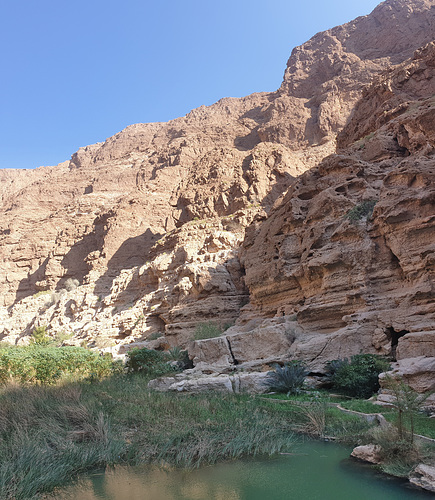
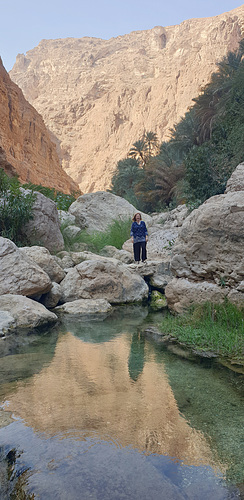
Getting close to Muscat, we visited Wadi Shab. It seemed to be the most touristy place we have been in Oman, with many nationalities seemingly represented amongst those heading up. First, there was a boat trip across a smal "lake" from the car park, then on foot, past ancient water channels that are still maintained, modified, and important.


On our Walk, Wadi Shab

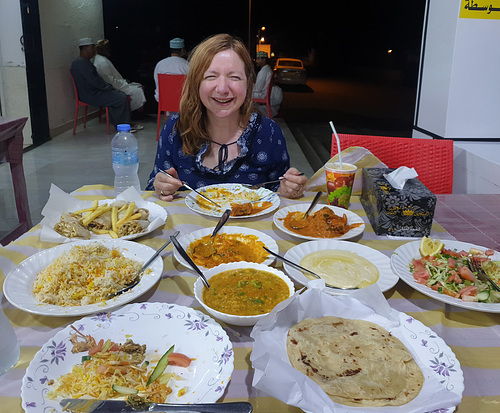
We Ordered Too Much
We Ordered Too Much
So, we knew we were ordering more than we needed. We forgot they would automatically give the rice, salad, pita, dahl, and hummus.

The prawn masala was excellent, but the chicken nashif was out of this world.


Old Muscat Gate
Unusually, Old Muscat is not at the heart of Muscat city. What tends to happen, is the historic heart remains the heart of the city, to some degree or another. A new centre may spring up, but the new city surrounds and engulfs the old city.

Muscat, though, has its new city along the coast. Kind of bumped against the old city, but then sprawled out away from it for the next 20 or more kilometres.


Uzbek Serenity


26 Sep to 2 Oct, 2022 - Samarkand, Shakhrisabz, Termez - (Uzbekistan)


As a visitor lacking any common language with the locals, there are certain vulnerabilities. One that we are especially wary of is overcharging. While this can happen even when you can converse, using misunderstandings is a common tactic to squeeze you for more money. In the end, the misunderstanding may have been genuine and we never want someone else to miss what they are due if the communication failure has occurred.

On this trip, we have never felt unsafe. We have seen multiple examples of honesty and good will. We have bargained for purchases, and regardless of whether we agree on a price or not, have always parted on good terms with smiles.

We had one taxi driver try to decline our tip, wanting to round down instead because he didn't have the correct change. I observed a customer and waitress arguing over money, trying to push some cash in to each other's hands. Every deal we struck was honoured and completed unbegrudgingly.

Heading west from Tashkent to Samarkand, we took the train. Our intention was to take the high speed service, but only one day before, most services were full, and ended up on a leg if a much longer sleeper service.

Four days was a nice amount of time for this fascinating city. Unhurried visits to the main sights, some shopping, and plenty of time to linger over meals or cay (chai).

One day, after visiting the museum of the ancient city ruins, we decided to shortcut back to the new town, only to find ourselves clambering down the remains of the old city walls, ending up wedged between them, the cemetery, an express way, and a drainage channel.


Registan, at Night
Registan, at Night
Sublime and dignified. The three madrasahs which now make up the Registan in Samarkand, Uzbekistan. Although the name, in reality, relates to the square which these buildings were built around, it has now become synonymous with the buildings themselves.


Registan, Disneyfied
There are numerous criticisms in books and on websites about the "Disneyfication" that is occurring to various monuments in Uzbekistan. This was not as bad as we expected (and not as bad as this photo might suggest). There was stirring music, culturally appropriate and not too loud, while the lights changed colour and "danced" along the rows of arches. That said, although I didn't reel in horror or disgust, I don't know if it added anything to our enjoyment. On other evenings, when it was simply lit, the subtle details were more prominent, and the overall feel was certainly more dignified.


Registan by Day
Registan by Day
Staying in Samarkand for four nights meant we had ample visits past this view. Some days, we crossed here multiple times. It was wonderful to enjoy the changing moods of the shifting shadows.


Repairing a Leaning Tower
Well, if you go back to our other photos, you will see there are some leans. From some places in the grounds, you struggle to see anything that looks perfectly vertical. However, seeing this photo from the 1930s made us appreciate that, in comparison, we can probably call the current angles as "near enough".


Ceiling Selfie, Registan
In Tilla-Kari Madrasah, the "Gold Covered" Madrasah. This is the middle madrasah in the Registan. The ceiling is a beautiful kaleidoscope, and standing in the middle staring up, one starts to lose orientation of up and down…


While the Ragistan is king of tourist sights in Samarkand, it is not alone. There is a lot more to this city than most first realise.


Gur-e-Amir Mausoleum, Samarkand
Another highlight sight of Samarkand. This Mausoleum contains, amongst others, the remains of Timur. He is often described as a tyrant, after ransacking his way through much of the reachable world, from norther India through to Iran. Much of the plunder, though, returned to this part of the world, including craftspeople. So he is also remembered as a builder and developer. In this mausoleum is also the remains of a couple of sons and grandsons, including ruler, astronomer, mathematician Ulug-Beg.


Mausoleum of Qusam-ibn-Abbas
A cousin of the prophet Mohammed, credited with bringing Islam to this part of the world in the 7th century. The shrine grew and was modified over the year, and in the 14th and 15th centuries, many magnificent mausoleums were built in the area.


Magnificent Wood Carved Doors
The mausoleums doors were also worth keeping an eye on, as they contained incredible craftsmanship, too.


Shah-i-Zinda
Shah-i-Zinda
These are some of the oldest mausoleums in Shah-i-Zinda, and the tile work on them is beautiful. Apparently, much of the tiling is original, and restoration on these was quite minimal, testament to the quality of the workmanship.


On the Avenue of Mausoleums
Shah-i-Zinda is like a little street lined with mausoleums. Here we can see some of the work in detail, including where it has curved to create shape and form as well as texture and colour. Looking past the tiles, the Octagonal Mausoleum can be seen, unusual in that it is open sided.


Inner Details, the Octagonal Mausoleum

A Fine Breakfast Spread
OK, it was not just for the two of us, but the array of foods meant we did not start any of our days hungry. On top of these dishes, we were given a small bowl of porridge, a fried egg, and a sausage. No complaints from us.


Russian Jeep for Sale
It hardly ever rains around here, so the lack of a roof seems hardly an issue.


No Translation Needed
A picture might be worth a thousand words. This one is worth one word. A very important word.


Bibi-Khanym Mosque
Bibi-Khanym Mosque
When built, in the 14th century, it was possibly the largest mosque in the world. Can you see Jo in the foreground? It is not possible to go inside, with the main dome still unrepaired after a 19th century earthquake. Peering through the doors and windows, giant cracks in the walls and ceiling make the structure look very vulnerable. Outside, though, that sense is lost, and the colossal facade is humbling. The historians, though, record that the building was done so quickly, and the engineering was stretching the limits so much, that cracks started appearing even before the works were complete. It's no wonder, then, that some movements in tectonic plates might cause the whole endeavour to appear precarious.


Recently Refurbished Hazrat-Hizr
Certainly much humbler in size, the nearby Hazrat-Hizr Mosque in Samarkand presents an extremely colourful ceiling.


Heading south from Samarkand, we found ourselves progressively further and further from the trodden tourist path. Most foreigners don't make it to Shakrisabz, and in Termez on the border of Afghanistan, we saw one person who was definitely not local.


There was a Piece of Rope
A car we passed on the way south in Uzbekistan. Loading your car in this way is probably not legal in many countries, but it looked surprisingly sturdy, even though there only appeared to be one piece of rope running over the top. Looks like he may have done this before.


Ak-Saray Palace, Shakhrisabz
All that remains of Timur's Ak-Saray Palace. the two sides of the entrance portal. This must have been impressive before it was destroyed - you can see it only gets to where the arch would have begun.


Cay (Chai) in a Converted Caravansary


Using online translation is getting better, rapidly, but is a tool we try to avoid unless it is important or getting awkward. Locals generally seem to have one installed, and are quicker to resort to using that than we are. Whike it takes out some of the fun and challenge, it introduces a new game. What did they think they were saying or asking? Negotiating a taxi, just this morning, while waving fingers in the air and trying to clarify for how many and how far, a phone was thrust in front of me. The English translation displayed said "Uzbek serenity." My perplexed expression did not seem to deter him as he pointed insistently at the screen. Yesterday, at the hotel comparing different options, the manager used his phone to ask Jo a puzzling question, "Can I paint the room now?"

Termez, in southern Uzbekistan, the border of Afghanistan. The drive down here was flanked by landscape that perfectly reflected what I expect Afghan landscapes to be. Pretty broad and dry, with rocky hills and outcrops. Goatherds riding donkeys or walking, surrounded by scores of black woolly goats. When we got to the city, it was enveloped in a cloud of dust, limiting visibility and filling our eyes, noses, and lungs with grit. Thankfully it settled after a few hours, but it did not feel out of character for where we were.

As we were leaving from the bus station, before getting in to our vehicle, a police officer approached us and asked to see our pasdports. I took them and accompanied this officer to a small, slightly terrifying room reminiscent of many a movie scene. It had a table with one chair, which he took, and another chair in the middle of the room. Bare concrete walls, and nothing else in the room, except an exercise book and pen. Thankfully there was a window, and my concern would have been greater had he closed the door and told me to sit. He smiled, haphazardly copied some details from our documents in to the unformatted and messy pages of his book, took a photo of the entry stamps, and sent me on my way.