Current Travels

Showing posts with label forts. Show all posts

Capital da Alegria - Salvador


23 to 26 Feb, 2026 - Salvador - (Brazil)


Brazil's "Capital of Happness". Salvador has a unique identity, even within Brazil. It is a city of rhythm and colour. It is vibrant and, at the same time, relaxed. It has a legendery spirit, forged out of Afro-Brazilian roots. It is uplifting. It is spiritual.

Google returned the following about Bahia. "Sem pressa, olha para o céu, fala com Deus, você tá na Bahia". A local saying that translates to "No rush, look at the sky, talk to God, you're in Bahia".
Local specialities were consumed, and on our balcony we were entertained by drummers in the streets. We drank caiparinhas in praças, and beers with sea views. Museums educated us. Churches encouraged soulful contemplation. We got happily lost in a labrynth of lanes lined with pastel, eventually stumbling back out in to familiar largos with distinctive grand edifices from bygone eras.


The Curves of Bahia
The Curves of Bahia
Coming in to Salvador.


Our First Salvador Meal, Moqueca
Moqueca is a local seafood stew. A perfect gastronomical fusion of Indigenous, African, and Portuguese influences.

Options are prawns and seafood, fish, or a mixed version, with veggies, spices and coconut milk. Perhaps the secret is the Dende palm oil, described as bringing a nutty flavour?

Or maybe the secret is not in the ingredients. Perhaps if we are ever going to authentically reproduce it we might need to get a genuine Salvador hand made clay pot.
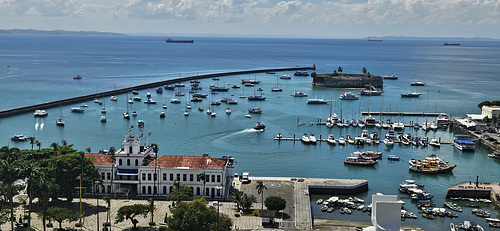

The Belly Button of Bahia
Forte de São Marcelo, with a catchy little nickname from it's unusual donut shape.


No, Jo, it will Never Fit
Yes, I do realise we could finally fit all our spices in.

An apothecary cabinet in Museu da Misericórdia, the Muesum of Mercy.


Natural Ventilation
Natural Ventilation
Once upon a time, staying cool was more about clever design than mechanics. It's a bonus that the arches make fantastic frames for the spectacular views.


Elevador Lacerda Behind Me
The Art Deco appearance was a result of 1930s renovations. The concept and underlying structure date back another 60 or 70 years before that, to the latter 19th century, when it was opened as the world's first public elevator.


Unmistakable Salvador
The lighthouse sits inside an old fort, Santo Antônio da Barra. The black and white stripes alone seem to be what makes this so iconic for Salvador. A fantastic nautical museum is now housed in the fort itself, with a good sized (read "not too much") amount of items on display.


Mmmm, Blue Drinks
Mmmm, Blue Drinks
To be honest, I don't remember what the drinks were marketed as. It's not the drinks we need to remember. The meals were great, simple meals that felt more like they came from a home kitchen, but it's not those either.

The photo is here for us to remember the trouble we had finding somewhere to enjoy the sunset after scurrying through an increasingly emptying market. Feeling dodgier at every turn, we were convinced there must be somewhere on the seaward side to sit and drink and eat.

And almost everything was closed. Almost. One stalwart little eatery right on the water's edge, complete with views of the sunset and islands. Drinks, food, and our fingers on the ferry pulse of Salvador. That is what we want to remember.


Largo do Pelourinho
Largo do Pelourinho
We stayed right on this square, which actually is more of a triangle. It's beautiful, at many times noisily filled with drummers, but an early start gets some photos before the tourists pile in.

While it is one of the jewels of Salvador for its wonderful architecture, the somber fact is there in the name. Pelourinho means pillory, or whipping post. This was once the place of public punishment.
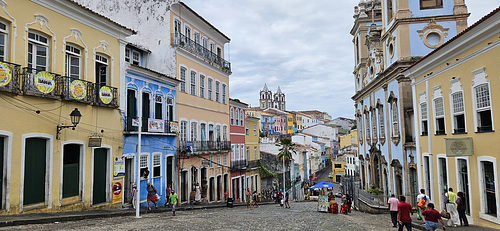

A Point on a Triangular Square
A distinctive Afro-Brazilian church on the square. A strong symbol for the community, it was built by slaves for themselves, but not under instruction. They chose to build this, during their small amounts of free time, taking nearly a century to complete.


Continuing North
Continuing North
More buildings to admire as we wandered the streets of Salvador.


Rua Direita de Santo Antônio
Santo Antônio Além do Carmo is a district of particular note, feeling less cluttered with tourists. Although there are numerous art studios and galleries, as well as bars and restaurants, the general vibe was more down to earth. It felt like the neighbourhood locals head to. Built on a winding ridge heading north of the centre, most of the buildings on the west would enjoy amazing sea views, with incredible sunsets I'm sure.


The Emirates - All of Them


30 Dec, 2025 to 9 Jan, 2026 - Dubai, Al Ain, Maleha, Al Nahwa, Madha, Fujarah, Ras Al Khaimah, Al Jazeera Al Hamra, Umm Al Quwain, Ajman, Sharjah - (UAE)


Sure, Dubai looks like an amazing place to visit. Everything to the max and on steroids. Amazingly, we have only flown via Dubai once, and did not leave the airport, so the city has lurked on our travel radar. However, our travel tastes have matured to look for the depths beyond the obvious, the oddities and unusual. OK, so our 10 days is still a short time to scratch much beneath the surface for seven Emirates, but we did our best.

Knowing that we were going to be in Dubai, we jigged the flights and plans a bit to ensure that we could be there for the New Years Eve celebrations. We rightly summised that there might be some celebrations put on.


Waiting for Fireworks
Jo looks up at the worlds tallest building.

We camped out for a good portion of the day, staking out a little patch for watching the NYE show. Being a public thoroughfare, the police came along and asked everyone to stand, and we dutifully obeyed. Equally, as people sat on the ground again, we joined them. We were endeavouring to add weight to the protest against the meaningless requests. Eventually, authorities gave up, when the crowd was large, the majority with their behinds on the ground.

We had certainly secured an excellent free vantage point, but perhaps we did not need to be quite so early. It was a long wait.


CLICK FOR VIDEO
Worth the Wait
CLICK FOR VIDEO


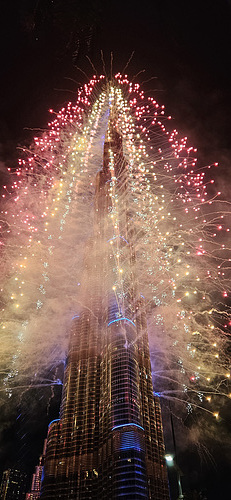
Assumption: nobody was disappointed. We were blown away, having never experienced fireworks like this. Somewhere between 10 and 15 minutes, augmented with lasers and drones.

One Moment of "Burj Khalifa" fireworks.
Paid vantage points were pricey, We may have had a long wait, but it was free.


Old Dubai
Old Dubai
There appears to be a bit of a revival in interest in "Old Dubai", and now there are some areas that feel a bit manufactured and lack authenticity. However, some pockets feel nicely restored and genuine, paying legitimate homage to what Dubai may once have been.

We spent a few nights in a gorgeous little boutique accommodation in Al Fahidi, allowing us to wend and wind through the old streets and markets after the majority of tourists had made their way back to their new town hotels.


Dubai Frame
Dubai Frame
Ascending to the top of the frame was not in the agenda. Although at 150 metres it did promise grand views, we found the concept and construction more interesting in its own right.


Museum of the Future
A striking asymmetrical elliptical torus building, decorated with Arabic calligraphy with quotes about innovation and progress. The calligraphy also serves as windows. Inside, one does not really get a sense of how the building is shaped around you. The museum is certainly ranked amongst Dubai's iconic structures.


Camels Form a Caravan up the Burj
One of our favourite moments during the light show spectacular.


CLICK FOR VIDEO
Enjoy a Small Excerpt from Burj Khalifa Fountain and Light Show
CLICK FOR VIDEO


The story of how we ended up at a prime viewing spot for an unexpected Burj fountain and light spectacular is for another time. Perhaps in person.

The long and the short is that we had no idea at all there were special performances were scheduled. A fountain show, even a highly rated one, would be some water squirting in time to music, accompanied by some lasers on the actual Burj Khalifa.

Suddenly, in spite of, or almost because of, our lack of knowledge of the evening's program, we were in a prime spot. From here we witnessed a 25 minute plus performance. Live dancers and musicians, fire, drones, lights and projections, lasers, and of course, fountains. Perfectly choreographed to a score we got a Dubai story.

Light Projections on the Fountains


Al Ain won when we chose somewhere in Abu Dhabi. The actual city of Abu Dhabi will just have to wait until we return another time. Al Ain was a perfect size for our timing, the beautiful oasis and smattering of interesting sights were the ideal counter-balance to everything we had done and seen in Dubail. A place that was important when water was more valuable than oil.


Beehive Tombs near Al Ain
Bronze Age structures nestled in the foothills just out of Al Ain in Abu Dhabi.


Oasis
Oasis
Tens of thousands of date palms form the basis of the Al Ain oasis. Underground irrigation feeds the palms, and hundreds of other plant varieties, in what is considered the oldest oasis in the Emirates. Parts of the irrigation system are 3,000 years old.

Shaded paths meander through and it was a pleasant place to pass a few hours of the day.


Al Jahili Fort
Al Jahili Fort
A nineteenth century mud brick fort in Al Ain, originally both residential and strategic in nature. The palm oasis was a valuable asset, and there are a number of defensive structures dotted in its vicinity.


Our next night was to be in Fujairah city, capital of the Fujairah Emirate. However, another geographic and political anomaly was to divert us from driving directly there.

Ridge Towers, Al Nahwa
The day I learnt about the Al Nahwa counter enclave, it was added to my list of unique and weird places in the world to visit.

Madha is an Omani enclave, entirely in the UAE. Al Nahwa is a UAE, more specifically Sharjah, counter enclave, entirely in Madha.

Really, it needs to be seen on a map to start the process of comprehension. Al Nahwa is the hole in the Madha donut on the UAE plate... or something like that.

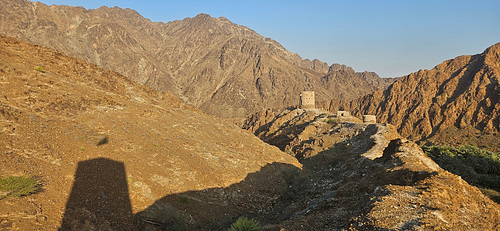
While in Al Nahwa, we ascended to this ridge with restored old watch towers.


High Above the City, 20 Metres above Sea Level


Back to the west of the Emirates, we spent a few days working our way down through Ras al-Khaimah, Umm al-Qaiwain, Ajman, and Sharjah. As always, we felt we could have spent longer, in almost each stop. Another week or two might have been ideal, but we do what we can with the times and schedules that we get.


Exploring Al Jazeera Al Hamra
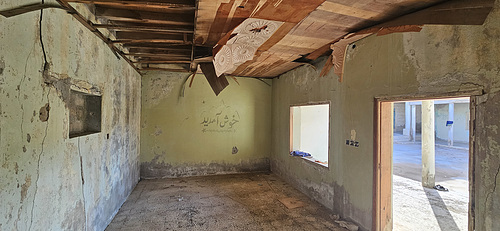
Red Island in English, Al Jazeera Al Hamra was once a thriving centre, one of the regions important pearling centres. With the introduction of cultured pearls, the town was unable to survive the down turned economy. Eventually, everyone left, and by the 1970s it was completely abandoned.

What remains has been largely pillaged. Anything of value or interest carted off long ago.

We spent a few hours clambering through the haunting shells of a once-was-life, creating stories in our head for the rooms with traces of decoration.


Exploring Al Jazeera Al Hamra
Of course, most of the abandoned buildings are houses and some shops. Wandering up and down the streets, we chose one every now and then with an architectural difference to enter and explore in more detail

The tree here is a Eucalyptus, widely planted in the area for its fast-growing shade.

Nothing says Posh Quite as Well as Towel Art

Dinner by the Lagoon
Umm Al Qwain is way less developed than its nearby relatives. The city has few towers, no hustle or bustle, and a vibe of taking it easy.

Celebrating our anniversary in a resort by the lagoon seemed perfect and appropriate.


Contemplating Art in Sharjah
Sharjah is home to a number of interesting and varied museums.

The art museum was a highlight. Having only a handful of pieces for each era kept the experience from feeling crowded or overwhelming. The mix of modern and contemporary pieces was an excellent taster.


A Bhutanese Phallus-cy


19 to 20 Sep, 2024 - Cheri Goempa, Pangri Zampa, Dochu La, Punakha, Sopsokha - (Bhutan)


The rules for visiting Bhutan are changing. Slowly. It's a two-edged sword thing. The SDF (Special Development Fee), although temporarily reduced in price, is still expesive. This helps encourage high value, low volume tourism, meaning they make more money from less visitors, and this in turn stops sights from being overcrowded and touristy. The additional requirements that you need a guide outside of Thimphu and Paro means that every traveller is actively engaging and employing locals who have chosen a career in tourism. So, while we obviously dislike handing over more money, we do like the low impact and sustainable result of these regulations.

Even the actual travelling would be near impossible without a driver and car. Accessible public transport, especially to places we'd like to visit, is pretty much non-existant. Some sites of particular note apparently refuse to let a foreigner in if their guide is not with them. Even in Thimphu, where guides are no longer needed, most visitors are already on their tour. Visiting top attractions there, we often encountered puzzled faces as officials pondered whether they were supposed to let us in or not, finally deciding that there did not really appear to be a reason to stop us.

So, even if we had our own way of getting about, we did not feel we could take a risk of travelling to a significant sight, only to be turned away.
As we neared the pass that separates Western Bhutan from Central Bhutan, we stopped at a roadside stall to try a local delicacy, chhurpi. This is a dried yak cheese, and it hangs outside the little booths on string, little white cubes actually looking palatable, almost tasty. As it turns out, we never realy got to taste them. They are hard. Very hard. Insanely hard. We may as well have put a stones in our mouths. After 40 minutes, we gave up. It was not going well, and then we were told 40 minutes was not enough time - this cheese can take hours to soften. Later, we met a lady who told us what she did as a little girl. She would put the cube in her mouth when she went to sleep, and by morning, it was soft enough to chew. Neither Jo, nor I, are that committed to the yak cheese.


Cheri Goemba
Cheri Goemba
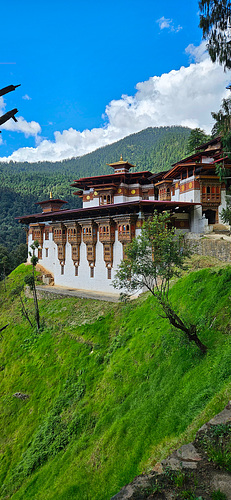
First established in 1620, this monastery north of Thimphu is reached by a 45 minute climb on a very pleasant forest track.


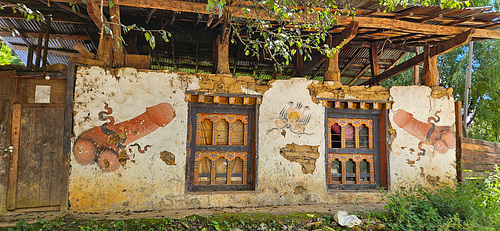
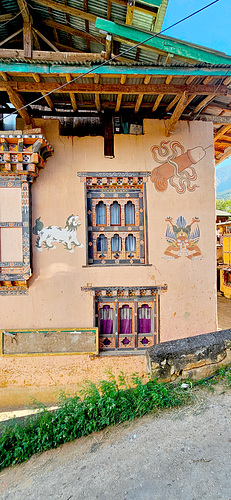
Penis Paintings, on a Seemingly Abandoned Home
Roadside, north of Thimphu, between places, really. The multiple phallus inclusion seemed excessive to our way of thinking.


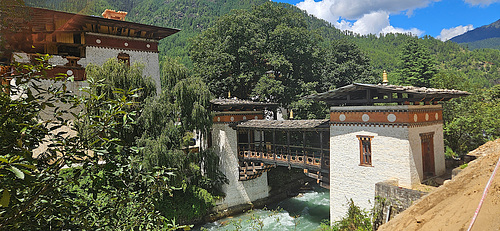
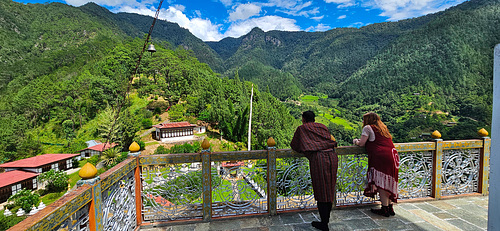
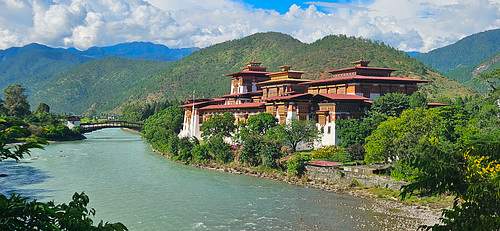
View to Pangri Zampa
A pleasant bridge (currently closed, unfortunately) leads over the river to Pangri Zampa.


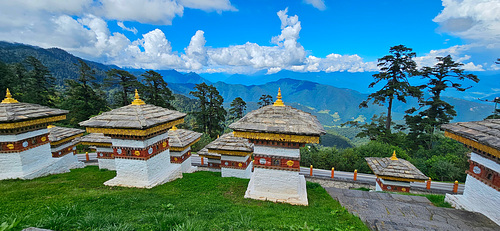
View from Dochu La
View from Dochu La
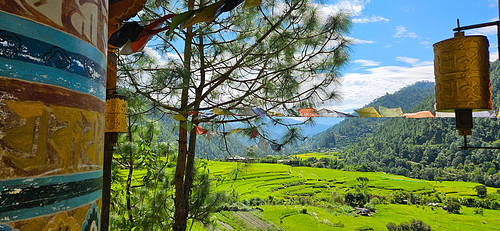
Dochu La is the high point of the pass between Thimphu and Punakha. Bhutan's highest peak is visible in the Himalayan vista.


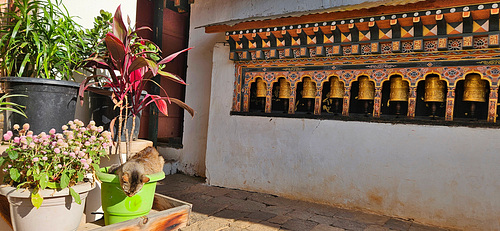
A Kitten Draped in a Pot Plant
Inside Chimi Lhakhang, the temple of the Divine Madman.


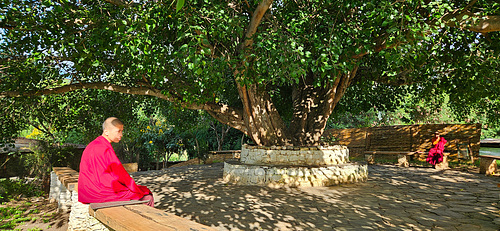
Morning Meditation
Morning Meditation
Beneath the bodhi tree. We came up to the temple early, to catch the atmosphere of individual meditation and group prayer.


Over the Rice Fields
Ascending to Khamsum Yulley Namgyal Chorten.


Jo and Sonam
Jo and Sonam


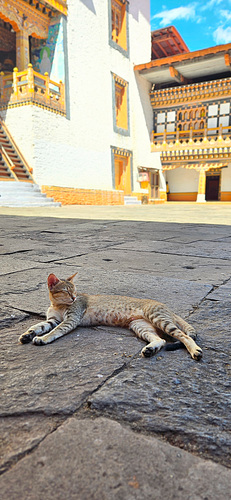
Cat Relaxation and Meditation
Inside Punakha Dzong.


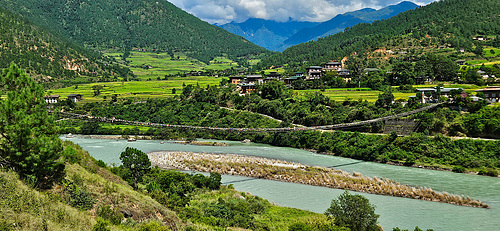
One of Bhutan's Longest Suspension Bridges
It felt stable, and due to not being high, did not require a lot of nerves to make it across.


The Obligatory Picture of Punakha Dzong


Protective Images, Sopsokha
Of course, again, it is the phallic image that makes this an unusual way to decorate one's house.


A Land of Castles and Forts, Mountains and Wadis, Deserts and Beaches


16 to 23 Jan, 2024 - Nakhal, Nizwa, Bahla, Jebel Shams, Al Ayn, Jabrin, Wadi Bani Khalid, Al Ayjah, Sur, Wadi Shab, Muscat - (Oman)


All too quickly, another trip is coming to a close, and another "final" blog entry is written. This one covers the time in the main part of Oman.

We opted to spend a bit more for the hire car for this part of the trip, getting a vehicle with 4WD capability. Not 100% sure of needing it, I was hesitant to spend the extra. We had no intention of visiting the deep desert sands, so we knew a true 4x4 would not be necessary, but since we were doing some areas with notorious unmade roads, including steep climbs, we felt obliged to dig deeper and cover ourselves. Now, after returning the car and assessing, the short number of kilometres we drove where it was useful would have been successfully driven in a regular car. Not easily nor comfortably, but possible. You know what they say about hindsight.

We have been observing a local custom. I would be surprised if it was just Omani, but we really don't know if this happens in neighbouring countries. When dining out, we watched the "take away ritual". This involved a customer driving up outside the restaurant and tooting their horn. Someone from the restaurant would then attend to that car. If not quickly, then the little friendly toot is repeated, perhaps as a more pertinent honk. So, the waiter, owner, or maybe one of their children, goes to the most recently arrived vehicle. Sometimes they would be required to run back in to the establishment and return with a menu. Order is taken from the vehicle occupants, which may be just the driver, or may be the whole family. Eventually, a bag or more of food is taken out, and the car leaves. Occasionally it seems the order has been pre-placed, or the driver has left and come back, but this does not appear to be the normal way. While waiting, bored children climb out of car windows or through open sunroofs to entertain themselves. There is often a need for the waiting cars to shuffle around, as they may be double or triple parked.

Jo and I had the idea of suggesting roller skates to these waitstaff, but the stairs and dirt and rocks would probably make implementation of that idea quite treacherous.

South-west we left from Muscat airport. Across the plains for the first half day, before abruptly encountering the mountains, climbing and winding over the next days, eventually nearing Oman's highest point of around 3,000 metres. It was cool at night, there, dropping to around 7 degress.

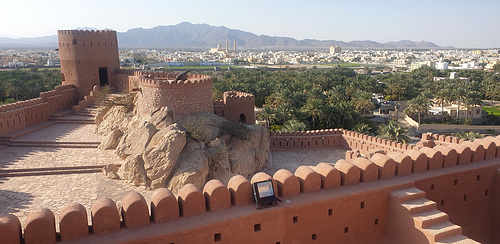
Nakhal Fort
Nakhal Fort
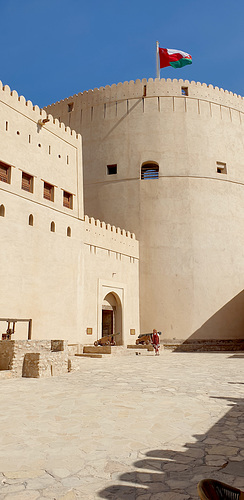
19th century fort, overlooking the local date plantations.


Inside Nizwa Fort
Inside Nizwa Fort
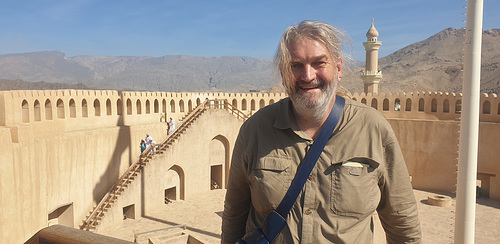
Inside the inner fortifications of Nizwa Fort. This is a 17th century fort, the inner stronghold of a much larger castle. Entrance to the fort was protected with multiple secret trap doors and pitfalls, reinforced doors where boiling date oil could be poured on enemy attackers, and many other impressive defensive components.


Nizwa Fort's Destinctive Tower
At 40m high, it would make quite the formidable task for any army of that day to consider.


Bahla Fort
Bahla Fort
One of the largest forts in Oman. Rooms here were generally left empty and unlabelled, allowing the visitor to be creative and hypothesise as one scrambled in and out and around the multitude rooms and the Escher like stairways.


Bahla Fort Interior
Bahla Fort Interior
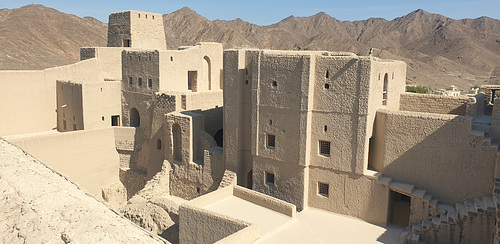
Built and modified over the 12th to 15th centuries. The mud-brick walls, as well as the architecture and layout, looked and felt quite different to the other forts we have visited so far in Oman. Not less refined, but they certainly did not feel as evolved.


Wadi Ghul Viewpoint
Wadi Ghul Viewpoint
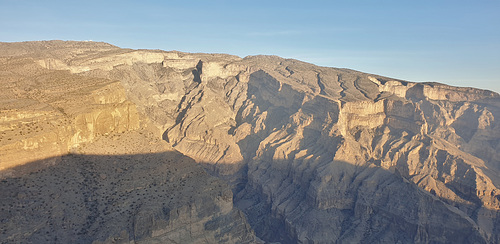
Looking down in to Wadi Ghul from the top of Jebel Shams. This canyon is often called the "Grand Canyon of Oman", and a deserved title it is indeed.


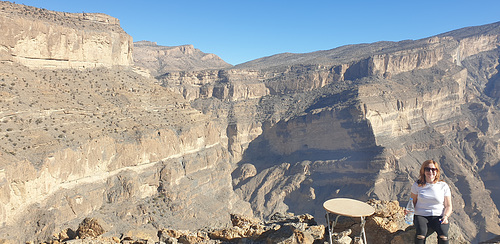
A Stop on the Balcony Walk
The balcony walk is a 5-6 km trail that runs in to Wadi Ghul. It is reasonably level, and although narrow in parts, never precipitous. Doing it in the morning meant we basically were in the sun for the majority. This lookout point seems to occasionally operate as a cafe, with two tables, although there was nobody when we came through. It is reasonably near the end (or start, depending whether you need a break early).


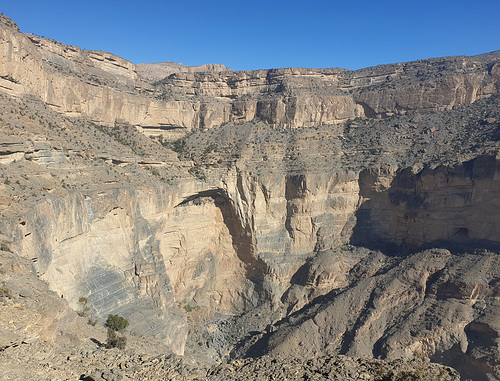
Another View From the Balcony Walk
Deep in Wadi Ghul, Oman's Grand Canyon.


Then east, rapidly loosing altitude, till it was a pleasant 27 degrees by the coast. Circling back to the north, we finished with a coupld of days in Muscat.

Beehive Tombs, Al Ayn
Some of the beehive tombs of Al Ayn, lined along a ridge. Dotted at various sites in the area, they are believed to be between 4000 and 5000 years old.


Inside Jabrin Castle
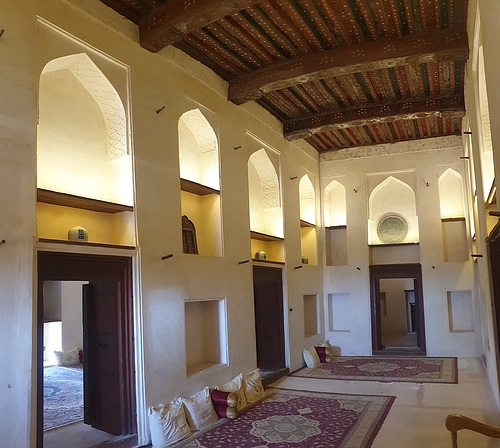
We both felt that Jabrin Castle was our favourite in Oman. The size and layout made for an excellent visit, and a good quantity of information. The furnished rooms, just lovely, and the painted ceilings are especially noteworthy.


Culturally Appropriate Signage

By the Lake, Wadi Bani Khalid
I had read about this location, but when it featured on the plane in Oman Air's in-flight safety video, I was inspired to upgrade it from "maybe" to "must do".


Chai by the Water
Chai by the Water
Although not visible in the shot, in this lake, and further upstream, families swam and played. It was joyful, listening to the chatter and laughter, children squealing with delight, adults calling and joking.

We didn't swim. Just drank chai and absorbed the atmosphere.


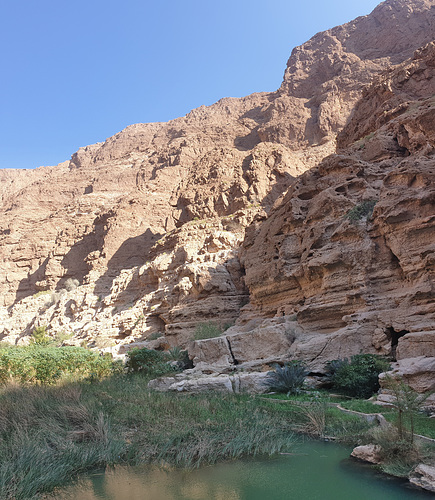
Deeper in Wadi Bani Khalid
Further up the wadi, the rock pools of various sizes were also inhabited by paddlers and swimmers.


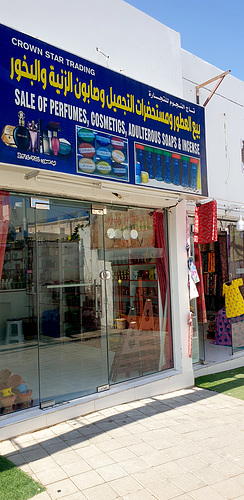
Hmm, Adulterous Soap
A shop sign in the ladies souk in Sur.


Wadi Shab
Wadi Shab
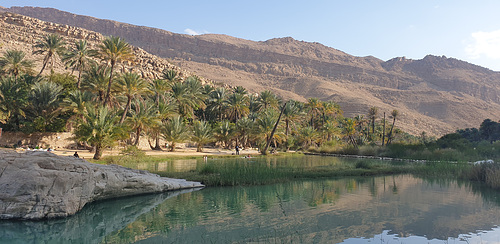
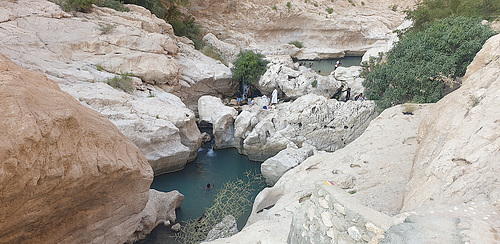
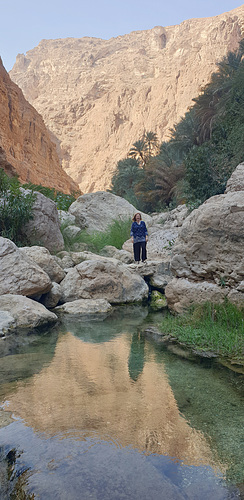
Getting close to Muscat, we visited Wadi Shab. It seemed to be the most touristy place we have been in Oman, with many nationalities seemingly represented amongst those heading up. First, there was a boat trip across a smal "lake" from the car park, then on foot, past ancient water channels that are still maintained, modified, and important.


On our Walk, Wadi Shab

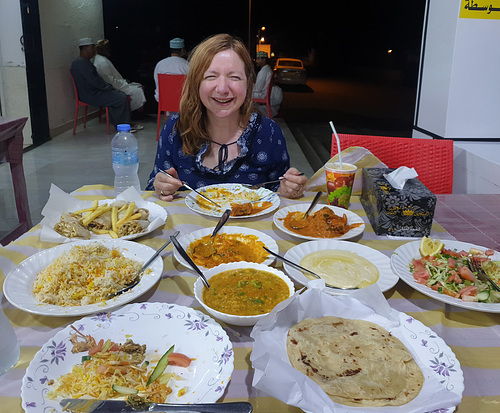
We Ordered Too Much
We Ordered Too Much
So, we knew we were ordering more than we needed. We forgot they would automatically give the rice, salad, pita, dahl, and hummus.

The prawn masala was excellent, but the chicken nashif was out of this world.


Old Muscat Gate
Unusually, Old Muscat is not at the heart of Muscat city. What tends to happen, is the historic heart remains the heart of the city, to some degree or another. A new centre may spring up, but the new city surrounds and engulfs the old city.

Muscat, though, has its new city along the coast. Kind of bumped against the old city, but then sprawled out away from it for the next 20 or more kilometres.