Current Travels

Showing posts with label animals: farm. Show all posts

A Remote Trip Across Mangistau


11 Sep to 16 Sep, 2022 - Aktau, Kampasay, Shopak Ata, Torish, Kokala, Sherkala, Airakty, Shetpe, Tuzbair, Beket Ata, Bozzhira, Mount Bokty, Kyzylkup, Shopan Ata - (Kazakhstan)


Our well selected flight from Almaty to Aktau, in the west, was delayed. We did not receive notification of this, but I discovered it when I went to check in. So, instead of a lovely evening flight, we had another shocking middle of the night trip. Checking in, my hand luggage caused a bit of consternation. Three or four times they passed the bag through the scanner. Each time, they asked if there was a pocket knife or similar. No, I replied, knowing that I had put my pocket knife in the main luggage. Eventually, triumphantly, they pulled out a corkscrew from my bag, which I had totally forgotten about. They let me keep it, and reminded me to put it in the checked bags next time, but I am curious how it got through (twice) when we checked in and began this trip in Rome.

We had read a number of times that travelling to the west Kazakh natural sights can be difficult, and almost dangerous, if you don't know where you are going. Unsigned tracks across the steppes, around the farms, and through the camels mean that having a competent and experienced driver is a must. After twenty minutes of our three day trip, we were comfortable we had done the right thing by booking a car and guide.

Day one was the most crowded with stops. The sights were relatively close together, but the total time bouncing around was still significant. We were keen to see both the natural wonders, and the important pilgrimage cave mosques.

Kampasay, Mangistau region of Kazakhstan
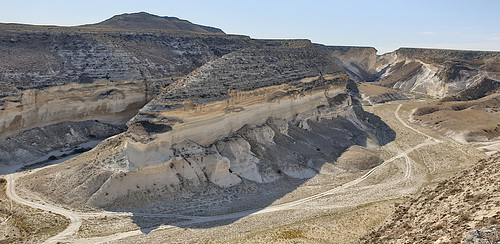
A dusty pot-holed track across the steppe appeared to be taking us nowhere. After a while, a rift in the landscape appeared, and afforded us a view of Kampasay. Only just visible in the picture, behind the layered rock formation, there is an oasis.
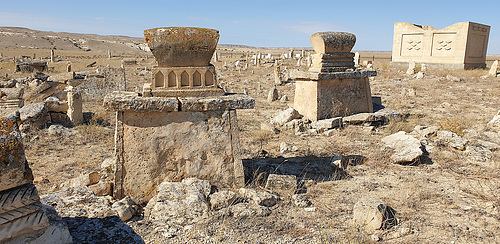

Graves Near Shokpak Ata
Shokpak Ata is a holy site in western Kazakhstan. For about a millennium, faithful have buried loved ones nearby. Some graves date from the 10th and 11th centuries, and newer ones are from the latter 1900s. Since the site is now a protected zone, new burials are no longer allowed. Only in (comparatively) recent years have dates or names been included on graves. So it is clues like style which help age the grave sites. These, we were told, are likely to be 16th or 17th century.


Approach to Shokpak Ata
Shokpak Ata is a cave mosque, where a Sufi monk lived and taught over 1000 years ago. Shokpak was the name given to him because of his legendary ability to create fire by snapping his fingers. Shokpak is the local word for the sound of two rocks striking a spark.
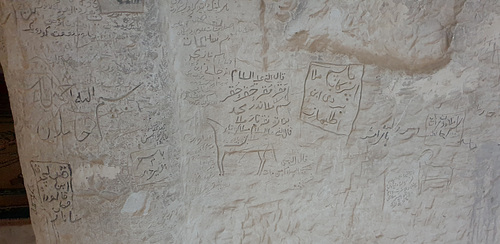

Etched Wishes and Prayers
The age of these requests are unknown, scratched in to the walls of Shokpak Ata cave mosque.
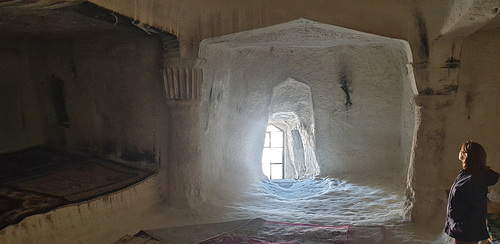

Inside Shokpak Ata in west Kazakhstan
The glass at the entrance is a twentieth century addition to protect the cave, but other than that it is just a natural cave which has been enlarged and shaped. Inside, no man made items exist other than a few beautiful hand made carpets.
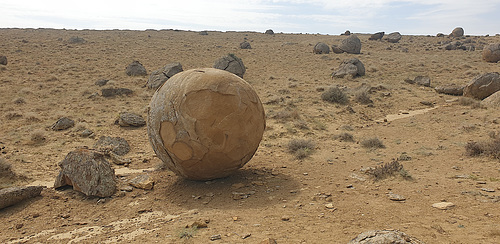

Rock Ball, Torish
Rock Ball, Torish
We were, of course, curious about the science of these balls, which litter the landscape for a strip of a few hundred metres. The shell fossils everywhere attest that almost the entire region was once the floor of the ocean. At that time, molten lava from an underwater volcanic eruption was broken in to blobs which were rolled around on the seabed as they cooled and hardened. Apparently, here at Torish, west Kazakhstan, is one of only two places where this is known to have happened. Eggs, toirtoises, muffins - these were the descriptors we used when pointing the different rocks out to each other. Only a small number were this spherical, but these "giant's marbles" were the most engaging. Most were cracked, and many were split into parts. Millennia of freezing and heating taking its toll. Some showed layers, like rings on a tree. Others peeled a "shell" off, like a boiled egg.
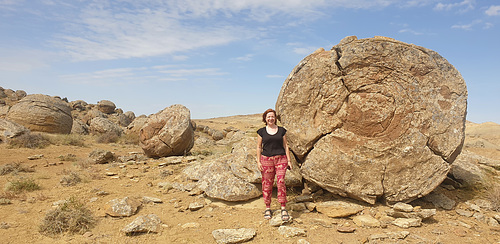

Jo, for Scale
Jo, for Scale
Here, she is a prop, so you can gauge the size of the Torish rock balls. This one is split quite cleanly, and shows off some of the layering.


Losing Myself in the Madness
Balls, part balls, peeled off layers, and distorted shapes. It all seems to be happening.
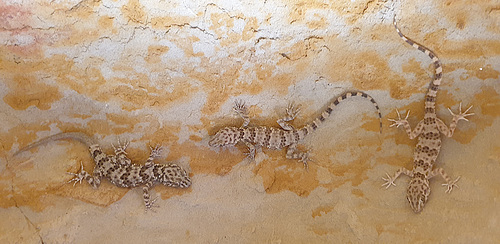

Cave Lizards
Cave Lizards
We were shown a cave, with a simple wooden door and a rug. A shelter if conditions should make it necessary to stay put. A score or more of these fat lizards were enjoying the cool conditions inside.


Kokala
Kokala
According to Nur, the rate of erosion here is so high, this entire site may disappear in the next seventy years. No real rock, just layers of coloured soil. Iron rich red layers, and a brown coal seam near the top, and sulphurous gravels in between. This colourful layered mound seems so fragile.
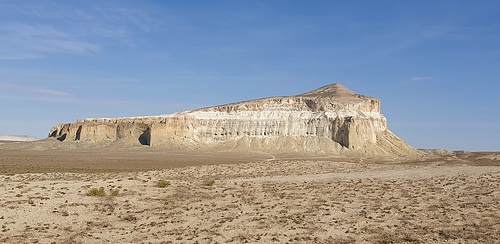

Sherkala, the Lion's Fortress
In western Kazakhstan, Mangistau, Sherkala rises out of apparent nothingness.
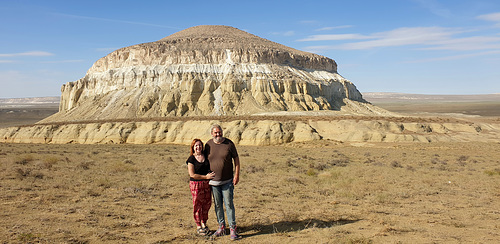

Sherkala, from Another Angle
From here it resembles a giant yurt. A popular photo spot.
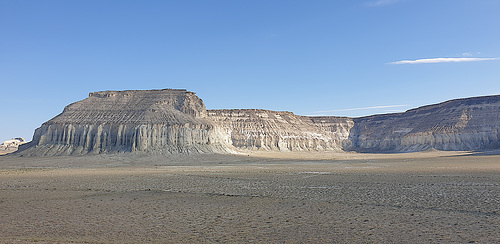

Dramatic Airakty
Dramatic Airakty
With erosion resembling columns, this area was made famous by an exiled Ukrainian artist and poet, Taras Shevchenko. He was sent here in the 1850s after writing some prose that was unflattering to the Russian government of the day.
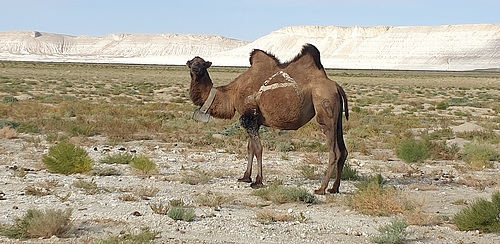

Camel
Camel
All the camels around here are marked. A letter, a number, or a symbol. By this, all know who owns which camel. We did try some proper shubat, I.e not from a plastic bottle in a supermarket. Shubat is the fermented camel's milk. It was surprisingly good, and quite refreshing.


The next two days became one little subadventure. With a magnificent night camping, one of the best camping experiences we have ever had, as the link of the two days. Fewer sights, and longer times in the car, were rewarded with wonderful vistas and stunning scenery.

Beket Ata cave mosque is a reasonable 20-30 minute walk from the car park at the top of the cliff. Winding our way down the path, we encountered hot and tired families and groups coming back up. Many smiled as we greeted them with one of our three Kazakh words. Invariably, they knew we were not local. Maybe it was our pronunciation, maybe our clothes, maybe our hair and features... Anyway, they just knew, and would frequently try and ask for information about us. Well, all we could really communicate is that we were from Australia. Oh, the smiles we would get, and even got a welcoming embrace from an older gentleman who beamed at us. Then, they would chatter amongst themselves, us not understanding a thing, except the word "Australia", and yes, almost every time, "kangaroo". At this, we would laugh, and they would laugh with us. Our confused looks ensured they knew we had only caught that small gist of the conversation.
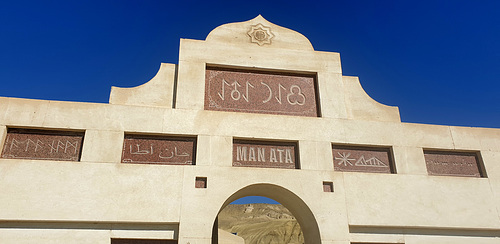

Shrine
Shrine
Man Ata. Little seems to be known about the inhabitant of this grave, now a shrine, attributed with being a protector of travellers. He was a Zoroastrian teacher or priest, from before the 10th century, when Islam came to Mangistau. We have no idea what all the scripts are. But the last one had me most intrigued. The majority of vehicles seemed to stop on the way past, with the occupants spending a few minutes in prayer and meditation at Man Ata's grave.


Tuzbair, a West Kazakhstan Salt Flat
The land is dotted with depressions, many are quite a bit lower than sea level. Tuzbair is the biggest salt lake here.
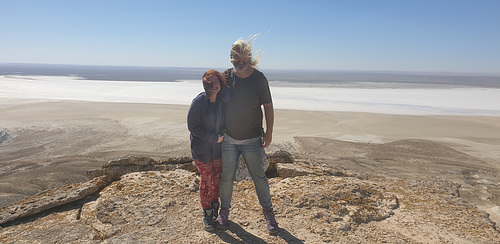

It Was Windy
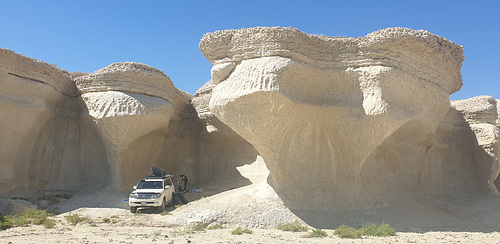
It Was Windy

A Sheltered Picnic Spot
A place out of the wind was the number one criterion when choosing where to stop for lunch.
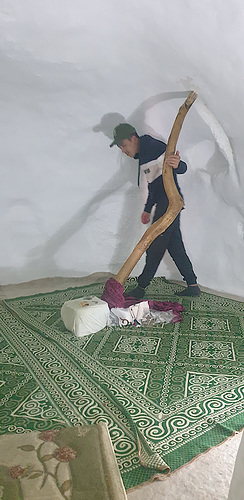

Holy Stick, Beket Ata
In the cave mosque of Beket Ata. Three small "rooms" where the Sufi, Beket Ata lived and taught. Pilgrims visit the cave where he is buried, and then come to this area to walk around the holy stick.
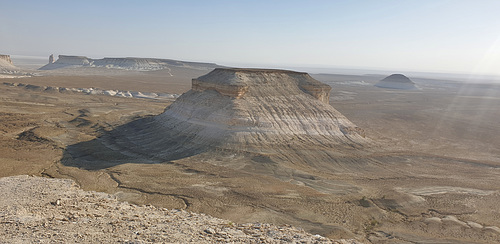

Looking Down, Bozzhira
Bozzhira in Mangistau, Kazakhstan. A multitude of gorgeous view points.
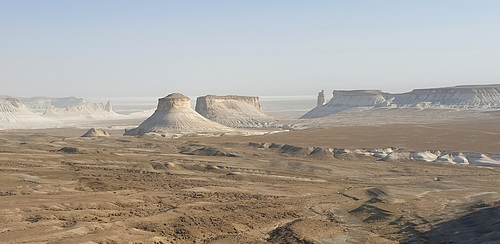

Breathtaking Views Abound
Bozzhira, Kazakhstan
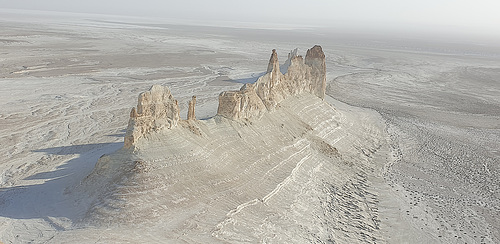

I'm Running Out of Superlatives
A few kilometres from our first stop at Bozzhira. We crossed a narrow join from the surrounding plateau to an outcrop where we could absorb the splendour of this formation.


Looking Out from our Campsite
We spent the night on the floor of Bozzhira. A recess in the rockface was deemed an ideal spot for our tents, protected from the blustery gusts that seemed to build the whole afternoon.
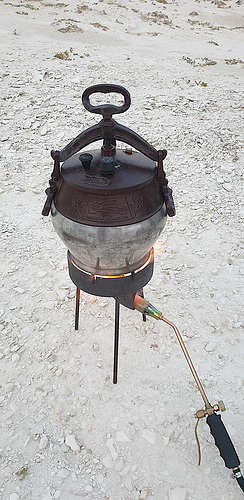

Dinner is On
Dinner is On
Chop vegetables; add some chicken; season and spice; screw the lid on tight; heat with the nearest flame throwing device. The driver, Ruston, got this fantastic pressure cooker from Afghanistan.
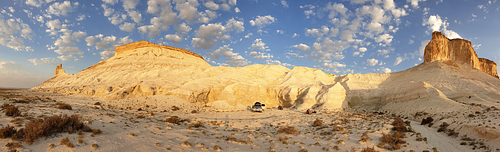

Sunrise Reaches our Camp
Morning in Bozzhira, and while Ruston cooked breakfast we just spent some time appreciating the soft light striking the formations that surrounded us.
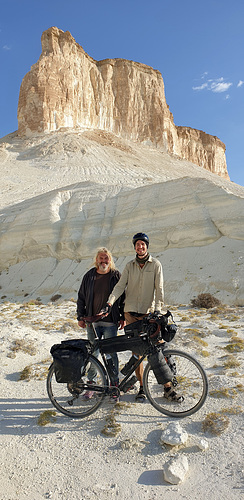

Dima, a "Keen" Cyclist
When we first saw a figure weaving through the rocks and sand and vegetation, I thought it was an animal. Despite a strong confidence in the knowledge that none would be here, I even thought it might be an ostrich. Nur said with confidence that anyone cycling here must be a foreigner, or crazy, likely both. It turned out to be a Kazakh guy, who had been riding four days, with four or five more ahead. He didn't really have a plan, or much of a map for that matter. Just wending and winding through the landscape in search of views. He appreciated greatly our gifts of water and food, and he joined us for dinner and breakfast. He cycled Jordan end to end, and once bought a bike in Amsterdam and rode to Barcelona, frequently being the first Kazakh that many Europeans had met. A toast to our crazy Kazakh Russian friend, Dima.
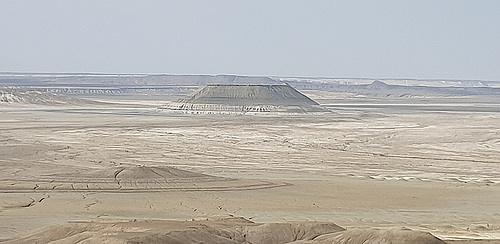

Mt Bokty
Mt Bokty
As depicted on Kazakhstan's 1000 tenge note.


Tiramisù
Tiramisù
Jo taking in Kyzylkup, in the Kazakh region of Mangistau. For fairly obvious reasons, it is also called Tiramisù.
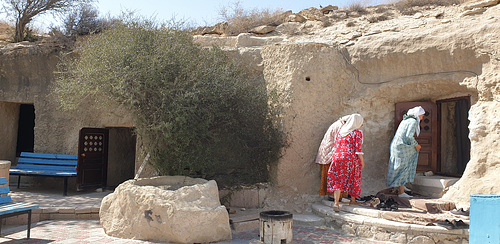

Pilgrims at Shopan Ata
Shopan Ata is the Sufi attributed with bringing Islam to the Mangistau region of Kazakhstan. Probably around the 10th century, he was teaching from this series of caves. The land near the cave mosque has centuries of burials. The closest spots are the oldest graves, with some of his students being amongst those burials. Further away, more recent cemeteries have sprung up, and burials still do occur out here, miles from everything.


Leaving Ethiopia - A Last Harar

31 December, 2014 to 4 January, 2015 - Addis Ababa, Harar - (Ethiopia)


We celebrated New Year's Eve in Addis. Largely a non-event, due to Ethiopia using it's own calendar. Ethiopia's New Year is in September on the Gregorian Calendar.

While in Addis, it was great to catch up with Kristal, a friend from Melbourne. She is in Ethiopia with a couple of her friends doing volunteer work in the south. Nice to have enjira with friends.

Our main reason for stopping in Addis was to sort out an onward visa for Somaliland. It actually came together a lot easier than expected, giving us a chance to do a couple of things we missed first time through. It was not all cheery, though.

Red Terror Martyrs Memorial Museum, Addis Ababa
Some of the identified remains of victims killed by the Derg during the Red Terror of the 1970's and 1980's. Also on display were piles of bones from unidentified victims. Somewhere between 100,000 and 500,000 people were killed or went missing during Mengistu's time as ruler. Yet another place where you can stand and ponder how incomprehensible it is what some people are capable of doing. And again, as we have seen at similar memorials in a number of places around the world remembering victims of various horrible regimes, people write in hope "Never Again!"


The ten hour bus ride to Harar was not the worst we've had. Relatively comfortable, and one of the first to not exceed the forecast travel time.

While we enjoyed many aspects of Harar, I don't mind confessing it did not live up to my high expectations. The old town, markets, and laneways lacked the anticipated romance. Overall, the vibe was not as pleasant as elsewhere in Ethiopia. The scenes were not as picturesque as described. So we stayed a day shorter than originally planned.

Don't get me wrong. It was worth coming to see, particularly for the hyenas. I was just over-enthused on what it would offer.

A Swooping Kite in Gidir Magala, Harar
Gidir Magala is a market in the old town of Harar. There are a number of butchers in the market, mainly selling goat and camel meat. Kites sit around the market and swoop down whenever there are scraps and offcuts thrown in to the street. Sometimes they swoop at people who are carrying meat!


At a Well, Gidir Magala, Harar
Kites look down from the walls, waiting for scraps of meat from the butchers. In the foreground, some women take their donkeys for water.


Donkey Parking
Donkey Parking
Outside Erer Gate, Harar. About 5 or 6 donkeys were tied to the pole, and the others were then tied to one of those. I'm not sure how anybody identifies their own donkey when they come back out!


In the Lanes of Old Harar (Jegol)
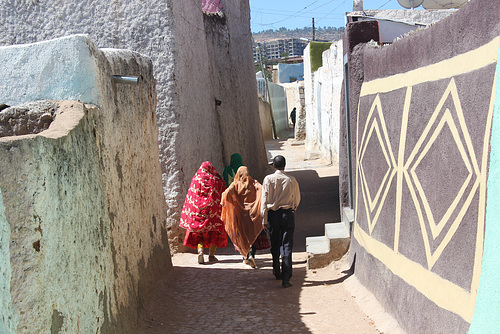
A typical scene in one of the warren-like laneways within the walls of Harar's Old Town.


And those hyenas. What an amazing sight. Apparently, after "feeding", they wander the streets and lanes of the old town. I do believe, though, you have to be out very late to risk encountering one. Locals assured us that they pose no danger.

Hyena Feeding, Harar
A hyena takes a strip of meat off a stick that I hold in my mouth. As night comes, the Hyena Men of Harar call the hyenas in from outside the city. At first, they skulk and dart in the shadows, snatching a few scraps of meat. But eventually, they come up to the man and begin to eat from his hand. I was asked if I wanted to give it a go, and seeing how healthy they looked, and how gentle they were with the man feeding them, I did not hesitate. First a scrap of meat on a stick hand held, and then he gestured for me to hold the stick in my mouth. It was a truly beautiful moment and I never thought I would see such a gentle and careful nature in an animal with such a horrible reputation. She gently grabbed the meat and lifted it off the stick.


A Hyena Climbs on my Back
There were no claws. I felt the big padded paws as the young hyena climbed on my back to take a piece of meat offered by the Hyena Man. Harar.


Where the Streets Have No Name


12 to 17 December, 2014 - Addis Ababa, Woldia, Lalibela - (Ethiopia)

Our plans for a morning snooze before lunch never quite fell in to place. We arrived early, but the debacle which is Ethiopian immigration meant we did not emmerge with our bags for at least an hour and a half. Then, our attempts to find a working ATM left us feeling flat and worn out. Eventually, we ended up in a hotel, only to be told we could not get in to our room till after midday.

But, let's go back one step and highlight some of the fun on Ethiopian Air. 1) The number of seats on the plane is known, so why not carry enough blankets so that there is enough for everyone? 2) Ditto for refresher towels. 3) Ditto for headphones. 4) Nice to have in-seat entertainment systems, but as it turns out, we were missing nothing by not having headphones - somebody decided not to run any movies. 5) Do Ethiopian men not lock toilet doors? Jo stumbled in on a man who had decided the lock was unneceassary. 6) Ditto for Ehiopian women, as I stumbled in on a lady sitting on the toilet. 7) I was both amused, and not at all amused, when a man four rows away and on the other side of the plane decided to watch music videos on his phone - without headphones. Even at that distance, it woke me up and kept me awake. I assumed somebody closer would complain, but I soon worked out the task would fall on me.

We decided to push through the incredible tiredness, and see a bit of Addis. Nothing too strenuous, a wander through Africa's largest market, followed by a beer on a cafe's balcony. Trying to orient myself, I asked "What is the name of this street?" "No, no" the waiter replied, almost agitated. "I don't think you understand. This street here, what is it called?" He shook his head. He appeared to be angry, and left us. Had we touched a raw nerve? We had read about the lack of knowledge of street names, but this was like we had asked about one of Addis Ababa's deep dark secrets.

Our First Enjira on Ethiopian Soil
Yum. We were looking forward to our enjira meals, and they have not disappointed. One dish is with lamb, and the other is kitfo, warm raw mince with spices.


Coffee - It's Always a Serious Affair in Ethiopia
In Ethiopia, coffee is NEVER instant. Most establishments, even if they serve burgers, has a person sitting in the corner with a fire and cups. Sometimes you get a full service, with scattered grass and incense, and sometimes you just get the coffee in a ceramic pot. It is always made with beans they have just roasted then and there. It is strong, very strong. It is good, very good!


The road north from Addis Ababa was lined with dozens of tiny stories. Countless sheep and goats being herded along. Children shoving the rear ends of cows to keep them off the bitumen. Men wrapped in white leading camels. Women berating disobedient donkeys. Groups of wandering people huddled under parisoles. Families laden with supplies from market. Even a number of long distance runners training on the highways. The backdrops for these activities varied. Mountain ranges at times, stone fences surrounding mud houses and barns at others, but more frequently, expanses of scrubland with flat topped trees dotted around. Each sight a story in itself, and some of it so stereotypical Ethiopia that we wondered if it was a show for the tourists.

Along the Road, North of Addis Ababa
A typical sight along the road as we headed to Dessie.


Our destination, Lalibela, would not be reached in one day, like we hoped. As expected, we had to overnight in Woldia before catching the bus in the morning. It's nice to have a freshly painted room, but the rooms had just been painted that day! I'm not sure if we slept, or if we just passed out on the paint fumes.

5:15 the following morning, we had one of the more bizarre hotel exits. First, I must highlight what this room was. There was a shared squat toilet down the hall, a shared cold shower next to it, so our room was just the one room. There was a bed, and it was pulled away from the freshly painted wall, and that was the entire furniture. No chair, no table, no wardrobe. And because of the fresh paint, no curtains. And yet, when we left at 5:15, the guard who was supposed to let us out came up and checked the room. Maybe the minibar? What did he think might be a problem? As it turned out, there was a problem. Jo's pillow! She always uses the provided pillow slip on a folded towel for sleeping as the pillows are too fat for her liking. So, this perplexed guard first couldn't find the pillow (next to the bed - in a room with no furniture in it - how could he miss it), and he looked accusingly at me like we had purloined it. Then there was the missing pillow slip to be found, which was caught up in the sheets. He seemed even more convinced we had taken that!

And the reason for all of this? To visit the ancient rock-hewn churches of Lalibelela. These incredible buildings started as pure rock, have been hollowed out, and then cut free from the surrounding rock. Effectively, they are entire buildings, each carved from a single piece of rock. There are 11 visited churches, most still functioning, and some are connected by trenches and tunnels. And all of these were created about 700-900 years ago.

Bet Maryam, Lalibela
The church of Bet Maryam, carved out of the rock. Essentially, it is all one piece!


Interior of Bet Mikael
Some of the interior details of the rock hewn church Bet Mikael, Lalibela.


An Apostle - Lalibela
Inside Bet Golgotha, a "men only" church in Lalibela. This is one of the four apostle carvings that is publicly viewable.


The Top of Bet Giyorgis, Lalibela
This is Bet Giyorgis. It truly is a marvel. The church is actually quite large, hollowed out inside the "cross". Inside, it has no supporting pillars.


Looking Down Bet Giyorgis
Peering over the edge at Bet Giyorgis.


Bet Gyorgis, Lalibela
This angle of Bet Giyorgis allows some true appreciation of what a magnificent feat this rock hewn church really is.


And a funny translation to finish this entry off.

Racial Salad?
Racial Salad?
No idea what it was supposed to be, but really, a very unfortunate name for a dish.


Ugly Functionality is Eclipsed by Beautiful Nature; Polluted Waters are Eclipsed by Earth that Breathes Fire; Watchful Paranoia is Eclipsed by Unreserved Hospitality

26 March to 9 April, 2013 – Baku, Qusarçay Laza, Naxçivan, Qobustan, Abşeron Peninsula, Quba, Xinaliq, Şǝki - (Azerbaijan)


Azerbaijan is a land of amazing contrasts. We have seen some eye-sore oilfields with hundreds of oil derricks pumping. Then in the days following we were blown away by the amazing scenery found when hiking in the Caucasus Mountains. We have stood next to waters where the oil slicks glisten on the surface and the waste of construction rusts in piles, and then nearby we viewed natural gas vents that breathe through rock and have burnt for decades. We have watched over our shoulders in areas where the officers of the MNS, (Ministry of National Security, formerly the KGB), have either subtly and even blatantly checked up on us. But our enduring memories of Azerbaijan will be the hospitality shown to us repeatedly and unreservedly by strangers and chance encounters.

Before telling the stories, I should relay the “social faux pas” that Jo and I repeatedly did. I happened to encounter a web page about Azeri etiquette that described how the locals do not smile. Well, not to strangers. “They are warm but reserve smiling for friends and family.” OK, we had worked out they were not sour, but it explained the general straight faces. The site continued with “If you smile in public, particularly if you smile at someone you have not been introduced to, they may think you are mentally handicapped.” Hmmm, Jo and I do tend to smile at people... Oops!

We took the train from Tbilisi, Georgia, to Baku, capital of Azerbaijan.

Baku Couchsurfing Feast
Our Baku host from couchsurfing, Çavid, and his mum. On our first night, they put on an amazing feast of traditional Azeri dishes. In fact, every meal we had was fantastic, but the food really kept coming this first night.


Baku's Flame Towers
Baku's Flame Towers
Three towers, shaped like flames. And at night, the lights on them make pictures, rotating through Azeri flags fluttering, flames flickering, and patriotic flag bearers waving their flags. They are not projected, but lights on the building generate the images. Up close, though, you can not see the lights at all, and it looks like standard reflective building glass.


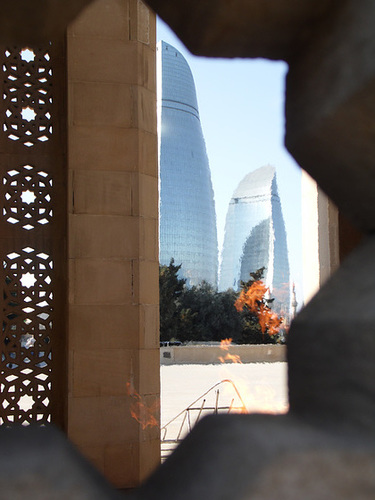
The Eternal Flame and the Flame Towers
View through the war memorial, Baku.


Baku Town Walls
Baku Town Walls
A section of the walls surrounding the old town of Baku, with the flame towers visible in the background.


Baku Town Walls Panorama
Looking to Baku old town, from the İçari Şahǝr metro station.


We were a little concerned about the possible weather, and would not have headed up in to the mountains for a few more days at least, but a couchsurfing connection with a German and Azeri couple who were heading up led to us being in Laza earlier. While visibility was not great and light drizzle came our way more than once, it did not stop us from having a great time as a group, clambering up to snow-lined waterfalls, taking in mountain air, and talking all sorts of stuff, both deep and meaningful as well as light-hearted.

Five Couchsurfers in the Fog
Arriving at Laza (Qusarçay Laza) in the fog. We got dropped a few kilometres away, and walked the rest of the way. That afternoon, we never got to see more than a few dozen metres. Us, Çavid, Andrej, and Vusala. All connected because of couchsurfing.


Cosy Bungalow in Laza
The five of us bunked down on the floor of this bungalow, fire roaring, super thick walls, and loads of covers. It truly was a cosy night considering the sub-zero temperatures outside.


The Washing Got Snowed On
Waking up in Laza, it was obviously cold overnight. Visibility had improved, though. We did not know that rocky formation was there when we went to sleep the night before. Between you and me, though, I would not have put the washing out given the prevailing weather, and I would have assumed locals would be better at picking that than I.


Frozen Spider Web
Frozen Spider Web
Condensation on the web has frozen during the night. The web strings across the rusting frame of a wrecked and abandoned car.


On our way back to Quba, we had our first KGB encounter. I know they are not called the KGB any more, but even the locals still refer to them as such. Not too subtly, he drove past our little group as we walked, stopping by the road a few hundred metres ahead. And then he was talking on his phone as we walked past. This was repeated three times. And minutes after he drove off, a pair of uniformed police stopped us, just to be polite and make light conversation. Strangely coincidental.

Curiosity, more than anything else, led us to booking flights to go and visit Naxçivan. An exclave of Azerbaijan, isolated by a segment of Armenia. This is troublesome for Naxçivan as Armenia and Azerbaijan do not really get on. As far as many are concerned, they still are effectively at war. This is because that segment of Armenia used to be Azerbaijan until the Soviet Union redefined areas. Also, because of the actual war in the 1990's over the Nagorno Karabakh region, which finished with a cease-fire but no real conclusion or result and the territory has been occupied by Armenian forces ever since. So, the only practical way they are connected to the rest of the country is by air. They could overland, in theory, through Iran, but things are not always easy for that route, either.

We deemed 9:00 a.m. not too bad a time for a flight to Naxçivan, determining that 8:00 would be an ideal check-in time to aim for. Get up at 6:00, be on our way by 6:30, that should allow us enough time with public transport. Coming out of the metro for our connecting bus at about 7:00 was when an alarming fact became apparent. All the clocks we could see were saying 8:00, and we discovered daylight saving (summer time) had begun. We had lost an hour! And we were still a long way from the airport. As we flew down the road in a taxi, I tried not to think about the clause I had read on the tickets saying “check-in closes 40 minutes prior to flight time”. At 8:25, we ran up to the counter, received our boarding passes, and two minutes later stood on a shuttle bus from the terminal to the parked aircraft.

Arriving in Naxçivan we found an extraordinarily neat and orderly city, with wide and clean avenues and tidy parks, all with a strange emptiness. This exuded a feeling that something is not quite right, but the sort of thing you cannot put your finger on. For the two days we were there, we often had the feeling of being watched. We know, for instance, that sometimes we were being checked up on. A KGB agent politely asked us some questions as we hopped in to a taxi, and noted them down, including the taxi details. I know that not all those solo men looking suspicious in the parks on mobile phones were following us, but we are certain that at least one or two were.

For sure, though, the visit to Naxçivan was interesting, and thankfully not just because of the paranoia.

Möminǝ Xatun
Möminǝ Xatun
The iconic tower of Naxçivan, viewed through the beautiful stained windows of a nearby palace museum.


Ancient Grave Marker
Rams appear to have often been used in this region as grave markers. Most have suffered terribly due to centuries of weathering, but this one, in great condition, retains very clear carvings.


Noah's Grave
Noah's Grave
Only in the last few years have some local archaeologists discovered a grave at this site. They claim to have ascertained that it is the final resting place of Noah. The monument is new, but we were disappointed to find that there was nothing to see inside. Single visitors will be pleased to know that you do not have to be in pairs to go inside...


View From Our Naxçivan Hotel
Looking southeast, past the airport, to İlandağ, some 30 km away. The snow capped mountains in the distance are the Lesser Caucasus Mountains.


There Was No Dial Tone
I was not expecting a dial tone, but locals thought it humorous that I picked up the hand piece and listened. I assume that rotary dial telephones are defunct in most places in 2013.


Çay
Çay
Azerbaijan's national drink. I cannot believe how many glasses we consume every day. I have not taken to the local method of drinking, by placing either a sugar cube or hard confectionery in one's mouth and drinking the tea through that.


Shoe Repair
Shoe Repair
Jo's boots were in a state. But we knew expert attention was required when the both soles came loose and began flapping when she walked. This man was just the expert required, and we hope they will now last the rest of the trip. On the other hand, we consider it a miracle every time that mine make it through another day.


How do you find a pocket knife you thought you had lost? Check in for a flight! Let the x-ray machine find it. Sure, you get the red face and have to tackle a “please explain” look from a security person with whom you share no common language. But you do find your pocket knife.

I don't know if or how this has anything to do with the situation in Naxçivan, but the flights, both ways, had many children and babies. At least one or two for every set of three seats. Children sat on adult laps or shared seats, as on buses, and babies were held everywhere. For the duration of the whole flight, there was a symphony of crying and wailing. Another thing, and while we have seen this many times before, but not to the same extent, people all through the plane talked on mobile phones and texted, during taxiing, take-off, and landing. And award for keenness to get ready for disembarkation goes to the man who got out of his seat and took his bags from the overhead locker, while the plane was still slowing down on the runway!

Back in Azerbaijan proper, (yes, amazingly, we did make it back in one piece), we spent a couple of days visiting some very interesting places close to Baku.

Scaling the Rocky Hills at Qobustan
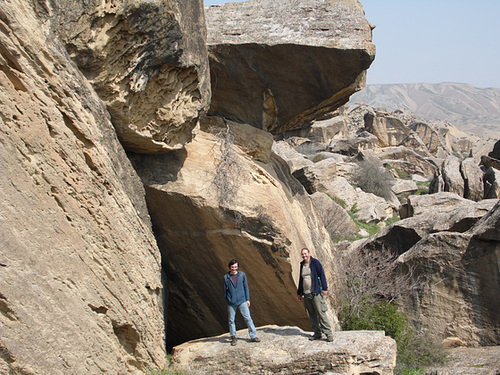
Çavid and me.


Petroglyphs – Qobustan

Jo and Çavid Survey the Expanse Below
Yes, we were starting to look for a way back down!


Checking How Good the Mud is for One's Skin
Çavid and Jo did not hold back with the mud bubbling out of the little volcano-like mound. Note the bubble about to pop behind Çavid.


Mud Emulating Lava
Mud Emulating Lava
Excess mud bubbles out of the “volcanoes” and runs like lava flows down the mounds.


Close Observation
Close Observation
Jo and Çavid entertained by a bubbling pool of mud.


The Earth Breathes Fire
Yanar Dağ, Fire Mountain. In the 1950's, a farmer's discarded cigarette caused the gas seeping out of the ground to ignite. It has been ablaze ever since.


Oil Derricks
Oil Derricks
A not uncommon sight in these parts, especially on the Abşeron Peninsula. Dozens of oil derricks, nicknamed nodding donkeys, pumping “black gold”.


We thought we might consider moving on from Azerbaijan at about this time, but improved weather forecasts encouraged us to revisit the mountains. We are so glad we did. And the great time we had there lifted us from the sobering visit we made en-route.

Massacre Victims
Massacre Victims
The remains of hundreds of people massacred in 1918. Bones, skulls, and teeth; all that remains of the bodies of people slaughtered and buried in two trenches and two wells near the town of Quba. The remains were uncovered relatively recently when building works were begun in the area. This location, however, represents only a small sample of the horror, with figures quoting over 16,000 civilians from over 120 villages massacred in the Quba region.


Testimony to Brutality
Investigations revealed that the victims of this massacre died predominantly due to blunt force impact. The bodies were then bulldozed into the ground.


On the Way to Xinaliq
We took transport from Quba to Xinaliq. We did not even ask the driver to stop for photos – he knew the right spot to let us have some time to take in the beauty and attempt to capture it. No hope, really. Photos never do justice for places like this.


Looking Down to Xinaliq
On the afternoon we arrived, we hiked up from Xinaliq to take it all in.


Hiking From Xinaliq
Hiking From Xinaliq
To leave Xinaliq, we just set out down the road to Quba. We passed through the best of the scenery, including expansive views to the mountains, and some pretty gorges with striking rock faces. When we got sick of walking, after 20km or so, we hitched a ride with a Russian couple, back to Quba.


It is Only for Sheep, Yeah-eah
A farmer waved us over as we walked down the road, close to the village of Çek. While we talked with him (well, gestured and pointed, as we had very few words common between us), his sheep just stood behind him, waiting for his next move.


Hospitality in Çek
Hospitality in Çek
To continue the story, that farmer I mentioned in the last picture, he lived in that house behind the sheep. His gestures indicated that he wanted us to join him for tea. And he did say one of those few words that we understood, çay. The family all came in, and the tea flowed, with the usual array of sweets, followed by home-made bread, home-churned butter, home-made cheese, and eggs (I assume from their own chickens). We tried to communicate about a number of things, both ways, some of it being understood, and other things ending in laughter at the realisation that the story was lost. They taught us a few words of their language, as Azeri is not what they speak in this area. We tried, but none of it stuck. Well, it wouldn't be useful anywhere else, in any case. After an hour and a bit, we continued on our way, and they came out, kissed us, and waved goodbye.


Looking Over to Çek
Looking Over to Çek
After a couple of kilometres, the road winds past Çek on the other side of the valley. Our friendly farmers live in the house a little to the right of the village there, with the red roof.


Besides the hospitality mentioned so far, I think I should mention some of the other stand-out incidents; Hopping in a shared taxi, and the other passenger paying for our fares; A group of teenage boys at a cafe who introduced themselves and then paid for our tea; When we were hiking, a passing car stopped and the family gave us fresh bread to enjoy while we continued on our way.

Last stop for Azerbaijan, on the way back to Georgia, with perfect timing for my birthday, was Şǝki.

Skyping Family on my Birthday
In Şǝki, we took a room in the Karavansaray Hotel, a 250+ year old caravansarai. A perfect place in a pleasant town to have my birthday.