Current Travels

Showing posts with label active volcanoes. Show all posts

It's France with an Active Volcano

7 to 10 January, 2016 - St-Andre, Piton de la Fornaise, La Brule - (Reunion/France)


Reunion. A French department in the Indian Ocean. Geographically, it's Africa. Culturally, it's laid back France. Magnificent topography, formed by numerous volcanoes, not all of them extinct.

We picked up a hire car, dealt with odd opening hours, discovered how little English was spoken here, and dined on take-away Creole food and a bottle of red. That was day one.

The second day saw us discovering some of the beautiful natural wonders of this island. The afternoon had us climbing high to spend the night close to the volcanic heart of Reunion.

A Beautiful Local
A Beautiful Local
Being French, geckos here care about fashion. I wonder if a gecko in Reunion calls in French?


Gecko Attitude
Gecko Attitude
I love how much detail has been picked up with this photo. He almost seems expressive, don't you think?


Falls at Bassin La Paix
Two of four waterfalls pouring in to this magnificently picturesque large pool.


Route du Volcan
Route du Volcan
The last few kilometres to Pas de Bellcombe (Piton de la Fornaise) are across this magnificent landscape. This is Route du Volcan - Volcano Route. I almost expected to encounter the Mars Rover!


We arose early - almost an hour before sunrise, so had already descended a couple of hundred metres to the lava field when the sun first appeared. The volcano itself cast a long shadow, keeping us out of the sun for at least another hour. By this time, we were some way up the side of the cone that houses the main crater. The going was relatively difficult - the dry lava underfoot being uneven and unyielding. But the views into the crater were amazing. We were so blessed, too. We were alone some ten to fifteen minutes before anyone else reached the viewpoint. Also, by the time they arrived, the clouds had began to roll in. They had to piece together the overall vista, as clouds rolled in and out and around. We expected to walk back in baking sun. Instead, it was moisture soaked fog. And somehow, we still got back to the car feeling dry and dehydrated. A wonderful experience, though, and still different to other things we have done.

Jo and the Volcano
Jo and the Volcano
Piton de la Fornaise, a very active volcano on Reunion. Reached by trekking 2-3 hours over lava fields. This viewpoint is reached after ascending to the eastern rim.


Smoking!
Smoking!
From the rim, the Dolomieu Crater floor can be viewed, some 350 metres below, smoking and steaming, just to remind observers that it is not dead, just asleep.


Driving along the south eastern coast of the island has you crossing the "Grand Brule". This is the lava field where the spewings of countless eruptions have made their way to the sea. Some are marked - 2001, 1986. The greatest flow is from the 2007 eruption.

Lava Flows in Stained Glass
The church in Piton Ste-Rose. In 1977, a lava flow split and went around the church. The stained glass of commemorates this miracle. The church is now know as Notre Dame des Laves.
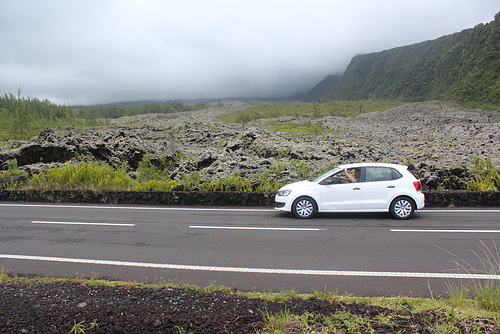

Driving Across Grand Brule
Older lava flows have significant vegetation growing. This lava field was from 2001.


Rippled and Rolled Lava
Some of the beautiful forms left when lava flows solidified.


Depression in the North, but no Need for Valium

18 to 23 December, 2014 - Mekele, Danakil Depression (Harmadela, Erta Ale, Lake Asale, Dallol) - (Ethiopia)


Our next stop north was Mekele. We managed to score a ride meaning we covered the distance in a single day instead of the anticipated two. The extra day was spent enjoying town and shopping.

In the Market at Mekele
A beautiful smile, spinning by hand, selling her spices and coffee pots.


Berhale Market
Berhale Market

Our reason for coming to Mekele was to arrange our time in the Danakil Depression. The Danakil Depression is a vast low area in northern Ethiopia, largely below sea level. It is hot. In summer it regularly goes over 50 celcius (although it only makes high 30's at this time of year). It is desolate. And it has some beautiful sights to see. Not least of all is the opportunity to see the way people live in such a place. Being close to the Eritrean border, soldiers and guards are never far. There are some who make a bit of money from tourism, either directly or otherwise. However, it seems the vast majority live here because of the salt extraction. They cut salt, or they transport salt, or they trade with the camel caravans. Such a brutal environment to live and work in. Sometimes, we drove kilometres without seeing a single thing growing, yet people live there, with a handful of goats. Oasis dot the land, and we were told there was no shortage of water just below the surface, suitable for animals at least. Or human consumption if desperate enough, but the people know how to make it OK for drinking.

Afar Man with Camel
Afar Man with Camel

Jo Gets her Hair Done
While sitting in a small village, waiting, the children gathered, and soon Jo was getting plaits done from all angles.


Camel Train Near Harmadela
Camels laden with salt. Destination, Mekele. Seven days travel from the salt flats.


Mum and Bub
Mum and Bub
Mother and baby camel in the Danakil depression.


Living where Almost Nothing Grows
Not many people live around here. The environment is incredilbly harsh and unforgiving. How anyone manages at all is beyond me.


Egyptian Vulture
Egyptian Vulture
Despite the feeling that nothing could survive here, it obviously does. Occasional birds this size must feed on small prey, which in turn feed on bugs and insects, which all have something to survive on. The complete cycle is here, difficult as it is to find.


While that was all interesting and worthwhile, nothing was even a close second to the main reason for our trip here. To climb Erta Ale and spend a night on the rim, next to the world's only permanent lava lake.

View in to Erta Ale
View in to Erta Ale
The thin fresh crust of rock tries to form over the massive lake of lava, but it is quickly liquified and absorbed once more in a cycle of heating and cooling.


Late at Night, Erta Ale Volcano
We ascended after dark to avoid the desert heat, and spent most of the evening and morning admiring one of the most amazing sights. I even singed the hair on my arms standing there. We camped on the rim of the crater (not precariously near the edge, though!) and admired the lava lake for sunrise, heading down before it got too hot.


Rolling and Rippling Molten Lava
Mesmerising changing formations in the Erta Ale lava lake, as rock changes state between molten and solid and back again.


Surreal Vistas Created by the Shifting Crust
Erta Ale lava lake. The cracks caused by the molten lava expand into immense bubbling pools before cooling just enough to crust over.


Bubbling Lava Shooting Dozens of Metres
Beautiful shapes and patterns appeared when large pools of lava became so intense that they bubbled and frothed erratically and spurted skywards.


Like Lightning
Like Lightning
Lava in the Erta Ale Volcano crater.


Lava Bursting Through
Pressure beneath the crust causes a dramatic break out of lava. Erta Ale Volcano.


More Lava Leaping
More Lava Leaping
Erta Ale Volcano.


A Gigantic Spurt of Lava
Besides the need to avoid desert heat, the lava activity is so much easier to take in when it is dark. Erta Ale creates an incredible, though momentary, lava "tree" for us.


Wide Angle - Erta Ale Crater
Thankyou, Carl, for lending me your lens. Last photo before going to bed.


Sunrise by a Lava Lake
No reflections in this lake, though. Dawn comes, and there was a new appreciation of Erta Ale. The lava activity and the sun rising were a perfect pair.


Daylight Begins to Enter the Crater
As the sun rose, we could finally see the warped countours of the lava lake crust. But day or night, Erta Ale never sleeps.


With so much land below sea level, so much water coming in, and so much sun, salt is the natural by-product. We stoon on Lake Asale's shore at sunset, seeing white in 3 directions almost to the horizon, and blue in the 4th.

Lake Asale, Ethiopia
Standing on the shore of the salt laden Lake Asale, in the Danakil Depression.


Another amazing area is the volcanic active area around Dallol. After climbing over centuries old lava flows, we came to the sulphur springs. Smelly? Actually, not as bad as you might imagine!

Sulphur Formations
Sulphur Formations
Sulpur laden water bubbles to the surface and evaporates. Dallol in the Danakil Depression.


Striking Yellow - Sulphur - Dallol
Another cluster of sulphur formations in the Danakil Depression.


Ethiopian Soldier
Ethiopian Soldier

And before leaving the depression, we stopped in a much drier area to see the salt extraction in progress.

Salt Extraction Site
A camel waits while in the background, salt blocks are cut and cleaned, ready for loading. Ragad, in the Danakil Depression.


Cutting Salt Blocks
Cutting Salt Blocks
A worker cuts blocks of salt into manageable sizes, ready for transport by camel to Mekele. Ragad, Danakil Depression.


A Windy Beach Ending

10 to 18 January, 2014 - Tagaytay, Naga, Caramoan, Manila - (Philippines)


It turns out that the back to back transports of getting to Pinatubo were not the end of it. After getting down, we went straight to the highway; caught a bus to one terminal in Manila; negotiated traffic in the chaotic capital to get to another bus terminal (over an hour and a half, and it wasn't even peak hour); and finally got out again, heading south, to Tagaytay.

Volcanic Cones in a Crater Lake
The outer crater is 75 kilometres round the rim. In the lake (Lake Taal) are numerous volcanic islands, cones, and craters, many still quite active. The main cone has a lake, which in turn has a crater with a lake, which has an island in it.

Unforturnately, that "matroishka doll" of craters is not visible from the rim. And, unfortunately, due to the haze, we were lucky to get anything at all in our photo. But here it is, anyway, albeit with the levels adjusted somewhat.


It did take us an extra night to recover from all the travelling, but after an extremely lazy day, we were ready to face travel again.

Lazy? Well, we got up, and went for brunch at a place on the crater's rim with a fantastic view. But the real marvel was how early everyone was eating lunch! Then we finally looked at a clock to find that our brunch was commencing, and it was nearly 2 o'clock. We dragged brunch (now lunch, or more correct in Seinfeld terms, linner) until about 5, when we went to another venue to celebrate beer o'clock while looking in to the crater from a slightly different angle. Yes, lazy.

Windy at Caramoan
Windy at Caramoan
We had visions of this dog doing a Sally Fields impression, from the Flying Nun. He seems to be angling his ears in to get the aerodynamics right for a lift off.

The wind blew so hard on our second day at the beach. The rain was not as constant, but still had us running every now and then, sheltering for only a few minutes at a time. Coffee shops, behind beached boats, under random tarpaulins, beneath the biggest tree, or sometimes, well, it was too much trouble, and easier to face getting wet.

Despite the weather, we found the place very beautiful, and although we obviously would have enjoyed more if we had been able to enjoy a swim or a trip to islands, it was still a great final stop before returning to Manila for our flight home.


Queueing For Lumpia
Queueing For Lumpia
We walked past and saw more than 40 people lined up at this Lumpia House, which proudly proclaims it has been here since 1956. Knowing nothing more than its apparent popularity, we waited our turn. It was nearly an hour, and as it was take-away only, we found a space on some nearby steps to eat.

The juices and provided dipping sauce ran down our arms, over our shorts and shoes, and generally covered our faces. This elicetted comments from passers-by: "Enjoy your food."; "Looks good."; "They are tasty, aren't they."; "We wanted some but didn't have time to wait." All we could do was wipe our faces with our fore-arms, further smearing the mess, smile, nod, and keep eating. They were delicious, but impossible to eat with any decorum.


The Rest of Northern Luzon

5 to 10 January, 2014 - Vigan, Pagudpud, Mt Pinatubo - (Philippines)


It was time to lose some altitude. After all, we didn't come to The Philippines to be cold. The most obvious route, on a map, was not the easiest, with very few transport connections and options. But soon enough, we were delighted to be in the warmer climes of the coast.

Our first stops, though, were not to be beaches. World Heritage Spanish Colonial architecture was our focus for a couple of days, and Vigan was a great place to have our anniversary. We upped the accommodation a bit, and spent two nights in a former mansion, full of delightful antiques. It had that touch of class that we are becoming familiar with, now that we are "business class worthy" travellers!

Spanish Colonial Architecture
The Spanish centre of Vigan, The Philippines. It was spared in WWII just minutes before being flattened by American bombers. The architecture is actually a mix of Spanish and Chinese influences.


Frangipani and Bell
Frangipani and Bell
At Santa Maria.


Santa Maria
Santa Maria
Church of Santa Maria, near Vigan. Huge, and solid.


Happy Anniversary
Happy Anniversary
Celebrating 24 wonderful years together. Vigan.


Spacious Interior
Spacious Interior
The incredibly light and airy interior of the church of Paoay.


Paoay Church
Paoay Church
We saw this style referred to as "Earthquake Baroque". Made primarily from coral rocks, the walls are incredibly thick and have huge fortress like reinforcements. While very Spanish, it still displays many other influences. Hints of Indonesian and Chinese can be discerned.


A bit further north, and we reached our first beach stop.

Saud Beach, Pagudpud
An idyllic stretch of sand in the north Luzon, Phillipines.


Art Effect
Art Effect
A nice "art effect" added. Saud Beach, Pagudpud.


After some confusing phone calls, and a bit of weighing up of options, we hopped on what was supposed to be an "overnight" bus south. Have you ever noticed, that when you want a bus trip to take a bit longer, it is usually a bit shorter? Subsequently, we were deposited by the side of the highway at 2:30 in the morning. A couple of motor tricycle rides later, and we were near the foot of Mt Pinatubo.

The driver implied that the building was accommodation of some sort, and proceeded to wake the inhabitants up. Dogs barked wildly. Chickens started flapping through the yard. And after a few minutes, lights appeared from within the building. It was nearly 4 a.m. We asked about the possibility of a room, and were dutifully informed that perhaps we should forego sleep. After all, we could commence ascending the mountain at 5:30. Jo managed to convey our level of tiredness, having been deprived of rest for much of the bus trip, and what sleep we got being very light and intermittent.

By now, most of the family seemed to have been awakened by our arrival, and they began busying themselves with various jobs, one of which was preparing a room for us to sleep in. As we went to the room we passed a figure, covered head to toe, trying to sleep on a couch. Perhaps the only person in the place still doing so. Nearly two hours later, when we got up and had breakfast, we worked out that the person on the couch was the teenage daughter. She had been evicted from her room so that we had somewhere to sleep!

6:30, or maybe approaching 7:00, and we were in a jeep taking us up to where the walking was to commence. Less than 3 hours later, we stood on the rim of Mt Pinatubo, admiring the incredibly beautiful crater lake within. The sulphurous smells, the discoloured rocks and water, these reminded us it was active. And the local guide we chatted to, his story of lost loved ones in the 1991 erruption, that reminded us that looks can be deceiving.

Looking Down Into Mt Pinatubo Crater Lake
After an overnight bus, and feeling very sleep deprived, we climbed Mt Pinatubo. Admittedly, we got driven a fair way up, but the last couple of hours to the rim were on foot. And looking down in to a superbly beautiful lake with some stunning scenery made it all worthwhile.


Lakeside, Mt Pinatubo
Photo from the shore of the crater lake inside Mt Pinatubo. There is little evidence of the fact that the volcano is still very active, having significant erruptions in the last few decades.


Driving Down, Mt Pinatubo
The river down from Mt Pinatubo is largely just loose ash from recent erruptions. It is a significant hazard, as any decent amount of rain, particularly a typhoon, does not get absorbed, but turns the river very quickly in to mud and ash flows, with dangerous land slides possible at any time.


Why? Just beKos

17 to 20 June, 2013 – Kos, Nisiros – (Greece)


Hello. When you prepared for the trip, did you forget to pack your dignity? Please, if you do not have children with you, there is little excuse to be taking a "tourist train". I am referring to those tractors with painted panels which shunt around town ringing a bell and pulling three or four mostly empty carriages. At least sit close to the families that are on there so that on-lookers will think the kids are with you!

Jo and the Volcano
Jo and the Volcano
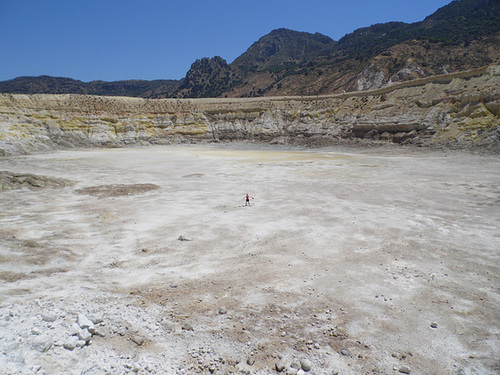
That's Jo down there.  In the crater.  This is not an extinct volcano, but not too active.  Dormant.  Stinking sulphurous gasses hiss out of various vents around, mainly near the rim.  Is it guaranteed not to erupt?  Nothing is guaranteed when it comes to things like volcanoes.  Just unlikely... Island of Nisyros, not far from Kos, Greece.


Crystals of Sulphur
Crystals of Sulphur
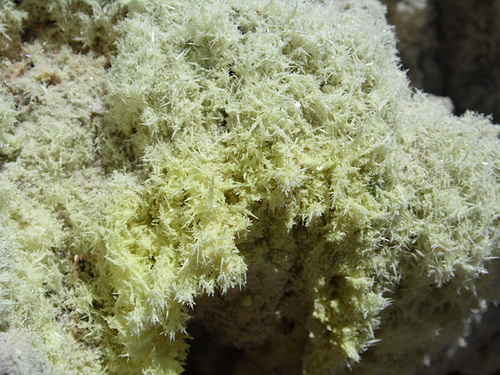
Where the smelly steam escapes from the ground, condensation and evaporation leaves behind fantastic crystal formations of sulphur. Primarily yellow, but at times tending towards green, depending on the minerals in the rocks where they form, I guess.


Corrosion
Corrosion
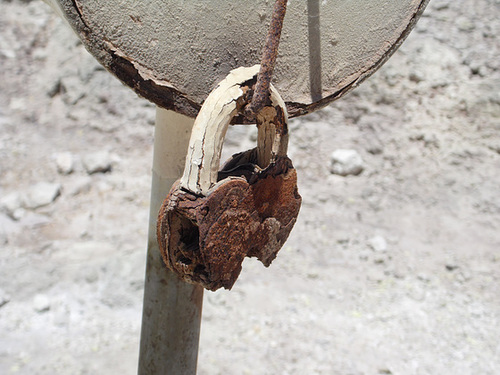
I guess this lock was put on some time ago and has not been opened for a while. Volcanic mineral laden steam at work.


Zia
Zia
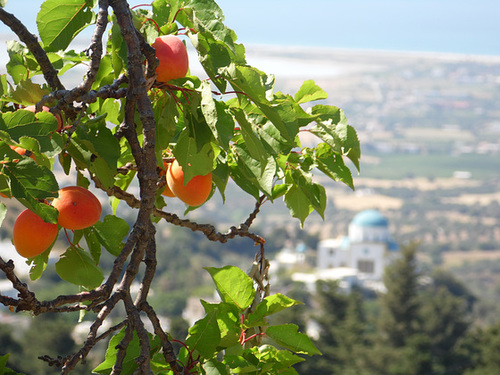
View from Zia, Kos.


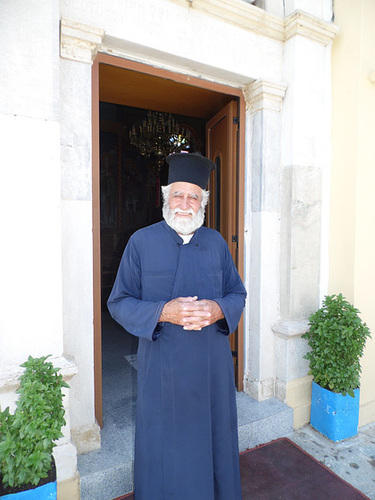
The Local Priest
The Local Priest
In a village near Zia.  A delightful man to chat with.


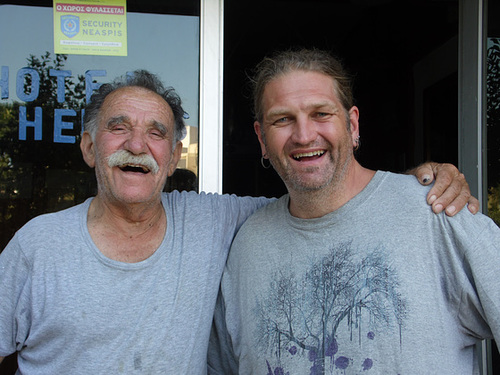
Me and a Greek Stereotype
Babi, owner of Hotel Hellas in Kos. He was so Greek that talking to him was like talking to a person who was sending Greeks up. "Good morning", he boomed when we came down in the morning, after which we would talk politics, and all about his extended family in Adelaide.


So, one of the things we went to on Kos was the "thermal beach". Volcanic gasses heat the water here, and where it mixes with cold sea water, it is a very pleasant place to swim. A "pool" is made with some really large rocks dropped in the sea to keep it all a bit contained as well as providing something to sit on in the water. It was not too crowded when we went, but there were enough people that we tried to pick a spot where we had some space around us and didn't feel too overwhelmed. It was fine, for an hour or so. However, one of the hairiest men I have ever seen got in the water, and decided to sit directly in front of us. We suddenly found our field of vision field with a huge, hairy back. Aaaargh. Oh well, time to get out, any way.

Leaving Kos, on our flight to Pisa was with Ryanair. Hmmm, Greek check-in staff, Italian passengers, Ryanair flight restrictions. It got heated in the queue on more than one occasion. Most people seemed to make it on the flight, but it seemed that a few were going to miss.