Current Travels

Showing posts with label Georgia. Show all posts

A Region Frozen In Time

25 April to 3 May, 2013 – Vardzia, Akaltsikhe, Kutaisi, Mestia, Batumi – (Georgia)


Two guesthouses in a row have given us alcohol with our breakfast. The first gave us a shot of cha-cha, which as an 80 proof spirit distilled from the leftovers from wine making. Two days later, what we thought was a fruit juice on the table turned out to be red wine. I guess it is just juice that has been left for a while.

So, our last week and a bit in Georgia. We ate well, and we drank very well. There were still some sights in the low country, including cave cities, monasteries, and forts.

Vardzia
Vardzia
View to the 800 year old cave city of Vardzia. More than just a monastery and centre of learning, it was a city in its own right. While many of the caves were used for living, there were stables and libraries and schools. In the photo, you can see the arches from some of the churches and chapels.


Chapel in the Cliff
Chapel in the Cliff
High up on the cliffs, in the cave city of Vanis Qvabebi, near Vardzia, this chapel sits on a narrow ledge. Unfortunately, the height is not conveyed by the photo, but if you make out the steps below in the steep sided valley, you can start to comprehend the precarious location of this little building. This cave city predates Vardzia by about 400 years, with the earliest caves (and this chapel) dating to the 9th century.


Vanis Qvabebi
Vanis Qvabebi
View of the aforementioned chapel at Vanis Qvabebi. The only access is via a series of tunnels and ladders that begins in one of the lower caves, and winds up inside the rock.


The Castle Above Akhaltsikhe

Gelati
Gelati
Gelati is a monastery near Kutaisi, Georgia.


Monastery of Motsameta

Dinosaur Footprints
Dinosaur Footprints
Fossilised dinosaur footprints in the caves of Sataplia, Georgia.
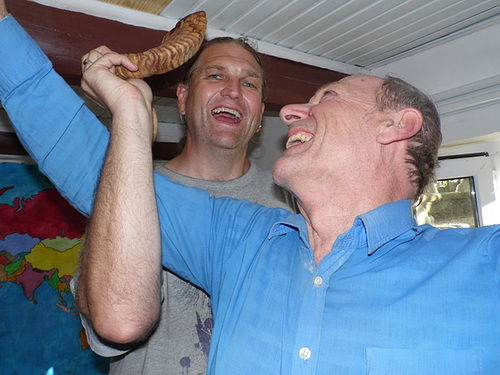

Another Ram's Horn of Wine With Our Host
So, this got me wondering, if I were driving, does a ram's horn hold more or less than one standard drink? Moot point, really, as nobody is in a position to drive after many ram's horns of wine, let alone the cha-cha!


Frog in a Pond
Frog in a Pond

Interesting Building, Batumi
Whose idea was it? Did the architect or the contractee decide that they wanted to put a fun-park wheel three quarters of the way up a building? It looks like the sort of thing a spoilt rich kid demanded. “... and I want a ferris wheel that I can use without leaving the building!” What would be really cool is if each “pod” was a different room, bedrooms or dining or living, but you could only get in or out when they had rotated to the right position!


However, the highlight for this little bit, and one of the highlights of this entire region, was getting to isolated Svaneti. Georgians had prepared us for the “step back in time”, but combining the cultural differences with the history and architecture, and putting it all in a magnificent setting in the Caucasus mountains, there is little that can be said to describe such a magical place!

Svaneti
Svaneti
The magnificent view when driving in to the remote region of Svaneti, Georgia.


Two Towers of Svaneti
Ancient towers in a village not far from Mestia in Svaneti, Georgia.


Farm with Tower, Svaneti
These towers are dotted all through the valleys of Svaneti. They were predominantly built between the 9th and 13th centuries. The bed and breakfast we stayed at in Mestia had its own, dating from the 10th century. Dates like these make the majority of “old” houses pale in comparison.


Cluster of Towers
Cluster of Towers
This cluster of towers is in the Svaneti town of Mestia. They were built for defensive purposes, and combined with the remoteness of the region, have served the inhabitants well for a thousand years. The area was well known as a stronghold and frequently sheltered important religious icons and artefacts when other regions were under threat by invading forces.


Towers of Svaneti at Night
The towers may be about a thousand years old, but the atmospheric lighting is a more recent addition. Mestia, Georgia.


Snow, Stalin, and Vodka Shots with the Year 10 Students

20 to 26 March, 2013 – Bakuriani, Gori, Stepnasminda - (Georgia)


Trying to map out a few days travel, and realising that the snow was interfering with some of our plans, we decided to take advantage of the sunny days and that aforementioned snow and we went skiing. The timing was perfect. Admittedly, not many runs were open any more, but enough for us to be happy for a day. Hardly another skier there, either. The tickets were cheap, the ski rental was cheaper, and the accommodation was already charging off season rates. It was the perfect thing to do for that moment.

Panoramic View from Our Balcony
View from Our Balcony
Our view in Bakuriani, one of Georgia's ski resorts.


Caucasus Behind
Caucasus Behind
Spring skiing at Bakuriani. The snow is disappearing, but grooming keeps some runs open. But this might just about be the last few days of the season. We practically had the slopes to ourselves, with maybe 20 people in total skiing or boarding. The majority of people using the cable car were sightseers.


Bakuriani Skiing
Bakuriani Skiing
Snow was good, weather great, and scenery, fantastic.


Bakuriani Village
Bakuriani Village
View down the slopes to Bakuriani.


Gori. It is the birthplace of a boy who went on to be known to the world as Josep Stalin. The Stalin museum still operates and is proud of this link, but overall, I'm not sure if Georgians feel the same about this link as they did a few decades ago. We had a guide in the museum who had been leading visitors for over 30 years. Our vote for best comment regarding Stalin and communism went to the off-handed “They made some mistakes, but...”

More significantly for us, Gori was a great place for a day excursion. We hopped from one bus to another, and walked quite some distances.

We first went to Ateni Sioni, only to find it shut up. We walked to town to fill in some time in case it opened a little later, then walked back to find it still locked. So, back to town to see if we could find a person with a key. But to no avail.

Ateni Village
Ateni Village
Ruins overlook the village of Ateni, not far from Gori, Georgia.


Slightly disheartened, we went to our second destination for the day, Uplistsikhe.

Approaching Uplistsikhe
A church on the hilltop above the cave city of Uplistsikhe. Sheep grazing by the approach road looked after by a shepherd with a staff.


Remains of an Old Temple, Uplistsikhe
The cave city of Uplistsikhe lies largely in ruins, but some remains are quite distinct, including pagan temples (later converted to churches) and dwellings.


Me, Some Wine Jars, and a View
The view up and down the river from Uplistsikhe is quite extensive and very pretty.


“Single Column Cave”
We nearly missed this cave, as it was a bit awkward to get to, but since it was one of the very few which had a sign, we made a bigger effort. And glad we did. The carved arches and the work around the column made it a highlight.


The cave city of Uplistsikhe was an interesting place, in its own right, but going there was greatly enhanced by our cultural interchange with a group of Year 10 students from Tbilisi. We first saw this group of students amongst the ruins. However, afterwards, we had a 2 km walk back to town to look for transport back to Gori. Along the road, we passed the group. They were stopped in a clearing by the side of the road, having a picnic. After waving from the road and receiving many waves back, a few of the students came running after us. Would we join their picnic? Why not. Home made food, some bought snacks, soft drinks, and vodka. Yes, vodka. “It is traditional. Of course we have vodka” explained one 16 year old.

The Year 10's
The Year 10's
Some of the kids who were on an excursion who invited us to join them for their picnic. The food was made up of various things that they had brought along to share, including some fantastic home made treats. The most surprising thing to see was, amongst the bottles of Coke and lemonade, a few bottles of vodka. Upon arrival at the picnic, we were presented with a plate and a small plastic “shot cup” of vodka, and gestures were made to the immense quantities of food to help ourselves. But apparently we didn't help ourselves enough as food was brought to us and put on our plates.


It's All Fun and Games Until...
After the picnic, the kids had some time to fill before they had to return to Tbilisi. They pulled out speakers and put on music and sang a few songs, including Georgian hits as well as stuff we knew like Coldplay. The activities got more boisterous, with students swinging each other around, fairly violently, and culminating in recreations of Georgian sword dances. Apparently, throwing each other in the air is part of those dances. I guess we just have to believe them. Jo did not seem to offend them by politely declining persistent invitations to be one of the thrown.


Since it was not too late when we were heading back to Gori, and it was not too much of a detour, we thought it prudent to attempt one last time to visit Ateni Sioni. When we arrived and the gate was still locked, I made a decision. Apparently, some of the nice details on the church are on the outside of the building. And the fence was not too high. So, having exhausted all possibilities, I didn't feel too bad about jumping that fence to see what we could. I had just got my leg over the top, and was straddled there, when a car pulled up. And a caretaker with keys arrived. Red-faced, I scrambled back over the way I had come, and waited while he unlocked the gate for us. He did not appear to be upset, and made no reference to what we were up to, but I was a tad embarrassed all the same.

Back in Gori, having dinner in a pub, a couple of guys at another table started playing the piano accordion and drum, and sang. It was all rather spontaneous and a lot of fun. One of them turned out to be quite the entertainer.

Gori Pub Entertainment
We never worked out if this guy was supposed to be putting on a show at the pub, or whether he was just a talented patron. He and a friend sang songs at their table, playing the piano accordion and a drum. When we acknowledged them with a smile and a little applause, he moved up to the “stage” area, where some equipment was set up, and he put on some music. He accompanied the music with some rhythms, throwing his drum in the air, rolling it around his body, arms, and legs, spinning it on his foot, and as caught in the photo, twirling it on the floor.


Heading to Kazbegi had us going through one of only three motorable roads that crosses the Caucasus Mountains. This high pass is open most of the year, but it was not the snow that delayed us. We were stuck for an hour, and eventually it was revealed what had blocked the road. A broken down B-double. Problem was, that even with two massive (and I mean massive) army trucks with snow chains could not pull it up the incline. Wheels spinning on the icy roads, spitting oil and black smoke over the snow by the road. It was very dramatic. Two days later, the truck was still by the road when we passed on our way back down.

The hike from Stepantsminda up to the beautifully picturesque church of Tsminda Sameba was gorgeous. Although, being some of the first people to go up for the day meant making our own path through the snow and forest. We had to turn back a couple of times and find an alternate approach, when we found ourselves trying to struggle up the slope in snow which was almost thigh deep. Arriving, though, took our breath away. The church, and its picturesque setting.

Approach to the Church of Kazbegi
The walk up through the soft snow was a bit of work, but to come over the rise and see the church was uplifting.


Tsminda Sameba Up Close
The Kazbegi church itself is old and interesting in its own right.  However, its fame and lure is greater because of its location and history, and it is quite the symbol for Georgians.


Another View of the Church
The church of Kazbegi.


Priests Heading Through the Snow
We have no idea where they were off to.  We thought that the only likely direction from the church would be down, to the village below.  But they had headed in another direction entirely, and all we could think of was that there must be another church or chapel or shrine, somewhere close in the mountains.


Cliffs and Snow add Dramatic Effect
As I said, the location and setting is the main part of the attraction and fame of this church of Kazbegi.


A number of times we have come in to Georgian churches when services have been on. I tell you, the chanting is amazing. Georgian singing and chanting has a unique three-part harmony. And when the acoustics assist, the effect is overwhelming.

A stop at Ananuri, and through Tbilisi once more, before heading on the train to our next country.

Ananuri
Ananuri
Fortress and churches of Ananuri, north of Tbilisi.


Tbilisi's New Cathedral
Tsminda Sameba Cathedral. A recent construction described as a "symbol of Georgia's post-Soviet religious revival". A marvellous building which is surprisingly light and open. Inside, the dome towers incredibly overhead.


Becoming Wine-oes

11 to 19 March, 2013 – Tbilisi, Sighnaghi, Davit Gareja, Telavi - (Georgia)


We have only been a week in Georgia, and we have already had a number of times when words simply escape us. This is such an incredible country!

We started with a few days in the capital, Tbilisi. We need a visa processed, and a day or two to acclimatise after being in Africa. This place is definitely Europe. Geographically, it sits in Asia, often categorised as West Asia, but culturally, you could transport this and put it next to Hungary, Czech, Bulgaria, or Romania. The old town is pretty and absorbing.

Ray of Light
Ray of Light
Jvaris Mama church, Tbilisi.


Tbilisi Old Town
Tbilisi Old Town
The old town below, with the controversial modern “Peace Bridge” crossing the Mtkvari river. It has been nicknamed the “Always Bridge” due to looking a little like a hygiene product.


Tbilisi's Sulphur Baths
Tbilisi has hot sulphur springs. The domes on the left are the vents over the private baths, the Royal Baths. We spent an hour soaking in the hot (almost too hot) sulphurous waters in one of those private baths. Considering the day was overcast, chilly, and drizzling a bit, it was a great way to warm up and feel a little special at the same time. The tiled building in the back is another set of baths, the Orbeliani Baths. They have communal pools as well as private baths.


We have couchsurfed with a lady, Nana, while here in Tbilisi. We took her out to the marionette theatre. You may, like us, think that this sort of thing is not for you. I tell you, don't think puppets, think theatre. It was a great tale (with English subtitles, thankfully). But the variety of marionettes, and the skill with which they were manipulated to tell the tale, was amazing. We were so impressed.

We headed east from Tbilisi, to the wine region. About a quarter of the world's 2000 odd varieties of grapes originated in Georgia. There is apparently evidence of wine making dating back to the bronze age, and that is when vines began to be cultivated, not just growing wild. Anyway, suffice to say that wine making is a tradition that goes back a long time here.

Signaghi was our first port of call. On a hill top, with a fantastic intact city wall, a magnificent view over the expansive plateau of vineyards, and the Caucasus Mountains in the distance. Some wineries in town, and our first proper tastings. Yes, we drank Georgian wines in Tbilisi, but now we are starting to learn a bit about what we are drinking, and how the Georgian techniques vary from Western European techniques. Most predominantly, Georgian techniques do not use wood barrels for ageing, rather they use clay vessels called qvevri buried in the ground. Also, while Western techniques tend to use the juice discarding skins and stems, Georgian techniques tend to leave the whole lot in. (As one man said, the stems and skins are the mother of the grape, and the mother is needed to nurture the wine). Another statement made to us was how people don't make wine, wine makes itself, people just help create the right environment. We went to one venture which is endeavouring to make organic wines (although, essentially, almost all Georgian wines are organic, anyway). But this mob is trying to ensure that none of the current knowledge and techniques are lost. Including the fact that they now make wines from some grape varieties that have not been used for wine for half a century or more. It was very enlightening.

Sighnaghi
Sighnaghi
On the roof of a church, built in to the walls of Signaghi. Looking down over the town, and St Georges church. Behind that, the plains stretch out, the fertile grape growing region of eastern Georgia. And suddenly, in the distance, the snow-capped Caucasus Mountains rise up. This is so perfect.


Evening Sun Hitting the Caucasus Mountains
In Signaghi, looking north.


The most beautiful thing was sitting on the balcony of the homestay we are at, with the sunset on the distant Caucasus Mountains.

From Sighnaghi, we were able to make a day trip to Davit Gareja, near the border of Azerbaijan. Beautiful in its own right, but perhaps even more-so because of the incredible setting in the semi-arid desert. It is actually a collection of monasteries, mainly based in caves, most of which have been long abandoned. But amazingly, this was once so significant, with thousands of monks working on translating and copying manuscripts.

South Eastern Georgia
Spring is coming, and the first blossoms are breaking forth. Near the border of Azerbaijan, the semi arid desert can still support flocks of sheep and goats, though fairly sparsely. The interesting striated rocks that you can see here run in perfect parallels, stretching for a dozen or more kilometres out.


Lavra Monastery, Davit Gareja
Abandoned during the Soviet Era, and now recently re-inhabited by a small group of monks and priests who are ensuring it will continue to be a place of holiness as it has been for over a millennium already.


Lavra Monastery, Davit Gareja
The view in to Lavra Monastery as we ascended the hill rising behind it.


Border
Border
This ridge defines part of the border between Georgia and Azerbaijan. An ancient tower looks down to the plains that are unseen in this picture but are laid out to the left of our point of view. The mountains and ridges to the right, behind the tower, are in Georgia.


Cave Refectory
Cave Refectory
The frescoes here date from the 11th century, although the caves were used as part of the monastery complex for many centuries before that. These are part of the Udabno cave monastery, part of Davit Gareja. Monks would eat here, kneeling at the long stone benches.


Panorama at Davit Gareja
This shot takes in a lot of the Georgian side, and is an attempt to capture a bit of the amazing geology and geography that is evident on that side of the border.


Lavra Monastery, Davit Gareja
Another angle on this beautiful monastery. The little caves running up the back are where the monks live.

An hour or so drive from Sighnaghi had us in Telavi, well and truly in the heart of the wine district. A few days here meant ample time to visit a couple of wineries, as well as some of the old monasteries and citadels around. One morning, we woke and it was snowing. Thankfully, though, this should be increasingly rare as we head in to Spring. And although the snow did not stay on the ground in town, the dusting on the hills was very pretty.

In the Wine Cellar
In the Wine Cellar
In the cellar of the Chavchavadze family estate in Tsinandali.


Wine Tasting, Georgian Style
We found this little winery in Tsinandali. We walked to it, and asked if they do tastings. The lady spoke reasonably good English, and said they did. 5 lari for wine tasting, and 10 lari for wine with some food. (That's about $3 and $6 respectively). So we decided to get some food as we had not eaten any lunch yet. After bringing out a stew, and a variety of salads and pickles, and a basket of home made bread, she brought out the wine for us to taste. One litre of white, and one litre of red! Oh, and there was some spirit called tchatcha (like grappa) to wash it all down with! Lucky we were walking!


Baking Bread
Baking Bread
After wine tasting, we were invited to have a look at how they bake their bread.


A Friendly Wave
A Friendly Wave
Always friendly, some Georgians greet us to their country as they pass by.


Citadel of Gremi
Citadel of Gremi
Gremi, close to Telavi in Georgia. It used to be the capital of the region known as Kakheti, from the 15th to 17th centuries.


Wine Qvevri
Wine Qvevri
These large clay pots are buried in the ground, and the wine is fermented in them.  These lie scattered near an old church.  Apparently, families bring them and leave them when they are unable to fulfil commitments they may have made.


Alaverdi Cathedral
Alaverdi Cathedral
When this was built, in the 11th century, it was the tallest church in Georgia.  And it remained so for nearly 1,000 years.