20 to 23 Feb, 2026 - Ouro Preto - (Brazil)
It’s hard to put Ouro Preto in to words. Curating the photos reminded me what a wonderful time we had there. Choosing these was no easy task. Enjoy these fragments of a place that felt like striking the secret gold in the heart of Brazil.

Church of Saint Francis Assisi
Our gorgeous B&B was a stone's throw from this church. We passed it on arrival, and every time we went out, making it the landmark of our Ouro Preto stay.
"Widely considered the masterpiece of Brazilian Baroque and Rococo architecture". Truth be known, neither rank amongst our preferred architectural styles, but certainly that did not prevent us from appreciating or admiring the house of worship.
It was here that we first learnt about Aleijadinho, an 18th century sculptor and architect who was prolific in Ouro Preto. More on him later, but this church was one of his designs. The cylindrical towers and the curved geometrics were very uncharacteristic elements, but features like this are why he is remember as being innovative.

View Over Ouro Preto

Waiting
The dogs were spread out in the milder parts of the day, laying in the grass where the sun rays warmed their upturned bellies. When we walked past the churches, two or three or more would gather and become our pack for a short while, running ahead or behind, sniffing the plants, other dogs, and each other, and then waiting as we visited a church. Eventually, they got bored and chose to wander away on their own again, only to reappear hours later in another part of town.

Around Town

A Work by Aleijadinho
Antônio Francisco Lisboa, known as Aleijadinho, the Little Cripple.
A legendary master sculptor and architect from Ouro Preto, who blended European techniques with Brazilian materials to develop new styles and signature works.
In his 30s, he developed a degenerative disease that slowly caused him to lose his fingers and toes. In spite of the incredible set back this must have had on his ability to create and fashion, he continued to produce works that are ranked as Brazilian masterpieces.
Towards the end of his life, he was known for asking his apprentices to strap tools to his arm, allowing him to continue working when he could no longer hold things in his hands.
I found this piece particularly captivating. It's so much more than the proportions, details and realism. I felt the emotions of Aleijandinho as he worked on this. I was emotionally stirred by the suffering that Christ endured. Looking at this, I appreciated that I was moved precisely as the artist had intended.

Main Praça, Ouro Preto

Unesco WHS, Ouro Preto
Eighteenth century Colonial architecture bestows Ouro Preto with an open-air museum feel. Whitewashed facades, terracotta tiled roofs, and vibrant accents on window and door frames. Iron railings on the balconies, which were once the homes above the commercial ground floors, and probably still are in many cases. Remove the cars, and you are back in time.

Marmoset
Tiny monkey species known as marmosets.
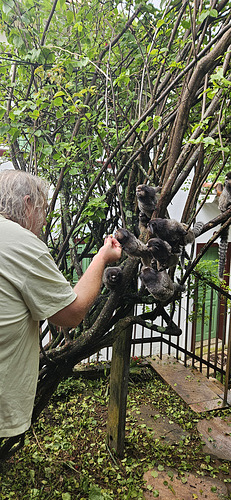
Feeding Frenzy
Each morning, the marmosets came in to the trees behind our BnB. They would squabble with each other over the fruit proferred by the staff, and of course I could not help but join in with the task of ensuring they each received their fair share.

More Specifically, Black-tufted-ear Marmoset
These marmosets are very common around Ouro Preto.

Typical Streetscape
Winding streets and hilly cobblestoned roads are a hallmark of Ouro Preto

Parque Natural Municipal das Andorinhas
Very accessible from Ouro Preto, and with a range of walks catering for all abilities and desired exertion levels, our visit to this park was a wonderful nature focused alternative for a day.

Looking Over Ouro Preto
Another good reason to make the effort of driving out of town for the day was this wonderful view. An opportunity to capture and appreciate the town as a whole.

The "Gold Church"
Described as the richest church in Brazil, this not-terribly-large church reputedly features an estimated 400-450 kg of gold and silver.
How a frontier outpost community could build one of the most opulent churches in the world is worth contemplating. The town was teeming with wealth. In the 18th century, and estimated 160,000 kg of gold was extracted from the earth in Ouro Preto alone. This church represented the peak of new money, funded by the elite trying to outdo each other in their shows of extravagance.

Looking Back to Central Ouro Preto

A Stop
Ouro Preto was a tiring place to visit. The sights were all at different altitudes up the hillsides, with steep inclines on very narrow streets, uneven cobblestones beneath our feet. So breaks were frequent. Enjoying the views for a few more minutes, or lingering a bit longer to admire the art in a church. They were good excuses before striking uphill again to the next point of interest.

In One of the Mines
Ouro Preto means Black Gold. A title given to the city because the gold extracted here was dark, covered in iron oxide upon extraction.
It was the epicentre of Brazil and Portugal's wealth, representing 70% of gold production in the 18th century.
The darker side of the gold story is, of course, who did the work, and the abominable conditions. Tens of thousands of slaves were brought from Africa, working in conditions that ensured short life spans. Accidents and respiratory disease caused early death for many. Conditions were by all accounts, predictably quite brutal.
This old mine we visited is now named in the memory of Chico Rei, a man believed to have once been a king in Congo before enslavement. He and his followers reportedly hid gold dust in their hair while washing it in the mines. He used these savings to buy his son's freedom, then his own, and eventually purchased the very mine where he had been enslaved.
He was subsequently credited with buying the freedom of hundreds of others, and with building churches and other notable buildings in Ouro Preto.

No comments:
Post a Comment