13 to 20 Feb, 2026 - Rio de Janeiro, Ihla Grande, Paraty - (Brazil)
Attending carnaval in Rio was not on our list when we began our planning. Truth be known, a return visit to Rio was not really on the cards. It was an off-the-cuff comment by a friend, along the lines of "so, you're going for carnaval, right?". We checked our arrival dates, and worked out that only a slight massaging of our work-in-progress itinerary would turn this fanciful possibility in to an actuality.

Street Parties in Rio
The blocos de rua are the local street parties. Free, informal, and not entirely disorganised. They spring up in multiple locales around the city. We found and attended a couple that were easy walking from our accommodation.
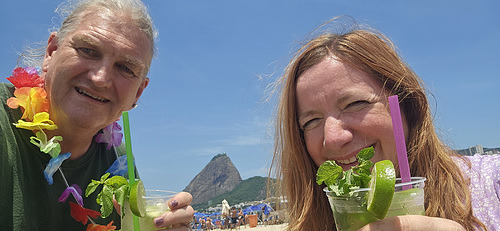
Caiparanihas, Beach, and Pão de Açúcar
Enjoying the view of Pão de Açúcar from Praia do Flamengo, Rio de Janeiro. It may look as if the beach was not too crowded, but in reality, they whole foreshore was heaving. Tens of thousands were down there to eat, drink, dance, and "carnaval".
CLICK FOR VIDEO
Carnaval Vibe
CLICK FOR VIDEO
Arriving at the Sambadrome, we were invited in to a stand to take some pictures and make a couple of videos. I am not sure exactly what we are promoting, hopefully just Rio and Carnaval.

In the Sambadrome Stand
We were told we had "allocated seats", and I guess we could have insisted and sat exactly where our tickets indicated, but in reality, it was a bit more fluid than that. Being not overly crowded (as it was an access group parade), we were able to find an approximate spot that worked.
Starting at about 10 pm, eight samba schools were scheduled to perform on the night. We did not last the distance. With a 5 or 6 am expected finish time, we knew we were not going to make it. We cheered and danced and enjoyed until around 2:30.
I got the impression that "seeing sunrise from the Sambadrome" is something akin to a right of passage for Cariocas (those from Rio).

Samba Parade Float
Each school is allocated 70-80 minutes to present a story, or a "plot". The school selects a specific topic. Examples might be a historical event, a famous Brazilian figure, a social issue, or even a mythological tale.
Each float, costume, dance, and song is expected to be strongly on theme, and this is a big part of the judging criteria.
In this category, the schools generally present 3 or 4 floats. The floats are meant to take the audience through the story, starting new chapters, and finally rounding up with an ending or a moral.

Samba School Dancers
Performers general number between 2000 and 3000 per school.
The "wings" of dancers are grouped by their costumes, and they are quite accessible for those who would like to participate.
Astoundingly, the dozen or so elite dancers with lighting fast feet somehow manage to maintain an amazing output for the full length of the Sambadrone. They look like they should be collapsing after 2 minutes, the energy level is so high.
Each school has to have a minimum 200 drummers, but the top schools end up with more, entering a percussion orchestra.

One of the Lead Floats
Acting like a title page, announcing the school, and setting the scene.

Selarón Steps
A mosaic staircase in Rio, decorated with thousands of tiles from many different places around the world.

Watching Sambadrome Fireworks
The next night, from our nearby B&B, we enjoyed the carnaval atmosphere from our terrace.
Ihla Grande has been on our radar since the first time we first visited Rio. They are frequently coupled together. Finding the "right" accommodation for us was a challenge, as the main town looked like it might be a bit of a noisy hub, and other locations around the island presented either logistical challenges or daunting price tags. As often happens, we chose to take on the more difficult task and keep the saved reals for our caiparinhas. So, despite the frequent misunderstandings in our communications with the owner, we ended up in a place that really was worth the effort. Out of the main hubub; on a beautiful beach; enough offerings for food and drink; right on the water's edge; access to walking trails allowing visits to other beaches; and as cheap as can be found on the island. It was certainly not free of imperfections, but they were acceptable for a three night stay,

From Our Room
The ocean sounds are wonderful for lulling one to sleep.

A Drink on a Fairly Idyllic Beach

Island Vista
The walk from our beach to the main town had us passing some lovely viewpoints.
A few twists and bends further along the coast brought us to Paraty.

Colonial Architecture in Paraty

Paraty
This church is actually now a museum. Outside are some of the giant puppets that were part of the town Carnaval celebrations. Many towns seem to leave the "bonecos gigantes" out for some time after the main festivities. The lingering presence seems to be part of the wind-down routine.

Prawns. Cheese.

Unesco Recognised
Paraty, that is, not me.
18th-century Portuguese colonial architecture lines the historic centre. Whitewashed, buildings of one or two-stories, accented with colourful doors and windows.

Wet Streets in Action
High tide flooding is a design feature of Paraty's historic centre. Planning deliberately included lower street levels so that high tides would flow in to clean them.

No comments:
Post a Comment