23 to 26 Feb, 2026 - Salvador - (Brazil)
Brazil's "Capital of Happness". Salvador has a unique identity, even within Brazil. It is a city of rhythm and colour. It is vibrant and, at the same time, relaxed. It has a legendery spirit, forged out of Afro-Brazilian roots. It is uplifting. It is spiritual.
Google returned the following about Bahia. "Sem pressa, olha para o céu, fala com Deus, você tá na Bahia". A local saying that translates to "No rush, look at the sky, talk to God, you're in Bahia".
Local specialities were consumed, and on our balcony we were entertained by drummers in the streets. We drank caiparinhas in praças, and beers with sea views. Museums educated us. Churches encouraged soulful contemplation. We got happily lost in a labrynth of lanes lined with pastel, eventually stumbling back out in to familiar largos with distinctive grand edifices from bygone eras.

The Curves of Bahia
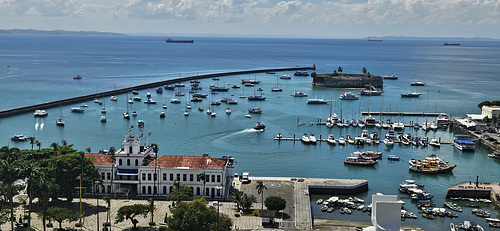
Coming in to Salvador.

Our First Salvador Meal, Moqueca
Moqueca is a local seafood stew. A perfect gastronomical fusion of Indigenous, African, and Portuguese influences.
Options are prawns and seafood, fish, or a mixed version, with veggies, spices and coconut milk. Perhaps the secret is the Dende palm oil, described as bringing a nutty flavour?
Or maybe the secret is not in the ingredients. Perhaps if we are ever going to authentically reproduce it we might need to get a genuine Salvador hand made clay pot.
The Belly Button of Bahia
Forte de São Marcelo, with a catchy little nickname from it's unusual donut shape.

No, Jo, it will Never Fit
Yes, I do realise we could finally fit all our spices in.
An apothecary cabinet in Museu da Misericórdia, the Muesum of Mercy.

Natural Ventilation
Once upon a time, staying cool was more about clever design than mechanics. It's a bonus that the arches make fantastic frames for the spectacular views.

Elevador Lacerda Behind Me
The Art Deco appearance was a result of 1930s renovations. The concept and underlying structure date back another 60 or 70 years before that, to the latter 19th century, when it was opened as the world's first public elevator.

Unmistakable Salvador
The lighthouse sits inside an old fort, Santo Antônio da Barra. The black and white stripes alone seem to be what makes this so iconic for Salvador. A fantastic nautical museum is now housed in the fort itself, with a good sized (read "not too much") amount of items on display.

Mmmm, Blue Drinks
To be honest, I don't remember what the drinks were marketed as. It's not the drinks we need to remember. The meals were great, simple meals that felt more like they came from a home kitchen, but it's not those either.
The photo is here for us to remember the trouble we had finding somewhere to enjoy the sunset after scurrying through an increasingly emptying market. Feeling dodgier at every turn, we were convinced there must be somewhere on the seaward side to sit and drink and eat.
And almost everything was closed. Almost. One stalwart little eatery right on the water's edge, complete with views of the sunset and islands. Drinks, food, and our fingers on the ferry pulse of Salvador. That is what we want to remember.

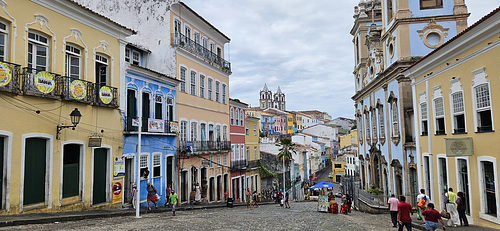
Largo do Pelourinho
We stayed right on this square, which actually is more of a triangle. It's beautiful, at many times noisily filled with drummers, but an early start gets some photos before the tourists pile in.
While it is one of the jewels of Salvador for its wonderful architecture, the somber fact is there in the name. Pelourinho means pillory, or whipping post. This was once the place of public punishment.
A Point on a Triangular Square
A distinctive Afro-Brazilian church on the square. A strong symbol for the community, it was built by slaves for themselves, but not under instruction. They chose to build this, during their small amounts of free time, taking nearly a century to complete.

Continuing North
More buildings to admire as we wandered the streets of Salvador.

Rua Direita de Santo Antônio
Santo Antônio Além do Carmo is a district of particular note, feeling less cluttered with tourists. Although there are numerous art studios and galleries, as well as bars and restaurants, the general vibe was more down to earth. It felt like the neighbourhood locals head to. Built on a winding ridge heading north of the centre, most of the buildings on the west would enjoy amazing sea views, with incredible sunsets I'm sure.

No comments:
Post a Comment