4 to 8 Jun, 2009 – Quetzaltenango (Xela) and surrounding sights
We finally got to Xela, and our hotel. A number of buses, and a desperate taxi ride. I had a mild case of diarrhea, and was glad to be close to a bathroom with no need to move. It turned out to be not so mild, and by morning I knew it. Ten or twelve visits to the bathroom during the night, but the most worrying symptom (sorry everyone) was that I was crapping blood. OK, that's the most graphic this is going to get. I started antibiotics and prescribed myself a day of rest. Jo turned professions for the day and became my nurse, running out to buy me suitable food stuffs, running around making me drinks of rehydration salts, and helping me to stay as comfortable as possible. Those antibiotics worked a treat, and 24 hours later, we were out sight-seeing again! Yay for pharmaceuticals!
Not far north of Xela, but a minibus, chicken bus, and pickup ride away, was the village or San Andrés Xecul. A pretty setting with some nice views down the valley, but our reason for coming was the, umm, slightly outrageous facade on the church. Why try and describe it when we have photos!

Interesting Symbology
Again, probably some Mayan influences, but certainly there are some interesting symbols (not to mention colours) in use on the facade of this church of San Andrés, near Xela.

Striking Colours
Hmm, really stands out, doesn't it!
Leaving San Andrés, we hopped in the bus. Like most local buses, it sat for a long time, engine running, while a trickle of people got on board and slowly filled it. Every two or three minutes, the driver would get on board, blast the horn a few times, and climb off again. After 10 or 15 minutes, when the driver had not been back on board for a while, I got out of my seat, and went to the front of the bus, and blew the airhorn a few times. I didn't look at anyone, but just returned to my seat. Jo assures me that most people on the bus were laughing or smiling at my joke.
As we left town, the assistant came down. Conductor is a bit of an exaggerated description for the guy who squeezes through the crowded buses to collect fares, as there are no tickets or receipts. He doesn't wear a uniform, or identification, he's just a bloke who walks down the aisle asking for money from everyone, and everyone obliges. He has other tasks. These include hanging out of the bus door as it races through intersections, shouting the destination, and waving or whistling at every potential passenger, enticing them to consider this particular bus. He also patrols the aisles to ensure that every seat has a minimum of 3 adults squeezed on to it. One important job is trying to hang on to the roof while tying down large bags of fruits and vegetables, and our packs which are almost always thrown up there, as the bus drives out of the terminal and lurches violently through chaotic streets as it heads out. Anyway, enough about who he was and his function, he came to us and asked where we were heading. We told him and he told us that it would be two Quetzals each, which is something like 35 Aussie cents. A lady across the aisle, (beautiful in her indigenous outfit, btw), queried him. Why was he overcharging us? OK, so he wasn't – she thought we were going to a closer town – but it was so thrilling to have a tiny little reminder how people really do look out for and look after visitors. I thanked her, and she smiled.
Our destination was Salcajá.

The First Church In Central America
I don't really know if that is true, as it is an odd place for the first church, not being in the first population centres. Oh well, let's go with it. It is certainly amongst the first, being dated from 1524! Iglesia de San Jacinto, in Salcajá. Just a pity it was not open for viewing.
In Zunil, yet another nearby village, we visited San Simón. If you have been reading this blog, you may remember my earlier description of the smoking, drinking, sort-of deity known as Maximón. San Simón is Maximón, again, but with slight regional variations.

San Simón - A.K.A Maximón
See our description of Maximón against another photo of a different Maximón. This one was quite the cowboy, and didn't seem to smoke as much, but was tilted back by worshippers who would then pour alcohol into his open mouth (which would then empty straight in to one of the bowls below him).
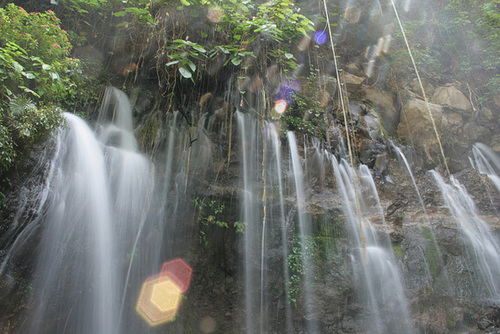
We met two nice Canadian girls, Fiona and Evelyn, when we went up to some hot springs, Fuentes Georgina. The springs were beautifully set, and the mist and rain that enveloped us while we were there only added to the atmosphere. Thankfully there were a couple of cooler baths, as we only lasted a few minutes in the first (and hottest) pool. Anyway, we were so pleased, as they decided to join us the next day.

Just A Pretty Shot
Cobwebs in a tree in the mist.
If Fiona and Evelyn had not agreed to join us, we may not have done the hike we planned, needing a minimum of four. And, we may never have known what a wonderful experience we would have missed. In fact, it has to be one of the trip highlights. Really, we were not expecting it to be THAT good, just good. The book had not talked it up, and we have not met anyone else that did it (or at least nobody that talked about it).
Santiaguito. BOOM! Erupting a couple of times every hour, and in such a dramatic fashion!

Santiaguito Blows
Every 20 to 40 minutes, Santiaguito erupts. This fantastic sight, an ash laden plume billowing in to the sky, is accompanied by a roar akin to an aircraft, and the sound of large rocks crashing into the ground. Even from this safe viewing distance, clouds of sulphur laden gasses would blow over us. We watched for about 2 hours (maybe a bit more), and witnessed four eruptions.
Palmar Viejo – Old Palmar. Yes, there is a Palmar Nuevo, but the old one is not that old. It was abandoned, after a mud slide ripped a new ravine through the centre of town in the 1990's. And it was an amazing sight. Firstly, the size of the ravine. It looks like it would need a few millenia to erode such a formation. Secondly, and most striking, is the church.
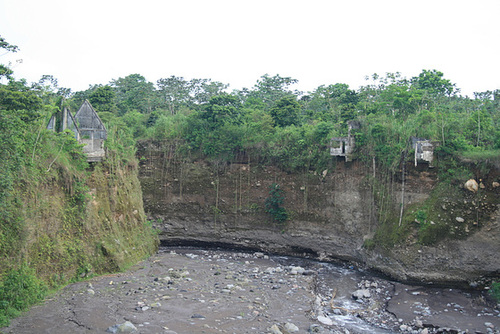
Church Split
A mud slide ripped through town, split the church, and deposited two parts on opposite sides of a newly created ravine! Nature is powerful, hey.
Back on to transport, for a bit. First, another couple of "observations" about chicken buses. Oh, how frustratingly long they can take. Oh, once moving, never fear, there's nothing on the road faster. The engines roar, the tyres squeal, and the brakes smell. Yes, once moving, the worry is how quick they can be. But, before that, you can sit in a terminal for an eon, and then crawl through the streets for an age looking for some more passengers, then stop at an unremarkable intersection for an eternity, squeezing every person possible in. And as alluded to before, squeeze is not over exaggerating. Three adults to a bench, two benches to a row, 10 or 12 rows in the bus. There's 60 to 72 seated adults. Throw in one or two children per seat, so that makes another 30 or so. Another five or ten standing. We have been on buses that full! Quick maths puts us close to, or over, 100 people. Plus driver, assistant, and maybe one or two friends with him.
The most fun transport is the pickup. Hailing at an intersection, leaving instantly, and covering relatively shorter distances, they are often the only way to get to some villages. They carry produce, people, and sometimes even livestock. When crowded, only the driver and a couple of passengers get to sit. Everyone else stands.

Our Transport
After we got out and waved goodbye to our travel companions. There were about 18 adults in the back, plus us, and some children and infants, about 160 kg of vegetables and fruits, and 3 or 4 people in the driver's cab!
All these things, out and about, may have left you wondering about Xela (Quetzaltenango) itself. Yes, it is a town of pleasant character to stay in. A very beautiful square, an old cathedral facade (with a new cathedral behind it), and an arcade with character (despite a slightly neglected feel). Sunday's once-a-month market was a nice way to dine for our last night in town.

Cathedral Of Xela
Beautifully lit cathedral of Quetzaltenango (also called Xela).
And now, I am writing this blog, sitting on a bus, many hours later than we should have been. Blockades have come to Guatemala. There was a protest somewhere, so our 8:30 bus was rescheduled for 12:30. Then cancelled for tomorrow. Undeterred we have headed in a different direction, changed buses, and skirted around the area of trouble. However, we are now hours behind, with no hope of making our connection in Guatemala city.
And the reason for the protest? Motorcyclists are protesting a change in the law, which would make it illegal to carry two or more passengers. Imagine that, an oppressive rule meaning you can't take your whole family on your motorbike!
We finally got to Xela, and our hotel. A number of buses, and a desperate taxi ride. I had a mild case of diarrhea, and was glad to be close to a bathroom with no need to move. It turned out to be not so mild, and by morning I knew it. Ten or twelve visits to the bathroom during the night, but the most worrying symptom (sorry everyone) was that I was crapping blood. OK, that's the most graphic this is going to get. I started antibiotics and prescribed myself a day of rest. Jo turned professions for the day and became my nurse, running out to buy me suitable food stuffs, running around making me drinks of rehydration salts, and helping me to stay as comfortable as possible. Those antibiotics worked a treat, and 24 hours later, we were out sight-seeing again! Yay for pharmaceuticals!
Not far north of Xela, but a minibus, chicken bus, and pickup ride away, was the village or San Andrés Xecul. A pretty setting with some nice views down the valley, but our reason for coming was the, umm, slightly outrageous facade on the church. Why try and describe it when we have photos!
Interesting Symbology
Again, probably some Mayan influences, but certainly there are some interesting symbols (not to mention colours) in use on the facade of this church of San Andrés, near Xela.
Striking Colours
Hmm, really stands out, doesn't it!
Leaving San Andrés, we hopped in the bus. Like most local buses, it sat for a long time, engine running, while a trickle of people got on board and slowly filled it. Every two or three minutes, the driver would get on board, blast the horn a few times, and climb off again. After 10 or 15 minutes, when the driver had not been back on board for a while, I got out of my seat, and went to the front of the bus, and blew the airhorn a few times. I didn't look at anyone, but just returned to my seat. Jo assures me that most people on the bus were laughing or smiling at my joke.
As we left town, the assistant came down. Conductor is a bit of an exaggerated description for the guy who squeezes through the crowded buses to collect fares, as there are no tickets or receipts. He doesn't wear a uniform, or identification, he's just a bloke who walks down the aisle asking for money from everyone, and everyone obliges. He has other tasks. These include hanging out of the bus door as it races through intersections, shouting the destination, and waving or whistling at every potential passenger, enticing them to consider this particular bus. He also patrols the aisles to ensure that every seat has a minimum of 3 adults squeezed on to it. One important job is trying to hang on to the roof while tying down large bags of fruits and vegetables, and our packs which are almost always thrown up there, as the bus drives out of the terminal and lurches violently through chaotic streets as it heads out. Anyway, enough about who he was and his function, he came to us and asked where we were heading. We told him and he told us that it would be two Quetzals each, which is something like 35 Aussie cents. A lady across the aisle, (beautiful in her indigenous outfit, btw), queried him. Why was he overcharging us? OK, so he wasn't – she thought we were going to a closer town – but it was so thrilling to have a tiny little reminder how people really do look out for and look after visitors. I thanked her, and she smiled.
Our destination was Salcajá.
The First Church In Central America
I don't really know if that is true, as it is an odd place for the first church, not being in the first population centres. Oh well, let's go with it. It is certainly amongst the first, being dated from 1524! Iglesia de San Jacinto, in Salcajá. Just a pity it was not open for viewing.
In Zunil, yet another nearby village, we visited San Simón. If you have been reading this blog, you may remember my earlier description of the smoking, drinking, sort-of deity known as Maximón. San Simón is Maximón, again, but with slight regional variations.
San Simón - A.K.A Maximón
See our description of Maximón against another photo of a different Maximón. This one was quite the cowboy, and didn't seem to smoke as much, but was tilted back by worshippers who would then pour alcohol into his open mouth (which would then empty straight in to one of the bowls below him).
We met two nice Canadian girls, Fiona and Evelyn, when we went up to some hot springs, Fuentes Georgina. The springs were beautifully set, and the mist and rain that enveloped us while we were there only added to the atmosphere. Thankfully there were a couple of cooler baths, as we only lasted a few minutes in the first (and hottest) pool. Anyway, we were so pleased, as they decided to join us the next day.
Just A Pretty Shot
Cobwebs in a tree in the mist.
If Fiona and Evelyn had not agreed to join us, we may not have done the hike we planned, needing a minimum of four. And, we may never have known what a wonderful experience we would have missed. In fact, it has to be one of the trip highlights. Really, we were not expecting it to be THAT good, just good. The book had not talked it up, and we have not met anyone else that did it (or at least nobody that talked about it).
Santiaguito. BOOM! Erupting a couple of times every hour, and in such a dramatic fashion!
Santiaguito Blows
Every 20 to 40 minutes, Santiaguito erupts. This fantastic sight, an ash laden plume billowing in to the sky, is accompanied by a roar akin to an aircraft, and the sound of large rocks crashing into the ground. Even from this safe viewing distance, clouds of sulphur laden gasses would blow over us. We watched for about 2 hours (maybe a bit more), and witnessed four eruptions.
Palmar Viejo – Old Palmar. Yes, there is a Palmar Nuevo, but the old one is not that old. It was abandoned, after a mud slide ripped a new ravine through the centre of town in the 1990's. And it was an amazing sight. Firstly, the size of the ravine. It looks like it would need a few millenia to erode such a formation. Secondly, and most striking, is the church.
Church Split
A mud slide ripped through town, split the church, and deposited two parts on opposite sides of a newly created ravine! Nature is powerful, hey.
Back on to transport, for a bit. First, another couple of "observations" about chicken buses. Oh, how frustratingly long they can take. Oh, once moving, never fear, there's nothing on the road faster. The engines roar, the tyres squeal, and the brakes smell. Yes, once moving, the worry is how quick they can be. But, before that, you can sit in a terminal for an eon, and then crawl through the streets for an age looking for some more passengers, then stop at an unremarkable intersection for an eternity, squeezing every person possible in. And as alluded to before, squeeze is not over exaggerating. Three adults to a bench, two benches to a row, 10 or 12 rows in the bus. There's 60 to 72 seated adults. Throw in one or two children per seat, so that makes another 30 or so. Another five or ten standing. We have been on buses that full! Quick maths puts us close to, or over, 100 people. Plus driver, assistant, and maybe one or two friends with him.
The most fun transport is the pickup. Hailing at an intersection, leaving instantly, and covering relatively shorter distances, they are often the only way to get to some villages. They carry produce, people, and sometimes even livestock. When crowded, only the driver and a couple of passengers get to sit. Everyone else stands.
Our Transport
After we got out and waved goodbye to our travel companions. There were about 18 adults in the back, plus us, and some children and infants, about 160 kg of vegetables and fruits, and 3 or 4 people in the driver's cab!
All these things, out and about, may have left you wondering about Xela (Quetzaltenango) itself. Yes, it is a town of pleasant character to stay in. A very beautiful square, an old cathedral facade (with a new cathedral behind it), and an arcade with character (despite a slightly neglected feel). Sunday's once-a-month market was a nice way to dine for our last night in town.
Cathedral Of Xela
Beautifully lit cathedral of Quetzaltenango (also called Xela).
And now, I am writing this blog, sitting on a bus, many hours later than we should have been. Blockades have come to Guatemala. There was a protest somewhere, so our 8:30 bus was rescheduled for 12:30. Then cancelled for tomorrow. Undeterred we have headed in a different direction, changed buses, and skirted around the area of trouble. However, we are now hours behind, with no hope of making our connection in Guatemala city.
And the reason for the protest? Motorcyclists are protesting a change in the law, which would make it illegal to carry two or more passengers. Imagine that, an oppressive rule meaning you can't take your whole family on your motorbike!